 Manufacturing and Distribution
 Firearms
 Automotive and OEMs
 Healthcare & Life Sciences
 Sports & Outdoor Hunting Gear
 Regulated Industries eCommerce
 Adobe Commerce
 BigCommerce
 Magento
 myMagento
 WooCommerce
 Shopify Plus
 Shopware
 Magento 1 to Magento 2 Migration
 Magento Upgrade Service
 Magento Design
 Magento B2B
 Magento Hosting
 Magento Consulting
 Magento eCommerce Developers
 Magento SEO
 Magento Integration
 Magento Speed & Performance Optimization
 eCommerce Development
 Headless Commerce
 eCommerce GrowthX
 B2B CRO Services
 Enterprise SEO Services
 Email Marketing
 Website Localization Services
 AEO, GEO and AI Search
 AI Tools for Business
 Data Analytics Services
 GrowthX Strategy & Consultancy
 eCommerce Integration
 CRM Integrations
 Accounting Software Integrations
 ERP Integrations
 PIM Integrations
 Payment Gateways Integrations
 Tax Platform Integrations
 eCommerce Site Migrations
 Project Rescue
 Hire Developers
 Free Audit Report
 Extensions & Applications
 Custom Applications for eCommerce
 Magento Extensions
 Security & Fraud Prevention
 User Interface & Experience
 Website Design Services
 Support & Maintenance
 About Us
 Blog
 Webinars
 News & Updates
 Downloads
 FAQs
 The Wagento Difference
 Hyvä
 iPaaS
 Klaviyo
 Sales Layer
 Sift
 Dot Digital
 Nousmedis
 Call
 Message
A Clear Decision Guide Comparing Security, Trust, Speed, Ease of Use, and AI Readiness
There is no single best B2B ecommerce platform. There is a best fit for your catalog, your pricing rules, your ERP, and your team. We build on Adobe Commerce, BigCommerce, and Shopify Plus, so this guide compares them the way we would for a client: by what your business needs to do, with our sources and our scoring method shown.
Start with your business
Four questions shape the choice more than any feature list:
- How complex are your catalog and pricing? Contract prices, customer specific catalogs, and quote workflows take real depth.
- How many systems must connect? ERP, PIM, CRM, WMS, and OMS integrations set the demand on APIs.
- Who should carry security and hosting: the platform or your team?
- How quickly must you launch, and how much control do you want after launch?
How the platforms compare on complex B2B
| Area | Adobe Commerce | BigCommerce | Shopify Plus |
| Complex catalogs and customer pricing | Native B2B module with company accounts, shared catalogs with company specific pricing, negotiable quotes, and requisition lists | B2B Edition adds corporate accounts, price lists, quoting, shared shopping lists, and an invoice portal | Companies, catalogs, and net terms on all plans; unlimited catalogs and catalogs assigned directly to companies on Plus |
| ERP, PIM, CRM, WMS, OMS | Full code access plus REST and GraphQL APIs on self managed deployments | Open APIs and a strong partner ecosystem | Well documented APIs and a large app ecosystem |
| Multi storefront and international | Built in, with wide flexibility | Built in multi storefront, supported in B2B Edition | Available, with more limits on complex setups |
| Headless and composable | Strong, with more build effort | Strong, with headless support in B2B Edition | Available through its storefront APIs |
Adobe Commerce offers the most native B2B depth, which suits stores with contract pricing and layered approvals. BigCommerce balances B2B capability with easier operations. Shopify Plus offers the smoothest experience, and its B2B features now cover many mid complexity needs.
Who owns security
This is one of the biggest differences. BigCommerce and Shopify are SaaS platforms. BigCommerce includes hosting, maintenance, and automatic security patching in its subscription, and Shopify states it is certified PCI DSS Level 1.
Adobe Commerce on Cloud is a platform as a service with shared responsibility: Adobe issues security updates for the core code, and applying patches is the merchant’s responsibility, along with custom code, extensions, and integrations. Adobe Commerce as a Cloud Service shifts more of that load to Adobe, which applies the infrastructure patches.
Neither model is better in every case. A team with strong engineering support may value control. A lean team may value a platform that carries more of the load. If you run Adobe Commerce, choose a partner who owns patching and monitoring with you, so control does not turn into risk.
AI features, agents, and your data
- Adobe Commerce has added semantic search to Live Search, which interprets the meaning behind shopper queries, and in July 2026 made product discovery on LLM surfaces available. It also offers the deepest code level control over how AI tools connect.
- BigCommerce syndicates catalogs to ChatGPT, Gemini, Copilot, Perplexity, and others through Feedonomics Agentic Catalog Exports, launched in April 2026.
- Shopify Plus launched Agentic Storefronts in its Winter ’26 Edition to place merchant products inside AI assistants such as ChatGPT, Copilot, and Perplexity.
Feature names change quickly, so verify what is live when you decide. Whichever platform you choose, connect AI tools with the least access they need. Give assistants read access before write access, keep customer and order data scoped to what each tool needs, and log every action an AI agent takes.
Admin ease and speed
Shopify Plus leads on ease of use and time to launch. BigCommerce sits close behind with a clean admin and strong B2B tools. Adobe Commerce asks more of your team, and repays it with control. Page speed depends on the build on every platform, and a well built store on any of the three can pass Core Web Vitals.
The scoring matrix
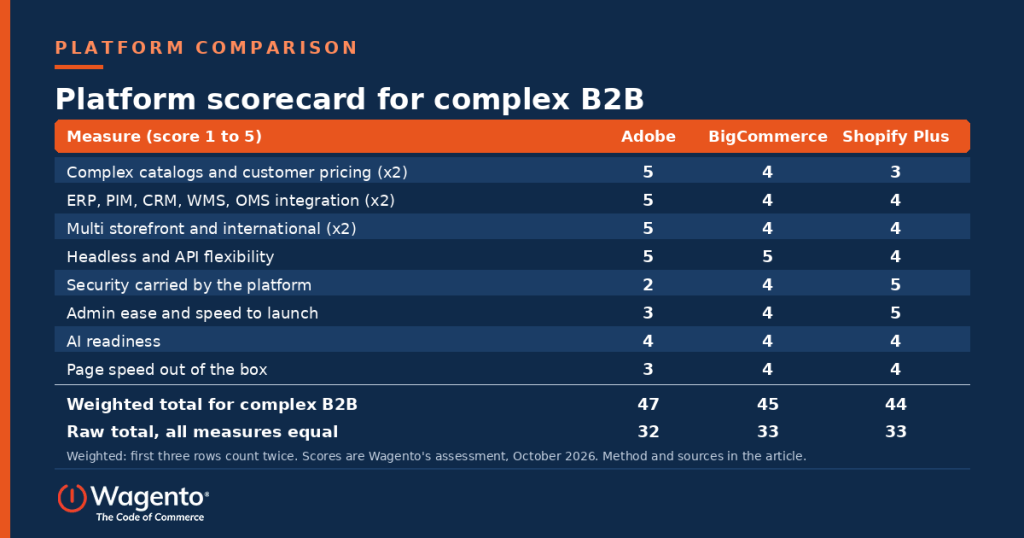
| Measure (score 1 to 5) | Adobe Commerce | BigCommerce | Shopify Plus |
| Complex catalogs and customer specific pricing (x2) | 5 | 4 | 3 |
| ERP, PIM, CRM, WMS, OMS integration (x2) | 5 | 4 | 4 |
| Multi storefront and international (x2) | 5 | 4 | 4 |
| Headless and API flexibility | 5 | 5 | 4 |
| Security carried by the platform | 2 | 4 | 5 |
| Admin ease and speed to launch | 3 | 4 | 5 |
| AI readiness | 4 | 4 | 4 |
| Page speed out of the box | 3 | 4 | 4 |
| Weighted total for complex B2B | 47 | 45 | 44 |
| Raw total, all measures equal | 32 | 33 | 33 |
For complex B2B, the depth measures carry the most weight, so the first three rows count twice in the weighted total. With every measure counted equally, the totals land within one point of each other, which tells the real story: the right answer depends on what you weigh most.
How we scored each platform
These scores are Wagento’s editorial assessment for a B2B merchant with ERP connections, as of October 2026. They are not an independent benchmark, and we adjust them for every client. Each score combines two inputs: the platform’s own documentation, linked below, and what we see when we build and run stores on all three platforms. Where a score rests on our experience rather than a document, the table says so.
The scale. 5 means the capability is native and deep enough for complex B2B without custom work. 4 means native and strong, with some gaps or an add on. 3 means available, but with limits that complex B2B stores often hit. 2 means the merchant or partner carries most of the work. 1 means not realistically available.
| Measure | Scores (Adobe, BigCommerce, Shopify Plus) | Evidence and reasoning |
| Complex catalogs and customer pricing | 5, 4, 3 | Adobe’s B2B module documents company accounts, shared catalogs with company pricing, negotiable quotes, and requisition lists natively. BigCommerce B2B Edition documents accounts, price lists, quoting, and shopping lists. Shopify documents companies, catalogs, and terms, with direct company catalogs on Plus only. We score quote and approval workflow depth lower on Shopify based on delivery experience. |
| ERP, PIM, CRM, WMS, OMS integration | 5, 4, 4 | Delivery experience. Full code access on Adobe Commerce lets an integration run inside the platform when an API is not enough; on SaaS platforms integrations run through APIs and apps, which covers most needs. |
| Multi storefront and international | 5, 4, 4 | Delivery experience, plus BigCommerce’s documented multi storefront support in B2B Edition. Adobe’s website, store, and store view model handles the widest range of country, brand, and B2B splits we see. |
| Headless and API flexibility | 5, 5, 4 | BigCommerce documents headless support in B2B Edition. Adobe offers APIs plus its Commerce Storefront on Edge Delivery Services. Shopify’s storefront APIs are capable; we score it one point lower for B2B specific headless needs, based on experience. |
| Security carried by the platform | 2, 4, 5 | On Adobe Commerce on Cloud, the merchant applies patches. BigCommerce includes automatic patching. Shopify is PCI DSS Level 1. Shopify scores one point above BigCommerce because its checkout allows less custom code, which in our experience leaves less room for script based skimming. Adobe Commerce as a Cloud Service would score higher than 2. |
| Admin ease and speed to launch | 3, 4, 5 | Delivery experience: typical launch timelines and how much training merchant teams need. |
| AI readiness | 4, 4, 4 | All three launched AI discovery features in the last year: Adobe Commerce, BigCommerce, and Shopify. None is clearly ahead for B2B yet, so we score them level. |
| Page speed out of the box | 3, 4, 4 | Delivery experience. Speed depends mostly on the build; we measure with Core Web Vitals. |
Already on Adobe Commerce? Start with an upgrade
For complex B2B, Adobe Commerce leads on the measures that matter most, and if you already run it, you also keep your data model, integrations, pricing rules, URLs, and team knowledge by staying. Upgrading to 2.4.9 gives you standard support to May 31, 2029. If you want the platform to carry more of the security load, Adobe Commerce as a Cloud Service is Adobe’s managed option, with Adobe applying infrastructure patches, or a managed service such as myMagento can own patching and monitoring for you.
Planning that upgrade? Read Magento 2.4.6 Is No Longer in Regular Support and Adobe Commerce Security Enforcement Is Coming.
Which platform fits you: a checklist
Answer yes or no to each question.
- Do prices vary by customer, contract, or quantity?
- Is your ERP the source of truth for stock and pricing?
- Do you need more than one storefront, currency, or language?
- Do you want the platform vendor to carry hosting and patching?
- Does your team need the simplest possible admin?
- Must you launch within a few months?
- Do you plan to connect AI assistants or agents to your catalog and orders?
Yes answers on questions 1 to 3 point toward the depth of Adobe Commerce. Yes answers on questions 4 to 6 mean you want the platform to carry more of the load. On Adobe Commerce, that can mean Adobe Commerce as a Cloud Service or a managed service partner; SaaS platforms are another route, and we will compare them honestly if you ask. Question 7 applies to all three: plan least privilege access from day one.
For how the systems behind the store fit together, see The B2B Commerce Tech Stack, Explained.
Talk it through with us
We build it, connect it, run it, and grow it on all three platforms, so our advice follows your needs. Book a platform consultation and bring your ERP, your pricing rules, and your goals. You will leave with a recommendation and the reasons behind it.
Book a platform consultation
Booking link: Book a time with Wagento