 Manufacturing and Distribution
 Firearms
 Automotive and OEMs
 Healthcare & Life Sciences
 Sports & Outdoor Hunting Gear
 Regulated Industries eCommerce
 Adobe Commerce
 BigCommerce
 Magento
 myMagento
 WooCommerce
 Shopify Plus
 Shopware
 Magento 1 to Magento 2 Migration
 Magento Upgrade Service
 Magento Design
 Magento B2B
 Magento Hosting
 Magento Consulting
 Magento eCommerce Developers
 Magento SEO
 Magento Integration
 Magento Speed & Performance Optimization
 eCommerce Development
 Headless Commerce
 eCommerce GrowthX
 B2B CRO Services
 Enterprise SEO Services
 Email Marketing
 Website Localization Services
 AEO, GEO and AI Search
 AI Tools for Business
 Data Analytics Services
 GrowthX Strategy & Consultancy
 eCommerce Integration
 CRM Integrations
 Accounting Software Integrations
 ERP Integrations
 PIM Integrations
 Payment Gateways Integrations
 Tax Platform Integrations
 eCommerce Site Migrations
 Project Rescue
 Hire Developers
 Free Audit Report
 Extensions & Applications
 Custom Applications for eCommerce
 Magento Extensions
 Security & Fraud Prevention
 User Interface & Experience
 Website Design Services
 Support & Maintenance
 About Us
 Blog
Blog Webinars
 News & Updates
 Downloads
 FAQs
FAQs The Wagento Difference
 Hyvä
Hyvä iPaaS
iPaaS Klaviyo
 Sales Layer
 Sift
Sift Dot Digital
 Nousmedis
 Call
Call Message
If your storefront is the only system you can name, that is the problem this guide solves.
The storefront is the part everyone sees, so it gets all the attention. But in a real B2B operation, the storefront is the smallest part of the machine. Behind it sits a stack of systems that actually run the business, and whether they are connected or not decides whether your ecommerce works or just exists.
This is the plain-language guide to that stack. No jargon for its own sake. Each system gets the same three questions: what does it do, what breaks without it, and how does it connect to the rest. Send this to anyone on your team who needs to understand why ‘just build us a website’ is the wrong way to think about B2B commerce.
The one-sentence version
Before the detail, here is the whole stack in a sentence you can actually remember:
The ERP stores it. The CRM knows it. The PIM enriches it. The OMS routes it. The WMS ships it. The CPQ prices it. And the storefront sells it.
Every system below is one clause of that sentence. Keep it in mind and the architecture stops being alphabet soup.
ERP: the system of record
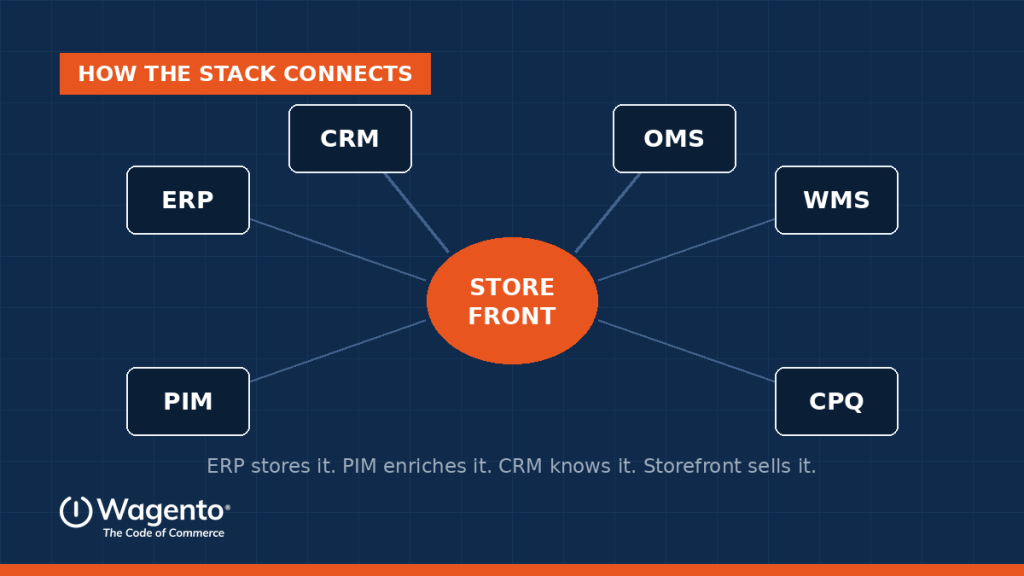
What it does: The ERP (enterprise resource planning) is the financial and operational heart of the business. Inventory, pricing, customers, orders, invoices, purchasing. It is the source of truth, the number that is actually real when two systems disagree.
What breaks without it connected: Your storefront shows stock you do not have and prices that are out of date. Orders get rekeyed by hand. This is the single most common and most damaging gap in B2B ecommerce.
How it connects: Through an integration layer that syncs inventory and pricing to the storefront in near real time, and pushes orders back into the ERP automatically. Common B2B ERPs: Epicor, NetSuite, SAP Business One, Microsoft Dynamics.
PIM: the product data engine
What it does: The PIM (product information management) is the source of truth for descriptive product data: specs, attributes, images, descriptions, documents. It publishes that data to every channel at once.
What breaks without it: Product information drifts out of sync across your site, sales sheets, and marketplaces. At scale, you end up with staff manually copying data between systems, and a catalog machines cannot read for AI search.
How it connects: The PIM feeds enriched product data to the storefront and marketplaces, while pulling some source data (like pricing or stock) from the ERP. Example: Sales Layer.
CRM: the relationship record
What it does: The CRM (customer relationship management) tracks the human side: contacts, accounts, deals, communication history, sales pipeline.
What breaks without it: Sales and ecommerce operate blind to each other. A rep does not know what their account bought online; the store does not know what the rep promised. The buyer experiences two disconnected companies.
How it connects: The CRM syncs account and contact data with the storefront and ERP, so online behavior and offline relationships inform each other. Common: HubSpot, Salesforce.
OMS: the order traffic controller
What it does: The OMS (order management system) takes an order from any channel and decides how to fulfill it: which warehouse, which shipment, which sequence.
What breaks without it: Multi-location or multi-channel fulfillment becomes manual and error-prone. Orders ship late, from the wrong place, or split badly.
How it connects: It sits between the storefront and the warehouse, receiving orders and orchestrating fulfillment across locations.
WMS: the warehouse brain
What it does: The WMS (warehouse management system) runs the physical warehouse: receiving, putaway, picking, packing, shipping.
What breaks without it: Inventory counts drift from reality, which poisons every system upstream, including the stock number your buyer sees.
How it connects: It feeds real inventory movements back to the ERP and OMS, keeping the whole chain honest about what is actually on the shelf.
CPQ: the quoting engine
What it does: CPQ (configure, price, quote) handles complex, configurable, or negotiated pricing: the quotes that are the heart of a lot of B2B selling.
What breaks without it: Complex quotes stay manual, slow, and error-prone, and cannot move online, so your largest deals are stuck in email and spreadsheets.
How it connects: It plugs into the storefront and ERP so configured products and negotiated prices flow into real orders.
Where AI fits
AI is not a box in this diagram. It is a layer that sits on top of everything else, and it is only as good as the data underneath it. AI can power search, personalization, demand forecasting, and increasingly the buying itself, but every one of those depends on clean data from the systems above. This is the uncomfortable truth about AI in commerce: it amplifies whatever foundation it finds. Connected, accurate stack, and AI makes you faster. Disconnected, messy stack, and AI just makes your problems arrive quicker.
The real lesson: connection beats collection
Here is what fifteen-plus years of building these stacks has taught us. The winners are almost never the companies with the most impressive individual systems. They are the companies whose systems are connected and owned. We have watched businesses running world-class software lose to competitors running ordinary software, because the ordinary stack talked to itself and the world-class one was a room full of strangers.
You do not need every system on this list. You need the ones your business actually requires, connected properly, with one team accountable for the whole. That is the difference between buying software and building a commerce operation.
Where to start
Our B2B systems audit maps your current stack against this reference architecture: what you have, what is connected, where the gaps are, and what to fix first. You leave with the map whether or not you hire us to act on it.
Book a discovery call: Contact Us | +1 (612) 594-7699
FAQs
It is the set of connected business systems behind an ecommerce store: typically ERP, PIM, CRM, OMS, WMS, and CPQ, plus the storefront itself and an integration layer connecting them. Each handles one job, and connected together they run the full commerce operation.