 Manufacturing and Distribution
 Firearms
 Automotive and OEMs
 Healthcare & Life Sciences
 Sports & Outdoor Hunting Gear
 Regulated Industries eCommerce
 Adobe Commerce
 BigCommerce
 Magento
 myMagento
 WooCommerce
 Shopify Plus
 Shopware
 Magento 1 to Magento 2 Migration
 Magento Upgrade Service
 Magento Design
 Magento B2B
 Magento Hosting
 Magento Consulting
 Magento eCommerce Developers
 Magento SEO
 Magento Integration
 Magento Speed & Performance Optimization
 eCommerce Development
 Headless Commerce
 eCommerce GrowthX
 B2B CRO Services
 Enterprise SEO Services
 Email Marketing
 Website Localization Services
 AEO, GEO and AI Search
 AI Tools for Business
 Data Analytics Services
 GrowthX Strategy & Consultancy
 eCommerce Integration
 CRM Integrations
 Accounting Software Integrations
 ERP Integrations
 PIM Integrations
 Payment Gateways Integrations
 Tax Platform Integrations
 eCommerce Site Migrations
 Project Rescue
 Hire Developers
 Free Audit Report
 Extensions & Applications
 Custom Applications for eCommerce
 Magento Extensions
 Security & Fraud Prevention
 User Interface & Experience
 Website Design Services
 Support & Maintenance
 About Us
 Blog
 Webinars
 News & Updates
 Downloads
 FAQs
 The Wagento Difference
 Hyvä
 iPaaS
 Klaviyo
 Sales Layer
 Sift
 Dot Digital
 Nousmedis
 Call
 Message
The AI Race Is Changing How Buyers Search: How Trust, Speed, and UI Decide Whether AI and Google Recommend Your Store
Where does a buyer start when they need a new supplier? For a growing share of B2B buyers, the answer is an AI assistant.
G2’s March 2026 survey of 1,076 B2B software buyers found that 51% now start their research with an AI chatbot more often than with Google, up from 29% in April 2025. Forrester’s State of Business Buying 2026, based on a survey of nearly 18,000 business buyers, found that 94% use AI during their buying process. Software buyers lead this shift, and B2B buyers in other categories follow the same pattern.
Google still matters a great deal. The opportunity is to be found in both places, and the good news is that the same foundations serve both.
How the two differ
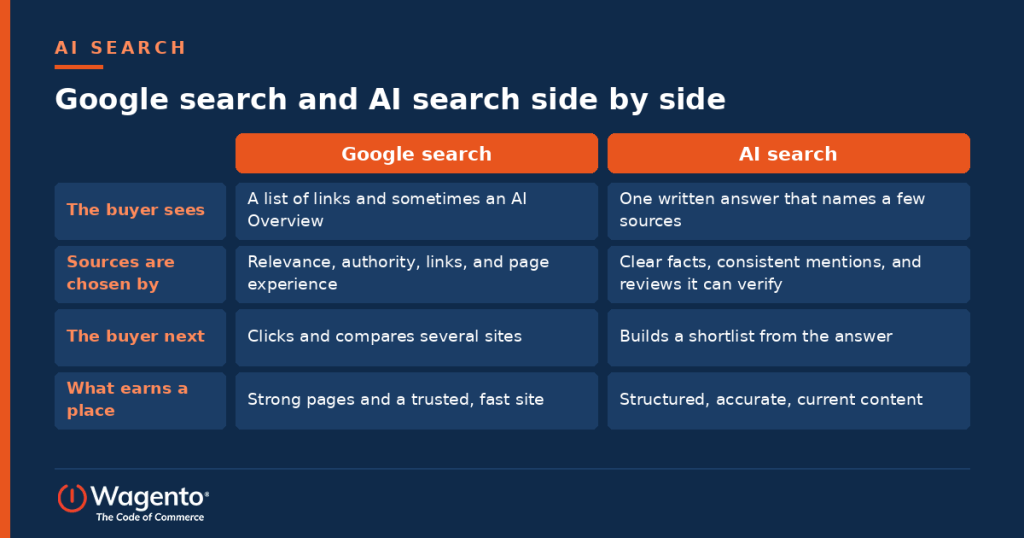
| Google search | AI search | |
| The buyer sees | A list of links, and often an AI Overview | One written answer that names a few sources |
| Sources are chosen by | Relevance, authority, links, and page experience | Clear facts, consistent mentions across trusted pages, and reviews it can verify |
| The buyer next | Clicks and compares several sites | Builds a shortlist from the answer, then visits fewer sites |
| What earns a place | Strong pages on a trusted, fast site | Structured, accurate, current content |
One point surprises many teams: Google says its AI Overviews and AI Mode draw on the same index and the same ranking and quality systems as ordinary results. Good SEO and good AI visibility on Google are largely the same work.
In practice, a buyer might ask an assistant for suppliers that connect to their ERP, get four names with reasons, and then check those four. If your company is not among the names, you never enter the comparison.
What both reward: trust, speed, and a clear experience
- Structured data. Schema helps search engines understand what a page describes and makes it eligible for rich results.
- Genuine reviews. Real reviews on trusted sites give both systems evidence that customers rely on you.
- Clear authorship. Named authors with real experience make content easier to trust.
- Secure, fast pages. Google can label a result “This site may be hacked” when it detects tampering, and a slow or confusing experience loses buyers even when the page ranks.
Ranking is only the first step. A buyer who lands on a slow page, a confusing menu, or a warning screen leaves, and the reviews that follow shape what AI assistants say about you next.
When AI gets your brand wrong
AI answers sometimes show outdated or wrong facts about a company: an old service list, a retired product, a wrong location. Buyers rarely double check. Three habits reduce the risk:
- Accurate structured data on your key pages, kept current when services change.
- Consistent facts across your site, your Google Business Profile, LinkedIn, and review sites, so every source tells the same story.
- Clear, crawlable pages that state who you serve, what you do, and where, in plain text rather than only in images or PDFs.
What about llms.txt? You may hear that an llms.txt file at your site root fixes this. Google’s own guide for generative AI search says you do not need llms.txt or other AI text files to appear in Google Search, including its AI features, because Google Search does not use them. Google’s John Mueller has also said the file cannot help AI systems decide which sites to surface. It does no harm and some agent and developer tools read it, so keep one if you have it, but put your time into the three habits above first.
The steps we apply on wagento.com
We recommend these steps to clients and apply them to our own site:
- FAQ schema on the main FAQ and top service pages.
- Review markup only where genuine reviews appear on the page, knowing Google may not show star ratings for a business’s reviews of itself.
- A Core Web Vitals check on the key service and landing pages.
- An internal linking pass that connects blog and resource content to service pages.
- One set of facts about our services and locations, repeated the same way on every profile.
A fast moving landscape
OpenAI, Anthropic, Google, and Meta keep releasing assistants that search, cite sources, and take actions for their users. A few dated examples from this year show how quickly the rules move:
- March 2026: OpenAI scaled back in chat Instant Checkout in ChatGPT and shifted toward product discovery that sends buyers to the merchant.
- April 2026: Feedonomics, part of the company behind BigCommerce, launched Agentic Catalog Exports to send product data to ChatGPT, Gemini, Copilot, and Perplexity.
- May 2026: Google published its first guide to optimizing for generative AI features in Search.
- July 2026: Adobe made product discovery on LLM surfaces available in Adobe Commerce.
The pace is quick, which is a good reason to build on foundations that last: clear facts, real reviews, secure and fast pages, and content that stays accurate.
Your visibility self check
- Ask two or three AI assistants for the best suppliers or agencies in your category. Does your company appear?
- Read the description. Is it accurate and current?
- Does your site carry FAQ schema on key pages, and review markup where genuine reviews appear?
- Do your key pages pass Core Web Vitals?
- Do your pages show who wrote them and when?
- Do genuine reviews appear on trusted review sites?
- Do your Google Business Profile, LinkedIn, and review profiles list the same services and locations as your site?
Count your yes answers. Five or more means you have a strong base. Four or fewer points to easy work ahead.
How B2B buyers find suppliers now
- They ask an AI assistant to explain the category and list options.
- They use Google to check names, pages, and reviews.
- They ask peers to confirm.
- They contact the few suppliers that looked clear and credible at every step.
A supplier that shows up with consistent facts at each of those steps has a real advantage. For the product side of this, read When AI Starts Shopping for Your Customers and Your Product Data Is Quietly Costing You Sales. Choosing a platform with AI in mind? See our Adobe Commerce vs BigCommerce vs Shopify Plus guide.
Let us run the check for you
We build it, connect it, run it, and grow it, and growth now includes being found in AI search. Book a call and we will run your visibility check across the major assistants and Google, then give you a short list of fixes in priority order.
Book a call and we will run your AI visibility check
Booking link: Book a time with Wagento