 Manufacturing and Distribution
 Firearms
 Automotive and OEMs
 Healthcare & Life Sciences
 Sports & Outdoor Hunting Gear
 Regulated Industries eCommerce
 Adobe Commerce
 BigCommerce
 Magento
 myMagento
 WooCommerce
 Shopify Plus
 Shopware
 Magento 1 to Magento 2 Migration
 Magento Upgrade Service
 Magento Design
 Magento B2B
 Magento Hosting
 Magento Consulting
 Magento eCommerce Developers
 Magento SEO
 Magento Integration
 Magento Speed & Performance Optimization
 eCommerce Development
 Headless Commerce
 eCommerce GrowthX
 B2B CRO Services
 Enterprise SEO Services
 Email Marketing
 Website Localization Services
 AEO, GEO and AI Search
 AI Tools for Business
 Data Analytics Services
 GrowthX Strategy & Consultancy
 eCommerce Integration
 CRM Integrations
 Accounting Software Integrations
 ERP Integrations
 PIM Integrations
 Payment Gateways Integrations
 Tax Platform Integrations
 eCommerce Site Migrations
 Project Rescue
 Hire Developers
 Free Audit Report
 Extensions & Applications
 Custom Applications for eCommerce
 Magento Extensions
 Security & Fraud Prevention
 User Interface & Experience
 Website Design Services
 Support & Maintenance
 About Us
 Blog
Blog Webinars
 News & Updates
 Downloads
 FAQs
FAQs The Wagento Difference
 Hyvä
Hyvä iPaaS
iPaaS Klaviyo
 Sales Layer
 Sift
Sift Dot Digital
 Nousmedis
 Call
Call Message
For twenty years, everything on your product page was written for a person deciding.
Increasingly, the first thing to read it is software deciding on that person’s behalf. And software does not skim marketing copy, does not respond to a hero image, and does not care how the page looks on mobile. It reads data, compares it against other data, and returns a recommendation.
This is the part of the AI conversation that actually changes how you sell, and it is worth separating from the hype around it.
Where this genuinely is right now
An IBM study published in January 2026 found that roughly 45 percent of consumers already use AI somewhere in their buying journey. That is research and comparison, mostly, rather than machines placing orders.
But the plumbing for machines placing orders arrived faster than most people expected. OpenAI and Stripe published the Agentic Commerce Protocol. Google launched the Universal Commerce Protocol at NRF in January 2026 with partners including Etsy, Shopify, Target, Wayfair, Walmart and Gap. Those are standards for an agent to browse a catalog, understand availability and price, and initiate a purchase.
It is worth being honest that the picture is still moving. OpenAI stepped back from in chat checkout in March 2026, shifting toward discovery followed by a redirect to the merchant. Anyone telling you they know exactly how this settles is guessing. What is not a guess is the direction: more of the discovery and comparison work is being done by software, and that software needs to be able to read you.
What an agent actually reads
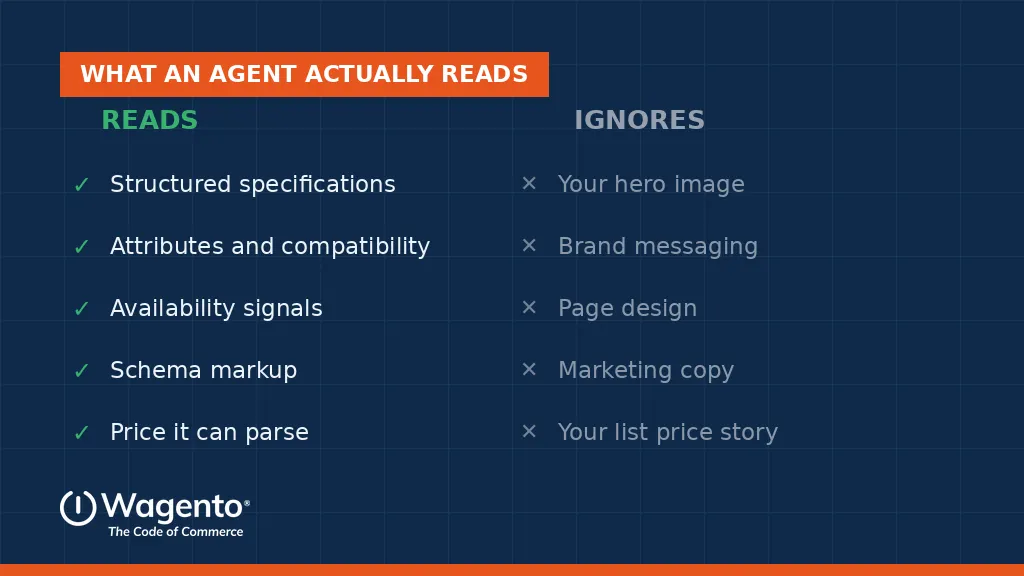
Structured product data. Specifications, attributes, dimensions, compatibility, availability and price, expressed in a format designed for machines rather than for people.
Reporting through 2026 has suggested that products with complete structured markup are substantially more likely to be selected by an agent than products without it. Whatever the precise multiple, the mechanism is not in doubt: an agent cannot recommend what it cannot parse, and it will not guess on your behalf when a competitor’s data is unambiguous.
Which means your schema markup has quietly stopped being a technical detail and started being a sales channel. The same is true of the product data underneath it. If your specifications live in a PDF, or differ between your site and your ERP, or are missing the attributes buyers filter on, you are invisible to the machine doing the shortlisting.
The B2B problem nobody is writing about
Here is where almost all coverage of agentic commerce falls down, because it is written about retail.
In retail, the price is on the page. An agent reads it, compares it, done.
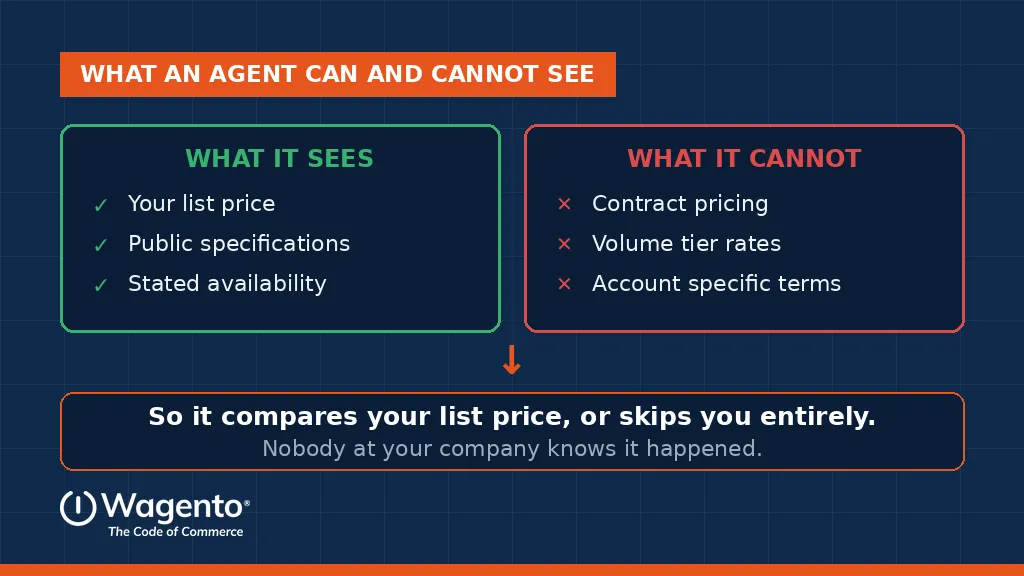
In B2B, the real price is not on the page. It resolves after login, per company account, from contract terms held in your ERP. Volume tiers. Negotiated rates. Customer specific agreements with expiration dates. All of it invisible to anything that has not authenticated as that specific customer.
So when an agent shops on behalf of a procurement team, one of two things happens. It reads your list price and compares that against competitors, which loses you the comparison on value you would have won on contract terms. Or it cannot read a usable price at all, skips you, and recommends a supplier whose numbers it could parse.
Neither outcome involves anyone at your company knowing it happened.
What to do about it, honestly
Some of this is solvable now, and it is worth doing regardless of how the protocols settle, because every item on the list also improves ordinary search and ordinary buyer experience.
✓ Complete your structured product data. Attributes, specifications, compatibility, units. This is the single highest leverage move and it pays off three ways: traditional search, AI answers, and your own site search.
✓ Implement proper schema markup on product pages, including availability and price where you can publish it.
✓ Make availability signals accurate and machine readable. An agent that recommends something you cannot ship damages you more than one that skips you.
✓ Decide deliberately which agents you allow to crawl you, and check that your firewall is not blocking them by accident. Blanket blocks written to stop training crawlers routinely catch the search and retrieval crawlers too.
✓ Measure it. Run your category questions through ChatGPT, Google AI Mode and Perplexity monthly, record whether you appear, and track AI referral traffic separately in your analytics.
And some of it is not solved yet. There is no clean industry answer to how you expose negotiated pricing to an agent without publishing it to competitors. Anyone who tells you otherwise is selling something. What you can do is make everything else so readable that you are in the consideration set, then win the price conversation where you have always won it, which is in the relationship.
The unglamorous conclusion
The foundation this requires is the same foundation good organic search required, and the same foundation a good buyer experience requires. Accurate, complete, structured product data, and systems that agree with each other.
That is not a new project. It is the project you already knew you needed, now with a third reason to fund it.
Where to start
Our GrowthX visibility review shows you what AI engines currently say about your company and your category, where you are absent, and what to fix first. It takes us a few days and it costs you nothing.
Book a discovery call: Contact Us | +1 (612) 594-7699
FAQs, with answers
Agentic commerce is when an AI agent takes action on a buyer’s behalf rather than simply answering questions. Instead of a person searching, comparing and ordering, they give an agent a goal, and the agent researches across suppliers, compares options, and in some cases initiates the purchase. For predictable, repeating B2B orders it is a natural fit, which is why the protocols behind it developed quickly.