




















In 2025, the speed at which your website loads has never been more critical. First Contentful Paint (FCP) is a key performance metric that plays a significant role in determining your website’s user experience and SEO performance. As Google continues to emphasize Core Web Vitals, optimizing FCP is crucial for maintaining a competitive edge. In this blog, we will explore what FCP is, its importance, the FCP impact on SEO, and actionable tips on how to improve First Contentful Paint for better website performance in 2025.

Core Web Vitals Overview
- FCP (First Contentful Paint): First visible content (text, image, etc.).
- LCP (Largest Contentful Paint): Largest visible content (typically an image).
- CLS (Cumulative Layout Shift): Page stability and no unexpected shifting.
Why it Matters:
- FCP and LCP are critical for SEO rankings.
- FCP affects bounce rates and user engagement.
- CLS ensures a stable user experience.
What is First Contentful Paint (FCP)?
First Contentful Paint (FCP) refers to the time it takes for the browser to render the first piece of content on a web page. This content can be any visible element, including text, images, or canvas elements. Unlike other performance metrics like Time to First Byte (TTFB) or Largest Contentful Paint (LCP), FCP measures when users first encounter meaningful content, marking the initial point at which the page appears to load.
FCP is a metric in the set of Core Web Vitals developed by Google, which also includes LCP and CLS. These metrics are used to evaluate the quality of the user experience on your website, focusing on speed, stability, and interactivity.
Why Does FCP Matter in 2025?
In 2025, FCP continues to be a pivotal metric for assessing website performance. Let’s explore why FCP is so crucial:

FCP & SEO: A Fast FCP = Higher Rankings
- FCP is a Google ranking factor.
- Slow FCP = Higher Bounce Rates
- Fast FCP = Better User Engagement
Impact:
- A faster FCP improves user experience and retention.
- SEO rankings improve as Google values fast-loading pages.
Google’s Core Web Vitals & SEO Rankings
Google’s Core Web Vitals are now integral to SEO rankings, and FCP is a key component of these metrics. Google uses FCP to assess the perceived speed of your website. A slow FCP can negatively affect your SEO rankings, making it harder for your site to appear in search results. By optimizing FCP, you not only improve user experience but also increase your chances of ranking higher in Google’s search results.
As of 2025, FCP remains one of the essential signals used by Google’s algorithm to measure page load performance. Websites with optimized FCP times are more likely to be favored by Google’s ranking system, which prioritizes sites that deliver fast and engaging user experiences.
User Engagement & Bounce Rate
The FCP impact on SEO is closely tied to user engagement. Users expect instant access to content. A slow FCP can frustrate users, causing them to abandon your site before they see any content. On the flip side, a fast FCP provides users with immediate content, reducing bounce rates and keeping users engaged. If your site’s FCP is optimized, users are more likely to stay, explore, and interact with your content, leading to better user retention and engagement.
Mobile Optimization
With mobile-first indexing becoming the norm, how fast should FCP be on mobile devices? Mobile users, who often have slower network connections, are particularly sensitive to delays in FCP. Optimizing FCP for mobile devices ensures that your website performs well across all devices, providing a better experience for all users. A mobile-friendly, fast-loading site is essential for maintaining user engagement and reducing bounce rates.
Conversion Rates
For eCommerce websites, optimizing FCP can significantly boost conversion rates. Faster loading times lead to quicker user interactions, including product browsing, adding items to the cart, and completing purchases. A fast FCP keeps the user engaged, leading to more sales and higher revenue. A slow FCP can lead to cart abandonment and lower overall conversions.
Want to optimize your website’s FCP and increase conversion rates?
Contact Wagento for a free website performance audit today!
How Does FCP Impact Your Website’s Performance?
First Contentful Paint (FCP) directly influences several aspects of your website’s performance. Let’s break down the key areas affected by FCP.
SEO Rankings
FCP is a key indicator of website speed, which Google uses to assess your site’s user experience. In 2025, optimizing First Contentful Paint is vital for staying competitive in search rankings. Slow FCP times contribute to poor SEO, as Google prioritizes fast-loading websites that provide a seamless experience.
User Perception and Bounce Rate
The perception of speed plays a crucial role in user retention. FCP directly affects how users perceive the speed of your website. If users don’t see content quickly, they may assume the website is slow, which can increase bounce rates. By reducing FCP time, you improve the perceived speed of the site, making users more likely to stay and explore.
Mobile User Experience
Given the increasing importance of mobile users, optimizing FCP for mobile devices is more crucial than ever. A fast FCP ensures that mobile users see content quickly, even with slower connections. This is essential for maintaining a good mobile user experience, reducing bounce rates, and improving engagement.
Conversion Rates
The conversion rate of your website is directly related to how quickly users can interact with your content. Websites that have a slow FCP may frustrate users, leading them to abandon the site before completing any desired actions, such as making a purchase or filling out a form. A fast FCP keeps users engaged and can significantly increase your conversion rates.
Improve your website’s FCP and boost conversions today!
Get your website performance audit free from Wagento.
How to Improve First Contentful Paint (FCP) in 2025
Improving FCP involves optimizing various elements of your website, from images to JavaScript loading.
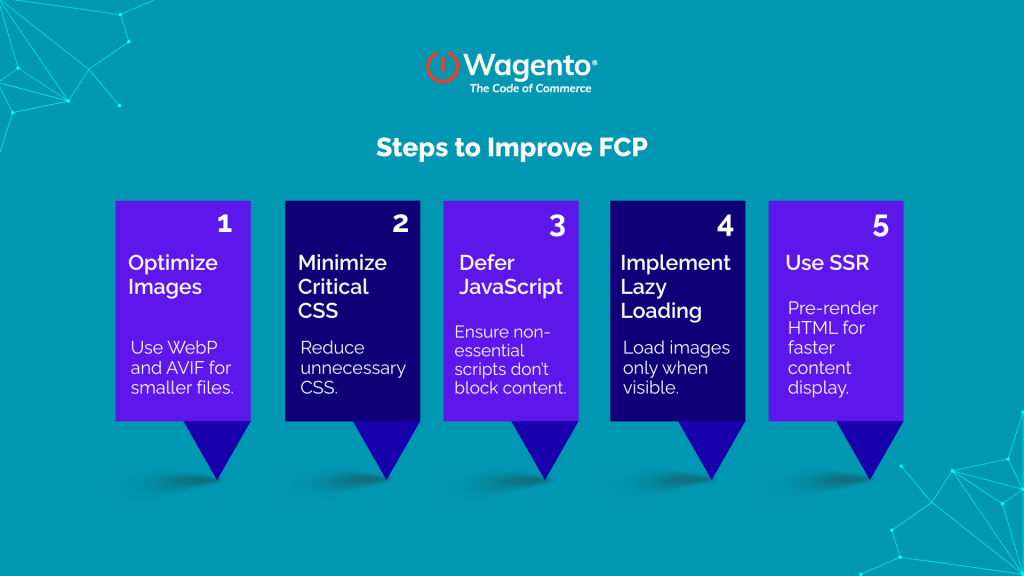
Steps to Improve FCP
- Optimize Images – Use WebP and AVIF for smaller files.
- Minimize Critical CSS – Reduce unnecessary CSS.
- Defer JavaScript – Ensure non-essential scripts don’t block content.
- Implement Lazy Loading – Load images only when visible.
- Use SSR – Pre-render HTML for faster content display.
Below are some practical ways to reduce FCP time and improve First Contentful Paint.
1. Optimize Images
Images are often the largest assets on a page, and they can dramatically impact FCP. Here’s how to optimize them:
- Use modern image formats like WebP or AVIF, which offer superior compression and quality.
- Compress images to reduce their file size without sacrificing quality. Tools like TinyPNG or ImageOptim can help achieve this.
- Ensure that images are responsive, so they automatically adjust to different screen sizes, especially on mobile devices.
By optimizing images, you can reduce FCP time and improve the perceived loading speed of your website.
2. Minimize Critical CSS
Critical CSS refers to the CSS necessary to render the content above the fold. By minimizing critical CSS and loading non-essential CSS asynchronously, you can reduce the time it takes for the page to render content, which in turn improves FCP. Using tools like Critical or PurgeCSS can help identify and load only the essential CSS required for the first render.
3. Defer Non-Essential JavaScript
JavaScript can block the rendering of content, which can slow down FCP. To improve First Contentful Paint, defer the loading of non-essential JavaScript that is not needed for the first render. This ensures that the browser can focus on rendering the content quickly, without waiting for large JavaScript files to load.
4. Implement Lazy Loading
Lazy loading delays the loading of non-essential resources, such as images and videos, until they enter the user’s viewport. This means that only essential content is loaded initially, improving FCP and overall performance. By implementing lazy loading for images and media, you can reduce FCP time and speed up your website.
5. Use Server-Side Rendering (SSR)
For modern JavaScript frameworks like React or Vue, Server-Side Rendering (SSR) is a highly effective technique for improving FCP. SSR allows the server to render the HTML content of the page and send it to the browser, which can then display the content immediately. This reduces the time it takes to load the first meaningful content and significantly improves FCP.
FCP vs LCP: What’s the Difference?
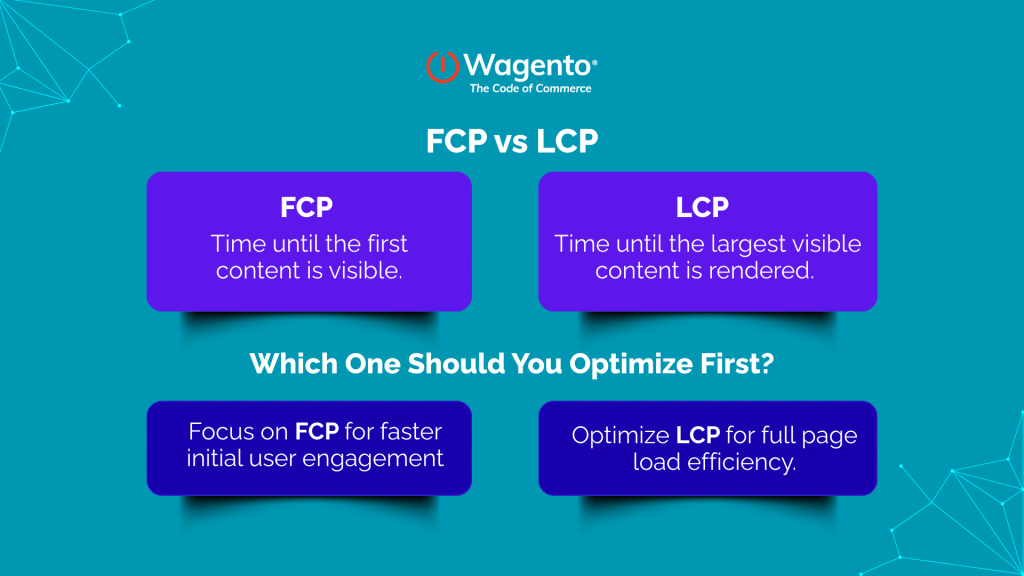
FCP vs LCP
- FCP: Time until the first content is visible.
- LCP: Time until the largest visible content is rendered.
Which One Should You Optimize First?
- Focus on FCP for faster initial user engagement.
- Optimize LCP for full page load efficiency.
It’s essential to understand the distinction between FCP and LCP (Largest Contentful Paint), as both metrics are part of Core Web Vitals and are critical for website optimization.
- FCP measures the time it takes for the first piece of content to be rendered.
- LCP, on the other hand, measures the time it takes for the largest visible content on the page (usually an image or a large block of text) to be rendered.
While both metrics measure page load performance, FCP focuses on the first visual feedback users receive, while LCP focuses on the main content that users are likely to interact with.
FCP vs LCP: Both metrics are important, but improving FCP gives users quicker access to initial content, which helps them perceive the site as fast. LCP focuses on the overall experience and is important for longer interactions.
Want to improve both FCP and LCP?
Get your website performance audit free from Wagento today
Tools to Measure and Monitor FCP
To ensure that your FCP optimization efforts are successful, you need to regularly test and monitor your website’s performance. Here are some tools that can help:
Google Lighthouse
Lighthouse is a comprehensive performance auditing tool developed by Google. It measures a range of performance metrics, including FCP, and provides recommendations for optimization. Lighthouse is a free, open-source tool that can help you track and improve website performance.
PageSpeed Insights
PageSpeed Insights provides detailed information about how fast your website loads on both mobile and desktop. It offers insights into Core Web Vitals, including FCP, and gives suggestions for improving performance.
Web Vitals Extension
The Web Vitals Extension is a browser extension that provides real-time feedback on FCP and other Core Web Vitals. It’s an excellent tool for monitoring your website’s performance as you make improvements.
Conclusion
In 2025, First Contentful Paint (FCP) remains a vital metric for measuring website performance. A fast FCP enhances user experience, boosts SEO rankings, and improves conversion rates. By applying best practices and using the right tools, you can reduce FCP time and ensure that users have a fast, engaging experience on your website.
At Wagento, we specialize in optimizing FCP and other performance metrics to help you stay competitive. Contact us today to improve your First Contentful Paint and take your website’s performance to the next level.
Start optimizing your website’s performance today!
Contact Wagento for a free website performance audit.
Frequently Asked Questions (FAQs)
The ideal FCP time should be under 1 second. Google recommends FCP under 0.8 seconds to provide a great user experience and boost SEO rankings.
You can use tools like Google Lighthouse, PageSpeed Insights, and Web Vitals Extension to test your website’s FCP. These tools offer insights into performance and actionable tips for improving website performance.
FCP is a ranking factor for Google’s search algorithm. A faster FCP improves user experience, reduces bounce rates, and can positively impact your SEO rankings.
To improve FCP for mobile, optimize images, defer non-essential JavaScript, implement lazy loading, and use responsive design to make sure your site loads quickly on mobile devices.
Yes, FCP can be improved on existing websites by optimizing images, reducing critical CSS, deferring JavaScript, and using server-side rendering (SSR) to speed up the page load time.
Need help optimizing your website’s FCP?
Contact Wagento for a free website performance audit today!