
 Manufacturing and Distribution
 Firearms
 Automotive and OEMs
 Healthcare & Life Sciences
 Sports & Outdoor Hunting Gear
 Regulated Industries eCommerce
 Adobe Commerce
 BigCommerce
 Magento
 myMagento
 WooCommerce
 Shopify Plus
 Shopware
 Magento 1 to Magento 2 Migration
 Magento Upgrade Service
 Magento Design
 Magento B2B
 Magento Hosting
 Magento Consulting
 Magento eCommerce Developers
 Magento SEO
 Magento Integration
 Magento Speed & Performance Optimization
 eCommerce Development
 Headless Commerce
 eCommerce GrowthX
 B2B CRO Services
 Enterprise SEO Services
 Email Marketing
 Website Localization Services
 AEO, GEO and AI Search
 AI Tools for Business
 Data Analytics Services
 GrowthX Strategy & Consultancy
 eCommerce Integration
 CRM Integrations
 Accounting Software Integrations
 ERP Integrations
 PIM Integrations
 Payment Gateways Integrations
 Tax Platform Integrations
 eCommerce Site Migrations
 Project Rescue
 Hire Developers
 Free Audit Report
 Extensions & Applications
 Custom Applications for eCommerce
 Magento Extensions
 Security & Fraud Prevention
 User Interface & Experience
 Website Design Services
 Support & Maintenance
 About Us
 Blog
Blog Webinars
 News & Updates
 Downloads
 FAQs
FAQs The Wagento Difference
 Hyvä
Hyvä iPaaS
iPaaS Klaviyo
 Sales Layer
 Sift
Sift Dot Digital
 Nousmedis
 Call
Call Message
Expanding into international markets is no longer just for large enterprises. Today, small and mid-sized B2B companies are also looking to sell beyond their borders. Yet, cross-border trade comes with challenges like different currencies, tax regulations, shipping complexities, and compliance requirements. That’s where cross-border B2B tools step in.
What Are Cross-Border B2B Tools?
These are digital platforms and integrations designed to simplify international transactions between businesses. They provide solutions for global payments, logistics, compliance, language localization, and customer support, ensuring that companies can operate smoothly in multiple regions.
Key Features of Cross-Border B2B Tools
- Multi-currency Payment Systems – Tools that handle secure payments in local currencies while ensuring compliance with tax and banking rules.
- Trade Compliance & Tax Automation – Automating VAT, GST, customs duties, and regional trade laws to reduce risk.
- Logistics & Supply Chain Visibility – Platforms that integrate global shipping carriers, provide tracking, and optimize routes.
- Localization Support – Translating content, adapting catalogs, and personalizing experiences for international buyers.
- Integration with eCommerce & ERP Systems – Seamlessly connecting with B2B marketplaces, CRMs, and ERPs for real-time data exchange.
Featured Tools for Cross-Border B2B
1. Multi-Currency Payment Systems
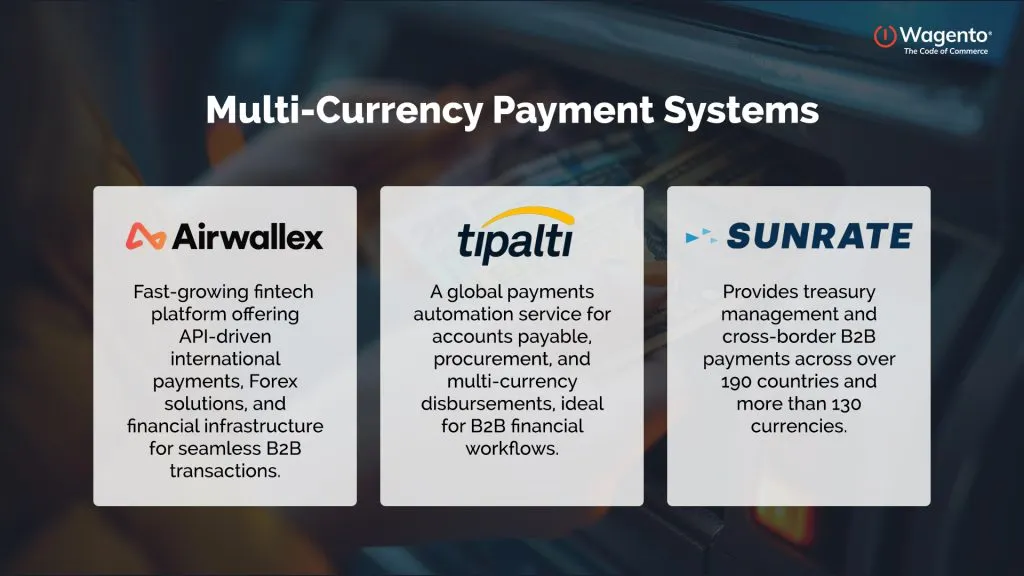
- Airwallex – A fast-growing fintech platform offering API-driven international payments, Forex solutions, and financial infrastructure for seamless B2B transactions.
- Tipalti – A global payments automation service for accounts payable, procurement, and multi-currency disbursements, ideal for B2B financial workflows.
- Sunrate – Provides treasury management and cross-border B2B payments across over 190 countries and more than 130 currencies.
2. Trade Compliance & Tax Automation
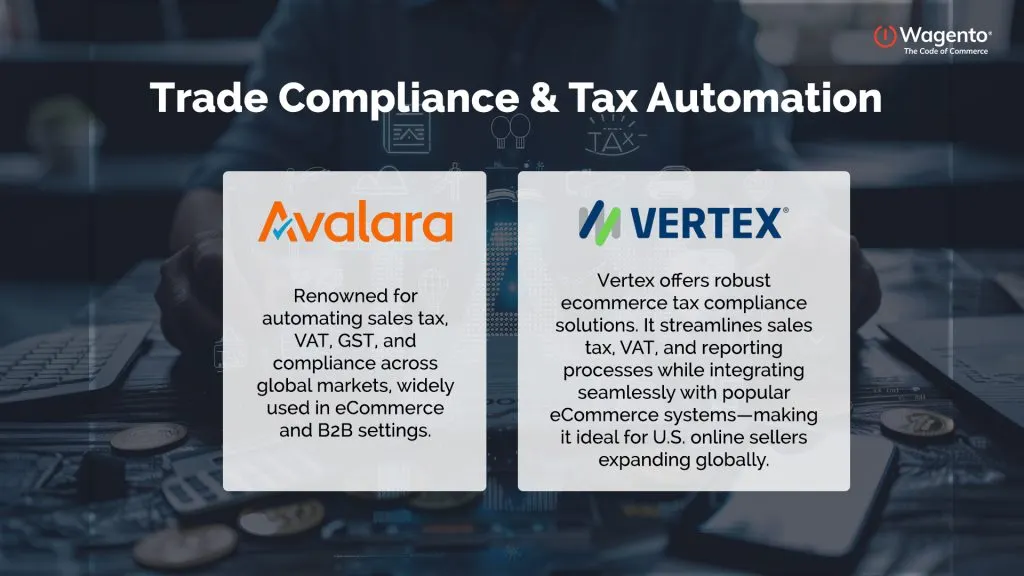
- Avalara – Renowned for automating sales tax, VAT, GST, and compliance across global markets, widely used in eCommerce and B2B settings.
- Vertex – Vertex offers robust e‑commerce tax compliance solutions. It streamlines sales tax, VAT, and reporting processes while integrating seamlessly with popular eCommerce systems—making it ideal for U.S. online sellers expanding globally.
3. Logistics & Supply Chain Visibility
- E2open – A cloud-based platform offering end-to-end supply chain visibility, including global supplier collaboration, logistics management, and trade compliance.
- OmniRetail – Focuses on simplifying supply chains in Africa by integrating manufacturers, distributors, warehousing, and payment tools (Mplify, Omnibiz, OmniPay) in one ecosystem.
4. Localization Support
- Global‑e – Enables localized checkout, payments, duties/taxes, multilingual support, and international logistics through a single integration—especially strong in global e-commerce.
- Lokalise – A modern localization platform (TMS) for managing multi-language content, integrating AI and human translation with seamless deployment into apps, websites, and more.
5. Integration with eCommerce & ERP Systems
- Shopify Plus – A scalable e-commerce platform with built-in capabilities for currency conversion, localization, tax compliance, logistics integrations, and B2B operations.
- Tradeshift – Offers cloud-based purchase-to-pay automation, e-invoicing, supply chain marketplaces, virtual cards, and supply chain financing, all integrated in one business network.
In summary: When modern B2B businesses go global, the right toolkit matters. For multi-currency payments, solutions like Airwallex, Tipalti, and Sunrate ensure seamless, compliant cross-border transactions.
In compliance and tax automation, Avalara simplifies complex VAT, GST, and duty calculations. To gain logistics and supply chain visibility, E2open and OmniRetail offer powerful platforms for tracking and managing shipments across countries. For localization, Global-e and Lokalise enable personalized, multilingual experiences and localized checkout flows. Finally, full e-commerce and ERP integration is achieved with platforms like Shopify Plus and Tradeshift, combining operational workflows, inventory, and global market access into unified systems.
Why They Matter
Cross-border B2B tools allow businesses to:
- Expand into new markets faster
- Reduce compliance errors
- Improve customer trust with localized experiences
- Gain transparency across the supply chain
If you’d like to understand the bigger picture of how cross-border B2B eCommerce operates and what businesses must prepare for before expanding globally, check out our detailed guide: Cross-Border B2B Ecommerce: How it Works and What Businesses Need to Prepare For.