 Manufacturing and Distribution
 Firearms
 Automotive and OEMs
 Healthcare & Life Sciences
 Sports & Outdoor Hunting Gear
 Regulated Industries eCommerce
 Adobe Commerce
 BigCommerce
 Magento
 myMagento
 WooCommerce
 Shopify Plus
 Shopware
 Magento 1 to Magento 2 Migration
 Magento Upgrade Service
 Magento Design
 Magento B2B
 Magento Hosting
 Magento Consulting
 Magento eCommerce Developers
 Magento SEO
 Magento Integration
 Magento Speed & Performance Optimization
 eCommerce Development
 Headless Commerce
 eCommerce GrowthX
 B2B CRO Services
 Enterprise SEO Services
 Email Marketing
 Website Localization Services
 AEO, GEO and AI Search
 AI Tools for Business
 Data Analytics Services
 GrowthX Strategy & Consultancy
 eCommerce Integration
 CRM Integrations
 Accounting Software Integrations
 ERP Integrations
 PIM Integrations
 Payment Gateways Integrations
 Tax Platform Integrations
 eCommerce Site Migrations
 Project Rescue
 Hire Developers
 Free Audit Report
 Extensions & Applications
 Custom Applications for eCommerce
 Magento Extensions
 Security & Fraud Prevention
 User Interface & Experience
 Website Design Services
 Support & Maintenance
 About Us
 Blog
Blog Webinars
 News & Updates
 Downloads
 FAQs
FAQs The Wagento Difference
 Hyvä
Hyvä iPaaS
iPaaS Klaviyo
 Sales Layer
 Sift
Sift Dot Digital
 Nousmedis
 Call
Call Message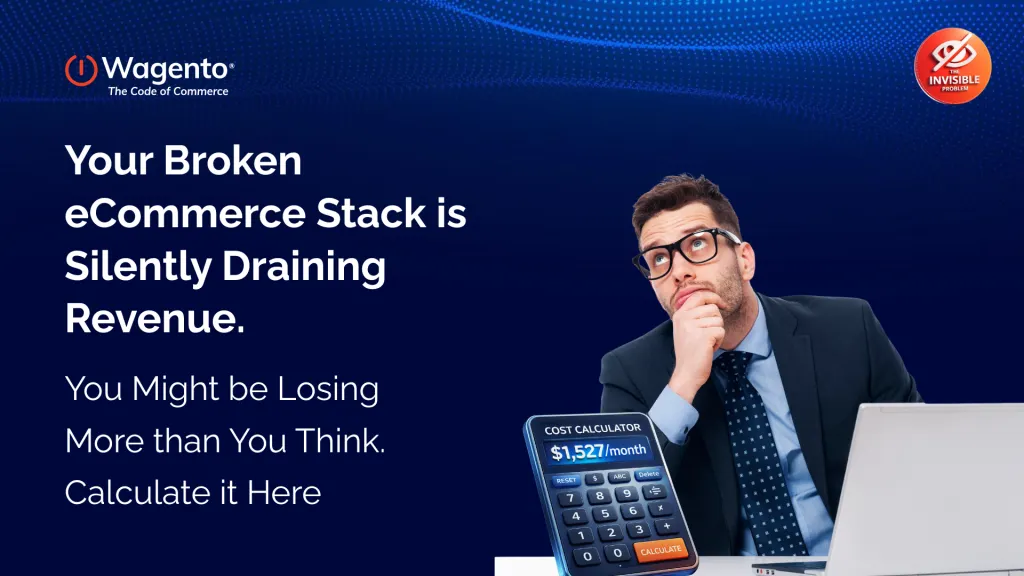
You Might be Losing More than You Think. Calculate it Here.
Most B2B brands think they have a performance problem, a marketing problem, or a conversion problem. In reality, they have an integration problem — and it’s costing real money every single month.
Here’s a question most B2B eCommerce operators never actually sit down to answer: what does a broken stack cost, in hard dollars, every month?
Not in frustration. Not in vague “we need to fix this eventually” conversations. In actual revenue leaving your business.
Most founders and ops leads have a gut feeling the number is bad. But gut feelings don’t get budget approved. A real dollar figure does. That’s exactly what this post gives you — a four-bucket cost framework you can calculate right now, plus a live calculator to plug in your own numbers.
Fair warning: the total is almost always higher than expected. Most B2B teams have never tallied their true ecommerce tech stack cost — or understood how much of their B2B ecommerce revenue loss ties directly back to disconnected systems.
What Do We Mean by a “Broken B2B eCommerce Stack”?
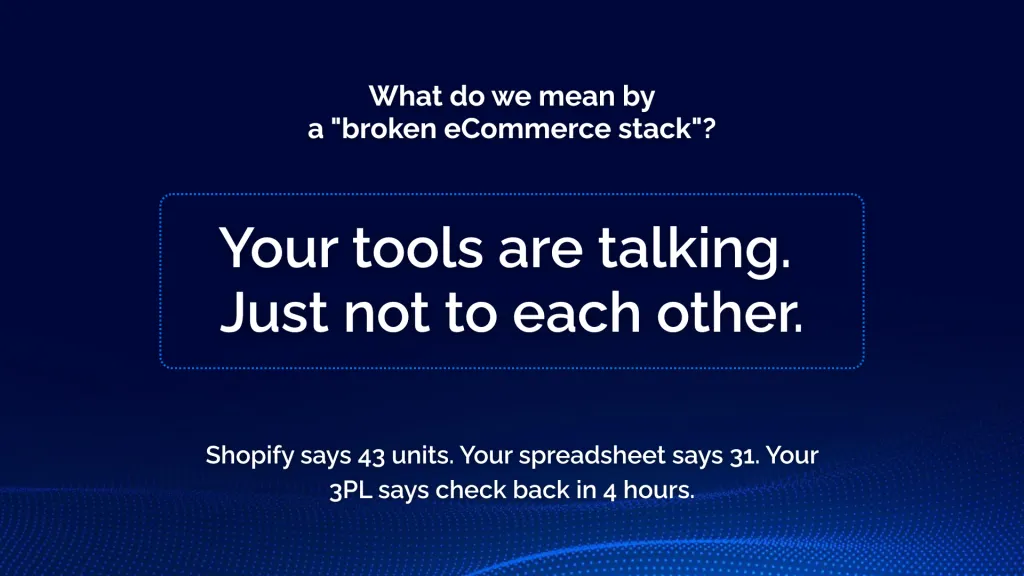
We’re not talking about a site crash or a checkout bug. A broken stack is any situation where your systems don’t talk to each other cleanly — and in B2B commerce, that’s remarkably common.
It looks like this in practice:
- Your inventory tool doesn’t sync in real time with your storefront, so buyers see stock that isn’t actually available
- Your ERP receives orders hours late — or requires manual re-entry — creating downstream fulfillment delays
- Your 3PL sends shipment updates on a lag, leaving your support team flying blind
- Your team copy-pastes orders from one platform into another because there’s no automated handoff
- Your developers spend sprint after sprint patching integrations instead of building features your buyers actually want
✦ Wagento Solution: Commerce Stack Audit
Not sure exactly where your stack is breaking? Wagento’s eCommerce audit service maps every system touchpoint — storefront, ERP, CRM, PIM, and fulfillment — and surfaces exactly where data breaks and what it’s costing you.
None of these feel catastrophic in isolation. That’s exactly why they’re so expensive. They bleed money quietly, every day, in four compounding places.
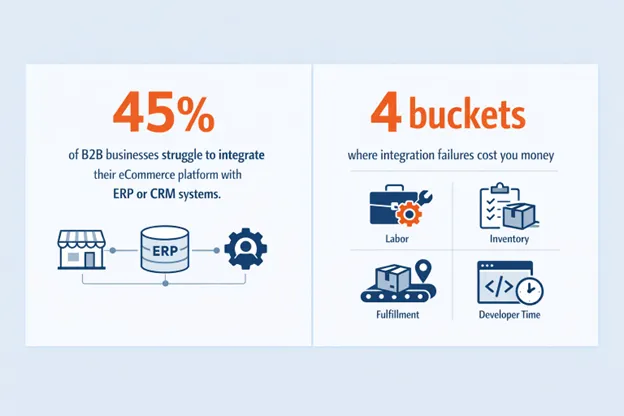
What Your B2B eCommerce Stack Actually Looks Like — and Where It Breaks
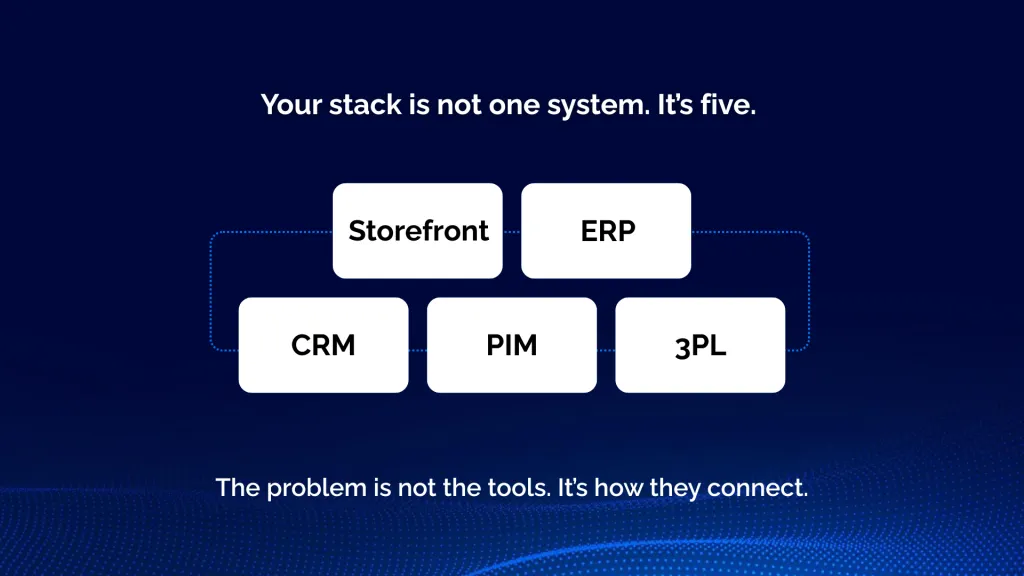
Most B2B eCommerce operations today aren’t running on a single unified system. They’re running on a patchwork of tools that each handle a different part of the business:
- Your storefront (Adobe Commerce, Magento, BigCommerce, Shopify Plus) manages the buying experience
- Your ERP handles orders, pricing tiers, and finance
- Your CRM stores account and contact data
- Your PIM manages product information and catalog updates
- Your 3PL or WMS handles fulfillment and shipment tracking
On their own, each of these systems works. The problem starts when they need to work together. If your ERP isn’t receiving orders in real time, your CRM has outdated account data, your PIM isn’t syncing product updates, or your 3PL is sending delayed shipment confirmations — the entire operation begins to slow down.
This is the hidden cost of a disconnected B2B eCommerce system. It’s not one catastrophic failure. It’s dozens of small friction points that, added together, represent a significant and very real number.
✦ Wagento Solution: ERP Integration (SAP, Oracle, Dynamics, Epicor & more)
When your ERP and storefront don’t share data in real time, every order becomes a manual operation. Wagento’s B2B eCommerce integration practice connects leading ERP systems — including SAP, Oracle, Dynamics, and Epicor — directly to your storefront, automating order flow, pricing, and inventory sync.
✦ Wagento Solution: PIM Integration — Single Source of Truth for Product Data
Inconsistent product data across your storefront, marketplaces, and distributor channels costs you in errors, delayed launches, and lost buyer trust. Wagento’s PIM integration service creates a centralized, auto-syncing product data layer across every sales channel.
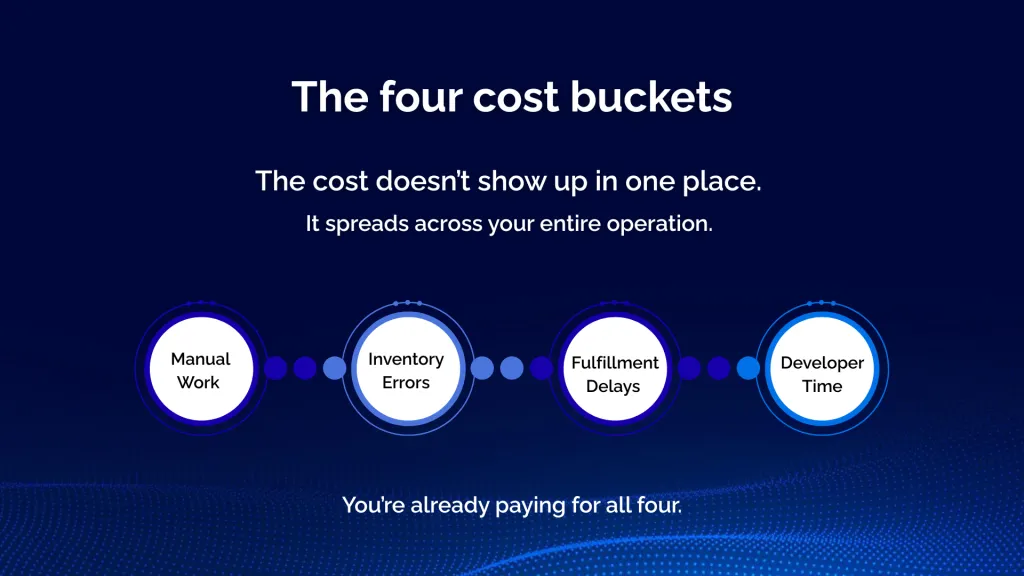
The Four Cost Buckets
The cost of a broken stack doesn’t show up in one place. It spreads across your entire operation. Here’s where to look.
Bucket 1: Manual Labor Hours
When systems don’t sync, people fill the gap. Someone on your team — usually a coordinator, ops manager, or account rep — is manually updating inventory counts, re-entering order data, checking shipment statuses, or reconciling numbers between platforms. This is skilled labor doing repetitive work that software should handle.
The math: At a loaded rate of $25–$50/hour, even 5 hours/week of manual data work adds up to $500–$1,000/month. Most B2B operations we audit are closer to 15–25 hours per week across the team.
✦ Wagento Solution: Workflow Automation via B2B Integration
Manual re-entry and copy-paste workflows exist because your systems aren’t connected. Wagento’s integration services replace manual data handling with automated, real-time flows between your ERP, storefront, CRM, and fulfillment tools — eliminating the labor cost entirely.
Bucket 2: Oversells and Inventory Errors
When inventory doesn’t update in real time across your storefront and ERP, you sell products you don’t have. In B2B, where buyers often place large, contract-backed orders, an oversell isn’t just an inconvenience — it erodes hard-won customer trust.
You pay for it three ways: the shipping cost to cancel and refund, the lost revenue from the order itself, and the long-term cost of a buyer who questions whether your operation can be relied upon.
The math: Even one oversell incident per day at an average order value of $60 = $1,800/month in lost revenue before you count cancellation management and chargeback costs. (Our calculator applies a 1.4x multiplier to account for the statistical cost of losing that customer relationship.)
✦ Wagento Solution: Real-Time Inventory Sync — Storefront ↔ ERP
Oversells happen when your storefront and ERP are operating on different inventory numbers. Wagento connects your eCommerce platform to your ERP so stock levels update instantly across every channel — eliminating the root cause of oversells, cancellations, and the trust damage that follows.
Bucket 3: Delayed Fulfillment and SLA Misses
Slow order routing, late warehouse pick signals, and missing shipment confirmations all create delayed deliveries. In B2B commerce, where buyers operate on procurement schedules and production timelines, a late shipment has downstream consequences that go far beyond a refund request.
Delayed deliveries generate support tickets, negative reviews, refund requests, and — in the worst cases — contract review conversations you never want to have.
The math: If your average delay rate is 3% of orders and you ship 500 orders/month, that’s 15 problem orders, each costing $10–$40 to manage = $150–$600/month in direct costs alone.
✦ Wagento Solution: Shipping & Fulfillment Integration (FedEx, UPS, DHL & 3PLs)
Delayed fulfillment usually traces back to broken data handoffs between your storefront, OMS, and 3PL. Wagento integrates your fulfillment systems — including FedEx, UPS, DHL, and warehouse management platforms — so pick signals fire automatically, shipment confirmations flow in real time, and your support team always knows where every order stands.
Bucket 4: Developer Firefighting Time
This is the sneakiest bucket because it shows up as salary you’re already paying. But when your engineers are patching broken webhooks, fixing data sync failures, or babysitting fragile API integrations, they’re not building growth features. Every hour of reactive firefighting is an hour of product roadmap delayed.
This is also where ecommerce technical debt compounds fastest. Each patch creates new fragility. The longer it continues, the more expensive the eventual fix becomes.
The math: At a loaded developer cost of $80–$150/hour, even 10 hours/month of reactive firefighting adds up fast. Most teams with heavily customized or patchwork stacks lose 20–40 hours per month to this.
✦ Wagento Solution: Managed Support & Project Rescue
Developers stuck in firefighting mode is a structural problem, not a staffing one. Wagento’s managed support service takes over reactive maintenance — monitoring, patching, and resolving integration failures proactively — so your internal engineers can focus on building. For stacks that are already off the rails, Wagento’s Project Rescue service stabilizes, audits, and rebuilds what’s broken.
✦ Wagento Solution: Project Rescue — When the Stack is Already Failing
If broken integrations, a stalled migration, or a failed implementation has your eCommerce operations at a standstill, Wagento’s Project Rescue team steps in — analyzing, stabilizing, and completing projects that previous agencies couldn’t deliver.
These four buckets don’t include brand damage, customer lifetime value erosion, or the slower compound cost of a team permanently stuck in reactive mode. Those are real too — they’re just harder to put a precise number on. The four above are fully quantifiable, right now, with data you already have.
Not sure which bucket is bleeding you the most? Wagento’s commerce stack audit identifies exactly where your systems are breaking — and what it’s costing you. → Audit Your Commerce Stack
Why the Number Is Always Higher Than Expected
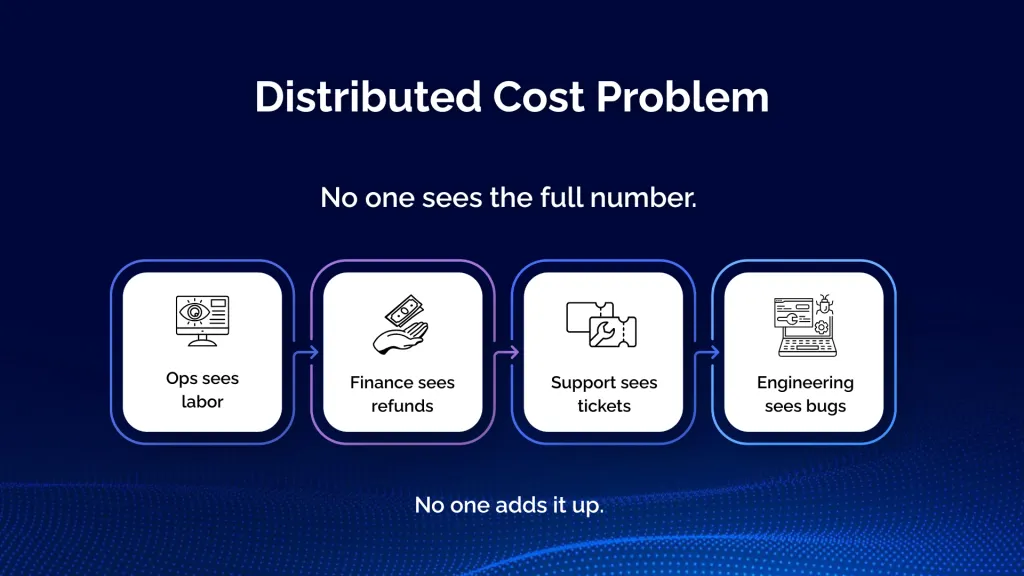
The reason B2B businesses consistently underestimate these costs is simple: they’re distributed. No single line item says “broken integration — $8,400/month.” Instead, the cost is spread across operations, support, finance, and engineering — and nobody in any of those departments sees the full picture.
- Ops sees the manual labor, but not the developer time
- Finance sees the refunds, but not the support overhead
- Support sees the tickets, but not the inventory errors causing them
- Engineering sees the bugs, but not the revenue impact of missed SLAs
Nobody’s sitting down and adding those up. Until now.
✦ Wagento Solution: eCommerce Site Audit — See the Full Picture
Wagento’s comprehensive eCommerce audit service examines your entire stack — from infrastructure and integrations to code quality, performance, and conversion metrics — and produces a unified view of where value is leaking across every department.
Your Monthly Revenue Loss Calculator
Use the calculator below to enter your business numbers. It will estimate what your broken or poorly integrated B2B eCommerce stack is costing you every month — including manual labor, inventory errors, fulfillment delays, and developer firefighting.
Your Monthly Loss Calculator
Estimate what a broken or poorly integrated stack is costing you every month.
Labor
Orders & inventory
Developer time
Estimated monthly loss
How the Calculator Works
Each of the four buckets uses a transparent formula:
- Labor cost = weekly hours × 4.33 weeks × hourly rate
- Oversell cost = affected orders × average order value × 1.4 (accounts for refund cost plus statistical impact of losing that customer)
- Delay cost = affected orders × $20 (average cost to handle a support ticket, issue a partial refund, or re-ship)
- Dev cost = monthly firefighting hours × developer hourly rate
The total is what those four things cost your business every month — on top of normal operating expenses — purely because your systems aren’t properly connected or automated.
What to Do With Your Number
Step 1 — Accept That It’s Real
“We’ve always operated this way” doesn’t mean it isn’t costing you money. It just means the cost is baked into your operations. That monthly figure isn’t theoretical — it’s money your business is spending right now to compensate for broken or disconnected systems.
For many B2B operators, this is also the moment they recognize the signs that their current eCommerce setup is no longer serving them — and that the gap between where they are and where they need to be has a calculable price tag.
Step 2 — Compare It to the Cost of Fixing It
Most integration and automation solutions cost a fraction of the ongoing monthly loss they eliminate. If your stack is costing you $6,000/month across these four buckets, a properly scoped integration project that eliminates 80% of that has a straightforward ROI. Wagento’s eCommerce development services are designed exactly for this — scoped to your stack, your integrations, and your growth stage.
✦ Wagento Solution: eCommerce Development — Built Around Your ROI
Rather than generic builds, Wagento scopes every development engagement against your specific cost buckets — prioritizing the integrations, automations, and platform improvements that deliver the fastest payback on your monthly loss figure.
Step 3 — Prioritize by Bucket Size
Look at your four numbers. The biggest bucket is where to start. For most B2B operations, it’s either manual labor (large ops team) or developer firefighting (heavily customized stack). Fixing the biggest leak first gets you the fastest payback and builds the case for addressing the rest.
Step 4 — Build the Business Case
Take your monthly loss figure and multiply by 12. That’s your annual stack cost — the number that makes budget conversations a lot more serious. Present it alongside a proposed fix and its annual cost. The ROI almost always speaks for itself.
✦ Wagento Solution: GrowthX — Full-Spectrum eCommerce Growth Accelerator
Once your integration foundation is clean, GrowthX helps B2B businesses translate operational efficiency into measurable revenue growth — combining CRO, AI-driven personalization, omnichannel expansion, and performance marketing under a single strategic framework.
We’ve Fixed This Before — Here’s a Real Example
This isn’t a hypothetical problem. This is exactly what we see in real B2B businesses.
One B2B company was running an Adobe Commerce store, but their ERP system (Epicor Prelude) wasn’t properly connected. Orders, pricing, and customer account data weren’t flowing cleanly between systems. Their team had to manually intervene to manage orders and pricing visibility — slower operations, more errors, and a limited customer experience.
The fix wasn’t a platform swap. It was a proper, structured integration between Adobe Commerce and their ERP — exactly the kind of ERP integration work Wagento specializes in.
Read the full case study: Adobe Commerce + Epicor Prelude ERP Integration for LAPP Tannehill
How You Can Fix This Too
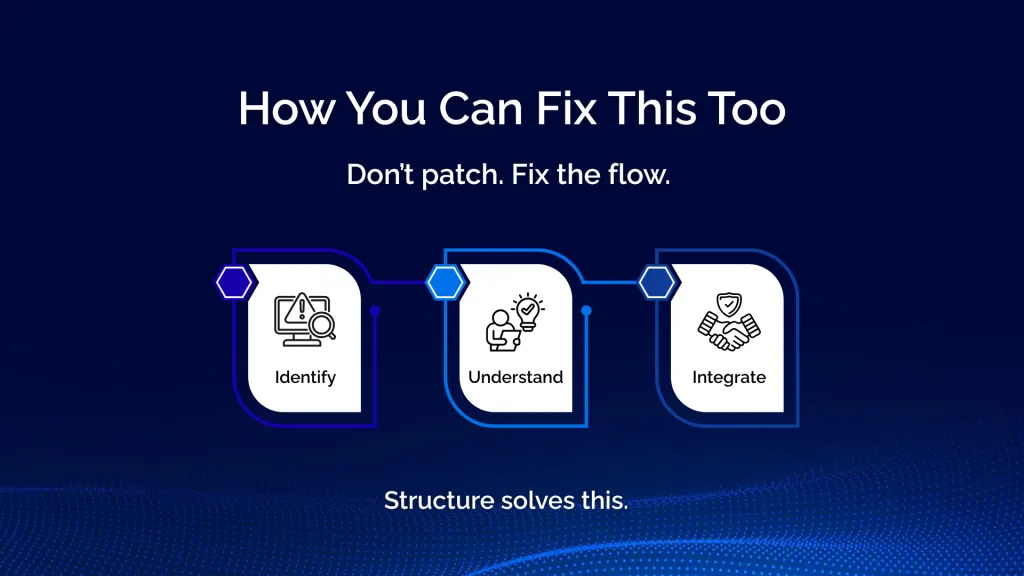
If any of this sounds familiar, the path forward isn’t complicated. It just needs to be done correctly — and in the right sequence. Most businesses that stay stuck skip the first step entirely.
Step 1: Map Your Systems and Data Flow
Before you can fix what’s broken, you need to know exactly where data enters, moves through, and exits each system. A proper eCommerce integration audit gives you this map — identifying every handoff point between your storefront, ERP, CRM, PIM, and fulfillment systems, and pinpointing where data breaks in transit.
✦ Wagento Solution: Start With a System Audit — Know Before You Build
Wagento’s audit service is the natural first step for any B2B business looking to fix its integration stack. You’ll receive a prioritized list of integration gaps, data flow failures, and performance issues — with a clear roadmap for what to fix first and why.
Step 2: Fix the Integration, Not Just the Surface Issue
Most businesses patch symptoms — a manual workaround here, a cron job there. What actually solves the problem is fixing the structure of how systems are connected. Wagento’s Adobe Commerce solutions and B2B integrations practice are built around this principle — connecting ERP systems like SAP, Oracle, Dynamics, and Epicor with your storefront so data moves automatically.
✦ Wagento Solution: Adobe Commerce Development & Integration
As an Adobe Commerce Bronze Solution Partner, Wagento builds and integrates Adobe Commerce stores for B2B businesses — covering custom ERP/CRM/PIM connections, self-service buyer portals, tiered pricing, approval workflows, and performance optimization.
Step 3: Build for Scale, Not Just Stability
A well-integrated stack isn’t just less painful to operate — it unlocks growth capabilities that a fragmented stack can’t support. Custom buyer portals, tiered pricing, approval workflows, real-time inventory visibility across channels — these are the standard B2B eCommerce capabilities your buyers increasingly expect. Getting your integration layer right is what makes them possible.
✦ Wagento Solution: Scalable B2B eCommerce Platform Development
Wagento builds mobile-first B2B eCommerce platforms with the features enterprise buyers expect — tiered pricing, buyer-specific catalogs, quote management, purchase order workflows, and secure account portals — all built to scale as your operations grow.
Need help fixing your systems the right way? Wagento has helped hundreds of B2B businesses stop the bleed and build for growth. → Discuss Your Integration →
The Bottom Line
A broken B2B eCommerce stack doesn’t feel like an emergency — even when it’s compounding in cost every single month. That’s what makes it so dangerous. It feels like just “how things work.” Slow syncs, a few manual steps, the occasional oversell, devs doing maintenance — it all seems normal.
But normal is not the same as free.
Your calculator result is what “normal” is actually costing you. And once you know the number, you can’t unknow it.
The B2B businesses that grow fastest aren’t the ones with the best products. They’re the ones that stopped spending time and money compensating for broken systems — and redirected that capital into things that actually move the needle: better buyer experiences, faster fulfillment, smarter account management.
Your stack’s monthly cost is a real number. Now you know what it is. The next question is whether you’re going to keep paying it — or fix it.
✦ Wagento Solution: myMagento — Predictable, Ongoing eCommerce Health
Once your stack is clean, keeping it that way requires proactive monitoring, security patching, and regular performance tuning. Wagento’s myMagento subscription service provides all of this at a predictable monthly cost — no surprise invoices, no reactive emergency billing.