



















Running a Magento store in 2026 is no longer just about launching a site and reacting when something breaks. Magento has evolved into a powerful, enterprise-grade platform, but with that power comes complexity. Security patches, performance tuning, extension compatibility, upgrades, audits, and monitoring are now continuous requirements, not occasional tasks.
For growing merchants, this creates a difficult reality. You need expert Magento support and maintenance, but hiring a full-time Magento developer or building an internal technical team is expensive and often unnecessary. At the same time, relying on ad hoc fixes or ticket-based help leads to instability, downtime, and long-term technical debt.
This is where optimized, subscription-based Magento support and maintenance becomes essential.
Modern Magento managed services are designed to be proactive, predictable, and scalable. They cover everything from security updates and performance optimization to audits, monitoring, and upgrades, all without the overhead of a full-time development team.
Why Magento Support and Maintenance Looks Different in 2026
Magento stores today operate in a far more demanding environment than even a few years ago. Customers expect fast load times, uninterrupted availability, secure transactions, and smooth checkout experiences at all times.
At the same time, the Magento ecosystem has become more sophisticated. Stores now rely on multiple third-party integrations, custom extensions, headless components, complex catalogs, and advanced payment and shipping logic.
The Cost of Reactive Magento Maintenance
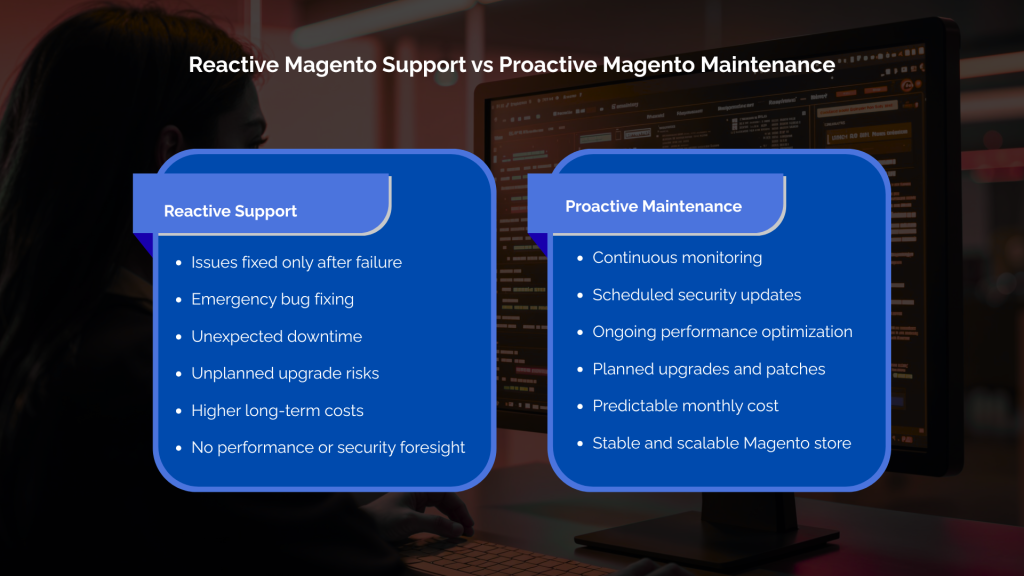
Many merchants still rely on reactive support models. They wait until something breaks, then raise a ticket or hire a developer to fix the issue.
This approach leads to:
- Higher long-term costs due to emergency fixes
- Increased Magento site downtime
- Repeated Magento performance issues
- Security vulnerabilities left unpatched
- Stressful upgrades and failed deployments
- No clear ownership of the Magento codebase
Reactive maintenance does not scale. As your store grows, the risks multiply.
The Shift Toward Proactive and Managed Magento Services
Leading Magento merchants are shifting to proactive Magento managed services. These services focus on preventing issues before they impact revenue.
Instead of fixing problems after they occur, proactive support includes:
- Continuous Magento monitoring services
- Regular Magento health checks and audits
- Scheduled Magento security updates and patches
- Ongoing Magento performance optimization
- Planned Magento upgrades and extension updates
This shift is not just technical. It is strategic. Magento support is now a growth enabler, not just a safety net.
What Is an Optimized Magento Support and Maintenance Solution
An optimized Magento support and maintenance solution is a subscription-based service that provides ongoing technical care for your Magento store.
It is designed for merchants who want expert Magento technical support without building an internal team.
Subscription Based Magento Care Explained
Instead of paying hourly rates or negotiating one-off contracts, subscription support offers:
- Predictable monthly costs
- Dedicated Magento experts who understand your store
- Continuous oversight of performance and security
- Faster response times for Magento bug fixing
- Strategic guidance for upgrades and improvements
This model aligns incentives. Your support partner is invested in keeping your store stable, fast, and secure over the long term.
Who This Model Is Ideal For
Subscription Magento support plans are ideal for:
- Growing Magento stores without full-time developers
- Merchants planning regular Magento upgrades
- Businesses experiencing Magento 2 performance issues
- Teams struggling with Magento extension updates
- Store owners concerned about Magento security vulnerabilities
- Companies that want proactive monitoring instead of firefighting
Core Components of Magento Support and Maintenance

An optimized Magento maintenance service covers multiple technical areas that work together to keep your store healthy.
Magento Security Updates and Vulnerability Management
Security remains the top concern for Magento merchants. With frequent security patches and evolving threats, skipping updates is no longer an option.
A proper Magento security maintenance process includes:
- Timely application of Magento security patches
- Monitoring for known Magento store vulnerabilities
- Review of third-party extension security
- Server and environment security checks
- Ongoing Magento store security audits
Proactive security maintenance reduces the risk of data breaches, downtime, and loss of customer trust.
Following Adobe Commerce security best practices for 2025 is essential for merchants who want to reduce vulnerabilities and maintain customer trust.
Magento Performance and Speed Optimization
Performance directly impacts conversions, SEO, and customer experience.
Modern Magento performance optimization focuses on:
- Fixing slow Magento store issues
- Backend and frontend performance tuning
- Database optimization
- Caching and indexing improvements
- Reducing Magento site errors and bottlenecks
Magento speed optimization is not a one-time task. Ongoing changes, content updates, and extensions continuously affect performance.
Many Magento performance issues originate in the checkout layer, which is why Magento checkout customization and performance best practices must be maintained continuously, not treated as one-time improvements.
For a comprehensive set of techniques merchants can implement today, review Magento performance optimization best practices for 2025, especially if improving both backend and frontend performance is a priority.
Magento Health Checks and Technical Audits
Regular Magento audits provide visibility into the technical state of your store.
Health checks typically include:
- Code quality review
- Extension compatibility checks
- Database health analysis
- Performance benchmarking
- Security and compliance review
Magento audits help identify risks early and guide optimization priorities.
Magento Upgrades, Patches, and Extension Updates Made Predictable
Upgrades are one of the most stressful parts of running a Magento store.
Why Magento Upgrades Often Go Wrong
Magento upgrade problems usually occur because:
- Custom code is outdated
- Extensions are incompatible
- Testing is rushed or skipped
- No rollback plan exists
- Production updates are done without staging validation
This results in broken checkout flows, site errors, and emergency bug fixing.
How Subscription Support Simplifies Magento Upgrades
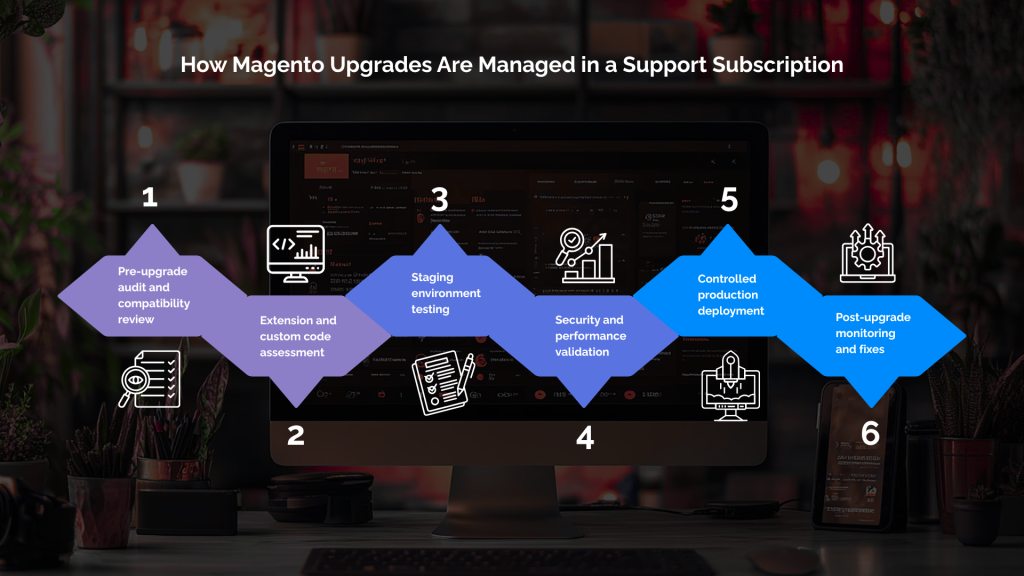
With ongoing Magento maintenance:
- Upgrades are planned instead of rushed
- Extensions are tested and updated proactively
- Compatibility issues are resolved early
- Staging environments are used properly
- Production deployments are controlled and monitored
This reduces downtime and ensures smoother Magento upgrades and patches.
Before planning any version update, merchants should follow a structured Magento 2 upgrade checklist for secure and predictable updates to avoid compatibility and deployment issues.
Proactive Magento Monitoring and Downtime Prevention
Magento site downtime is expensive. Even short outages can lead to lost revenue, failed orders, and damaged brand reputation.
What Magento Monitoring Services Include
Proactive monitoring services typically cover:
- Uptime monitoring
- Error log tracking
- Performance degradation alerts
- Magento site error detection
- Integration failure notifications
Instead of discovering issues from customers, your team is alerted early.
Modern Magento monitoring also includes frontend stability checks, such as testing cumulative layout shift as part of ongoing Magento performance optimization.
The Business Impact of Proactive Monitoring
Monitoring allows your support team to:
- Fix Magento site errors before they escalate
- Prevent extended Magento site downtime
- Identify performance regressions early
- Maintain consistent customer experience
This is especially important during peak traffic periods and sales events.
Why Growing Merchants Choose Subscription Magento Support
The subscription model continues to grow in 2026 for a reason.
Cost Efficiency Compared to Full Time Developers
Hiring a full-time Magento developer involves:
- Salary
- Benefits
- Onboarding time
- Limited availability
- Single point of failure
Subscription Magento managed services provide access to a team of specialists at a fraction of the cost.
Knowledge Continuity and Long-Term Stability
With ongoing support:
- Your Magento codebase is continuously understood
- Documentation improves over time
- Fewer repeated issues occur
- Optimization becomes strategic, not reactive
This continuity is difficult to achieve with rotating freelancers or one-off contracts.
AI Powered and Automated Magento Maintenance
Automation and AI are increasingly part of Magento support workflows.
Where Automation Adds Real Value
Automated Magento maintenance supports:
- Proactive monitoring and alerts
- Routine health checks
- Log analysis and anomaly detection
- Repetitive Magento troubleshooting tasks
This allows human experts to focus on strategic optimization rather than repetitive fixes.
AI Powered Magento Support Does Not Replace Experts
AI enhances Magento support, but it does not replace experienced developers. Strategic decisions, complex bug fixing, and upgrade planning still require deep Magento expertise.
The best support models combine automation with human oversight.
Common Magento Problems Solved by Ongoing Support
An optimized support plan addresses recurring merchant challenges:
- Fix slow Magento store performance
- Resolve Magento 2 performance issues
- Handle Magento bug fixing efficiently
- Prevent Magento site errors
- Reduce Magento store downtime
- Address Magento upgrade problems early
- Maintain extension compatibility
- Protect against Magento store security issues
Over time, these improvements compound into a more stable and scalable store.
How to Choose the Right Magento Support and Maintenance Partner
Not all Magento support plans are equal.
What to Look For in 2026
A strong Magento support provider should offer:
- Subscription based pricing
- Proactive monitoring and audits
- Clear upgrade and patching processes
- Performance optimization expertise
- Security first approach
- Transparent communication and reporting
Red Flags to Avoid
Be cautious of providers who:
- Only offer reactive ticket support
- Avoid audits or documentation
- Do not provide monitoring
- Lack upgrade experience
- Offer unclear or variable pricing
Final Thoughts: Magento Support as a Growth Strategy
Magento support and maintenance is no longer just about keeping the site running. It is about enabling growth, protecting revenue, and reducing operational risk.
An optimized, subscription-based Magento care solution gives growing merchants:
- Predictable costs
- Expert technical support
- Proactive performance and security management
- Stress-free upgrades
- Peace of mind without full-time staffing
If your Magento store is growing, your support model must grow with it.
FAQs
What does Magento support and maintenance include in 2026
Magento support and maintenance includes security updates, performance optimization, audits, monitoring, bug fixing, extension updates, and planned upgrades.
Is subscription Magento support better than hourly support
Yes. Subscription support offers predictable costs, proactive care, and long-term stability compared to reactive hourly services.
How often should Magento security updates be applied
Security updates should be applied as soon as possible after release, following testing in a staging environment.
Can Magento performance issues be fixed permanently
Performance optimization is ongoing. Regular monitoring and tuning are required as the store evolves.
Do small and mid-size merchants need Magento managed services
Yes. Managed services allow growing merchants to access expert support without the cost of full-time developers.