

















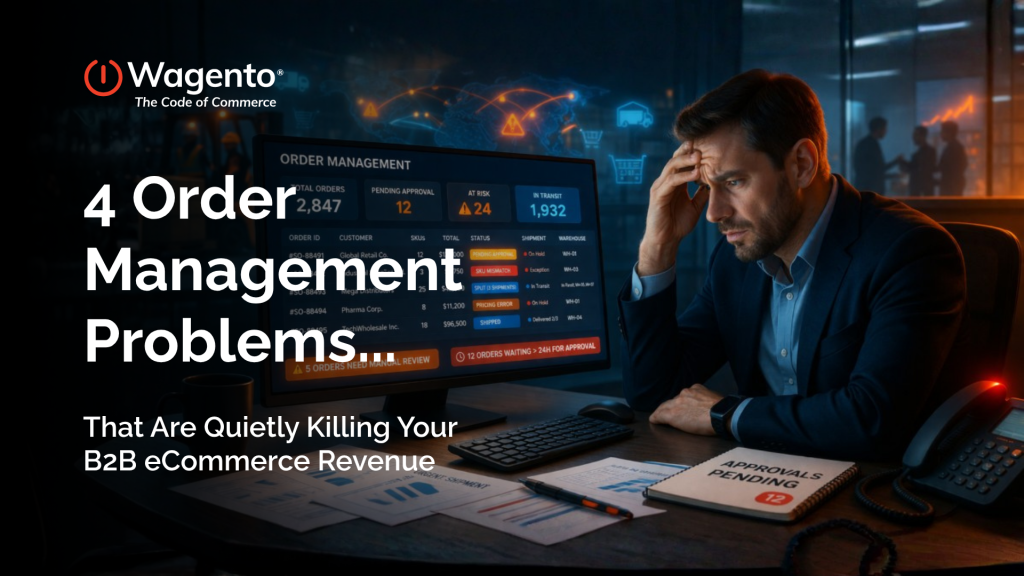
If your operations team spends part of every morning correcting orders before they go out the door, you are not alone — but you are losing money that you do not have to lose.
Order management sits at the heart of every B2B eCommerce operation. When it works well, orders flow from purchase to fulfillment without friction. When it breaks down — through manual corrections, fragmented tracking, or stalled approvals the cost compounds silently across every department: operations, sales, finance, and customer support.
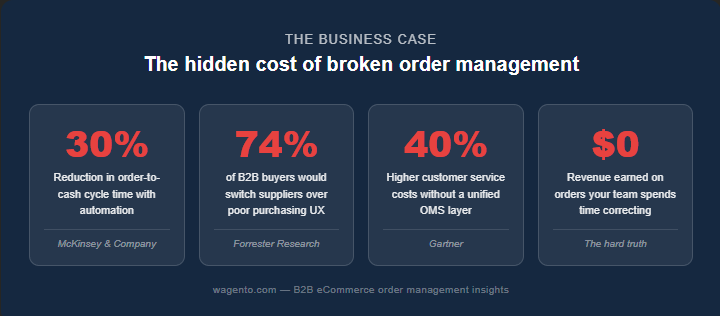
According to McKinsey & Company, companies that digitize and automate their core operational workflows reduce order-to-cash cycle times by up to 30%. Yet many mid-market and enterprise B2B sellers continue running order management processes that were designed for a different era.
This post breaks down the four most damaging order management problems we see across B2B eCommerce operations and the practical path to solving each one.
The Real Cost of a Broken Order Management Workflow
Before diving into specific problems, it is worth naming what broken order management actually costs your business.
It is not just the staff time spent on corrections or the support calls from confused buyers. The deeper cost is strategic: every manual intervention, every delayed fulfillment, and every friction-filled reorder experience chips away at buyer loyalty in a market where your competitors are investing heavily in making purchasing frictionless.
Forrester Research has reported that 74% of B2B buyers would switch suppliers if the purchasing experience is difficult. That is not a small risk — it is an existential one for companies that depend on repeat business.
The good news is that every problem below is solvable with the right platform architecture and implementation partner.
Problem 1: Manual Order Corrections Are Draining Your Operations Team

The pain: Wrong SKUs, outdated pricing, or missing shipping rules force staff to manually edit orders before fulfillment — every single day.
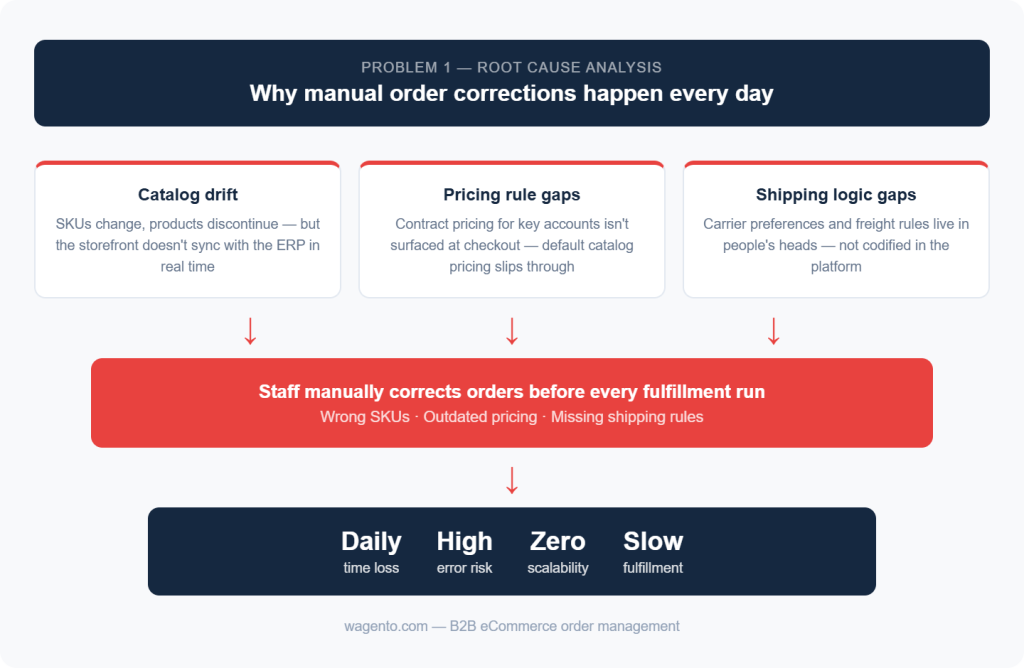
This is perhaps the most widespread and quietly accepted form of operational waste in B2B eCommerce. It typically looks like this: an order comes in with a SKU that has been discontinued, a price that reflects last quarter’s contract rate, or a shipping rule that does not account for the buyer’s agreed-upon carrier preference. Someone on your operations team catches it, corrects it manually, and moves on. And then it happens again tomorrow.
The underlying causes are almost always structural:
- Product catalog drift: SKUs change, products are discontinued, and variants are added — but the buyer-facing catalog does not stay in sync with the backend ERP or inventory system in real time.
- Pricing rule gaps: Contract pricing for key accounts is not surfaced dynamically at checkout, so default catalog pricing slips through.
- Shipping logic that lives in someone’s head: Carrier preferences, freight rules, and regional shipping constraints are not codified into the platform — they rely on institutional knowledge that is impossible to scale.
The Fix
The solution is not to hire more people to catch errors. It is to eliminate the conditions that produce the errors in the first place.
On Adobe Commerce, for example, customer group-specific pricing, dynamic shipping rules, and real-time catalog validation can be configured so that orders which do not meet fulfillment requirements are flagged — or corrected automatically — before they are even submitted. When integrated properly with your ERP, the platform becomes the single source of truth for SKUs, pricing, and shipping logic rather than a front-end layer that has to be corrected downstream.
At Wagento, our eCommerce development services include deep integration work that connects your storefront directly to your ERP and OMS, ensuring that what a buyer sees at checkout reflects what your operations team can actually fulfill — without the daily correction queue.
Problem 2: Split Order Chaos Is Confusing Your Buyers and Your Team

The pain: Large B2B orders fulfilled from multiple warehouses create fragmented tracking, duplicate invoices, and confused buyers.
Multi-location fulfillment is a reality for most mid-market and enterprise B2B sellers. A single order might include items that ship from three different warehouses, with different lead times, different carriers, and different invoicing rules. Managed well, this is invisible to the buyer. Managed poorly, it becomes a customer service crisis.
The most common failure modes:
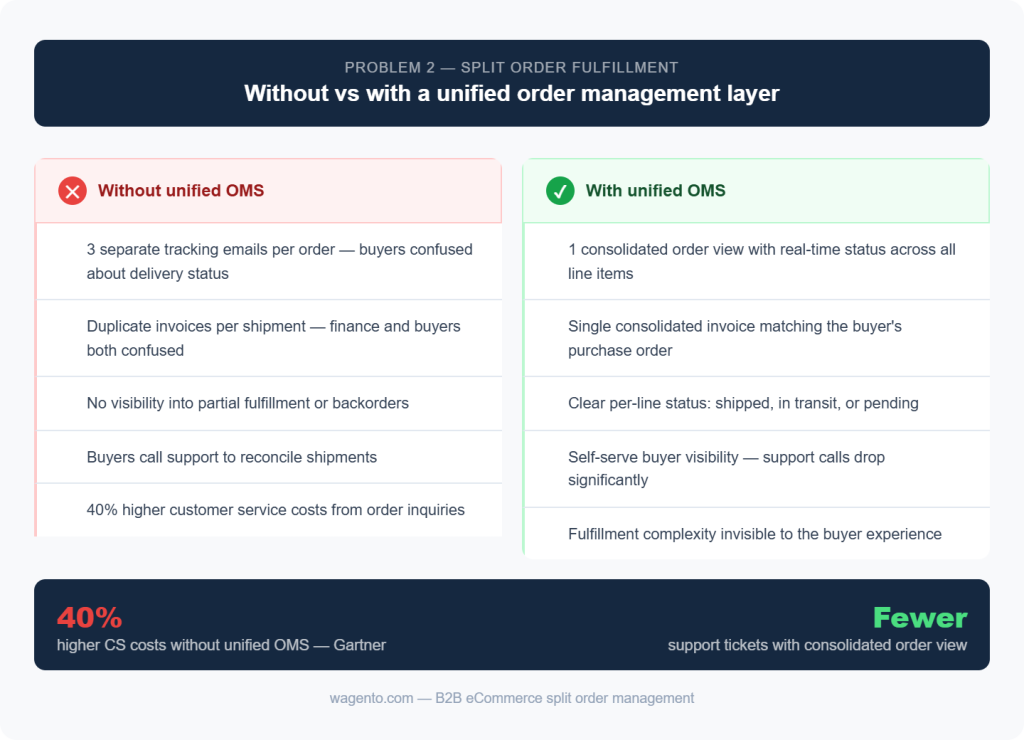
- Fragmented tracking: Buyers receive three separate tracking numbers with no unified view of their order status. They call support. Support spends time reconciling shipments across systems.
- Duplicate or split invoices: Finance generates separate invoices per shipment, which creates confusion for buyers who expected a single invoice matching their purchase order.
- No visibility into partial fulfillment: Buyers have no way to know whether their order is partially fulfilled, when the remaining items will ship, or whether a backorder situation exists.
This is not just a buyer experience problem. According to Gartner, companies without a unified order management layer report 40% higher customer service costs associated with order inquiries. When your support team is spending time explaining split shipments instead of building relationships, the operational cost of poor order management becomes very clear.
The Fix
The answer is a unified order management layer that presents a consolidated view of every order — regardless of how many fulfillment nodes it touches.
This means the buyer sees a single order record with real-time status across all line items, a consolidated invoice, and clear visibility into which items have shipped, which are in transit, and which are pending. Behind the scenes, warehouse assignments, carrier selection, and invoicing rules operate automatically based on inventory availability and fulfillment logic configured in the platform.
Wagento has implemented split-order fulfillment architectures for B2B clients that handle thousands of SKUs across multiple warehouse locations. The result is a fulfillment process that is operationally complex but experientially simple — for both the buyer and the internal team. You can explore our B2B eCommerce work to see how we have approached similar challenges.
Problem 3: Reorder Friction Is Costing You Repeat Revenue

The pain: Repeat buyers cannot quickly reorder from past purchases. They rebuild carts manually each time, increasing error rates and support calls.
Repeat business is the lifeblood of B2B commerce. Most B2B sellers derive the majority of their revenue from a relatively small number of buyers who purchase regularly and predictably. If those buyers find the reordering process difficult, the risk of churn — or of a competitor offering a better experience — increases dramatically.
The friction points most commonly reported by B2B buyers:
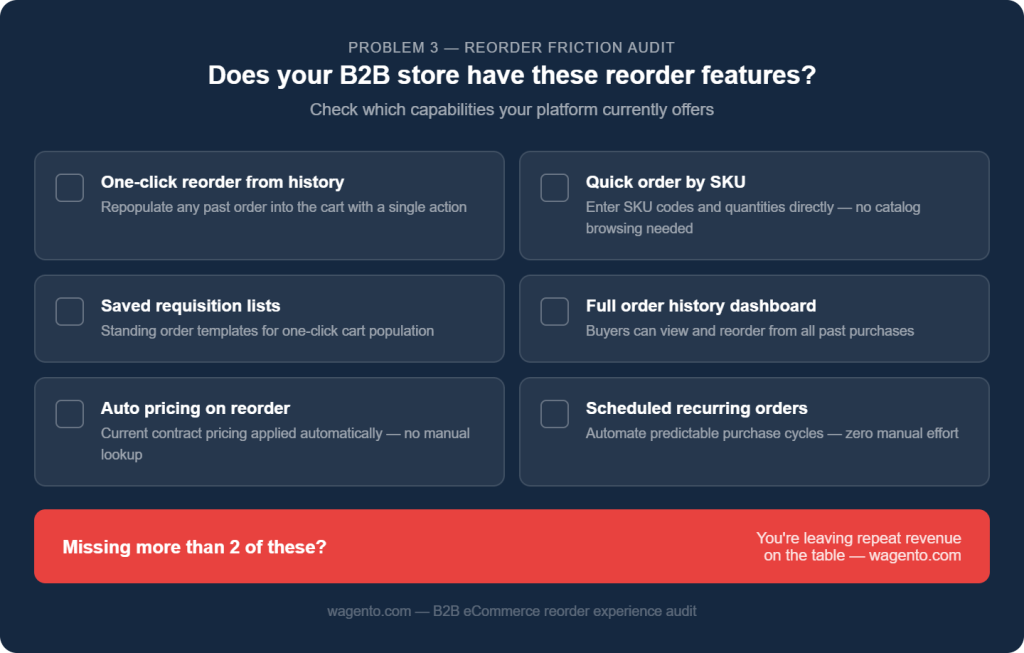
- No reorder from order history: Buyers must navigate back to the product catalog, search for each item, verify quantities, and rebuild their cart from scratch — even for an order they place every two weeks.
- Quantity and SKU errors: Manual cart rebuilding introduces errors. Buyers select the wrong variant or enter the wrong quantity, creating a downstream correction cycle.
- No quick order by SKU: Buyers who know exactly what they want — because they order it every month — have no mechanism to enter a list of SKUs directly and check out, without clicking through the catalog.
- No saved requisition lists: There is no way to save a standard order as a template for one-click reordering.
Adobe’s B2B Commerce research consistently shows that purchasing convenience is the top driver of platform loyalty among B2B buyers. When reordering is easy, buyers do not evaluate alternatives. When it is hard, they start looking.
The Fix
Modern B2B eCommerce platforms — when configured correctly — offer multiple mechanisms to make reordering frictionless:
- Reorder from order history: A single click to repopulate a previous order into the cart, with current pricing applied automatically.
- Quick order by SKU: A dedicated interface where buyers enter SKU codes and quantities directly, bypassing the catalog entirely for buyers who know exactly what they need.
- Requisition lists: Saved lists that function as standing order templates, enabling one-click cart population for recurring purchases.
- Scheduled ordering: For truly predictable purchase cycles, automated order scheduling removes the need for manual reordering entirely.
These are not advanced custom features — they are native capabilities in Adobe Commerce B2B that are frequently left unconfigured because implementation teams did not prioritize the buyer workflow during initial build. Wagento’s B2B eCommerce expertise includes a full audit of buyer workflows to ensure these features are activated and optimized for your specific buyer personas.
If your reorder process currently requires your buyers to do more than two clicks, you are leaving repeat revenue on the table.
Problem 4: Approval Bottlenecks Are Delaying Fulfillment and Frustrating Buyers

The pain: Multi-level purchase approvals lack automated routing. Orders sit idle waiting for sign-off, delaying fulfillment and frustrating buyers.
Purchase approval workflows are a non-negotiable requirement for most enterprise B2B buyers. Corporate purchasing policies require that orders above a certain value — or within certain product categories — receive sign-off from a manager, a procurement officer, or a finance team before fulfillment is triggered. This is entirely reasonable. The problem is how most B2B eCommerce platforms handle it.
In many implementations, approval workflows are manual: an order is submitted, a notification goes to a manager’s email, the manager logs in to review it (if they remember), approves or rejects it, and the buyer is notified. Meanwhile, the fulfillment clock has not started — and in many cases, the buyer has no visibility into where their order stands in the approval queue.
The operational consequences are significant:
- Orders sit idle for hours or days while approvals are pending, delaying fulfillment commitments.
- Buyers call support to check status because they have no visibility into the approval process.
- Approvers are a bottleneck when approval logic is not tiered — a $500 order and a $50,000 order go through the same approval chain.
- Rejected orders create confusion when buyers are not clearly notified or given guidance on how to revise and resubmit.
According to Harvard Business Review, procurement friction is among the top three reasons B2B buyers report dissatisfaction with a supplier’s purchasing experience. Approval bottlenecks are a direct and measurable contributor to that friction.
The Fix
The solution is automated approval routing with buyer-facing visibility — not manual email chains.
A well-configured B2B approval workflow includes:
- Role-based approval routing: Orders are automatically routed to the correct approver based on the buyer’s company hierarchy, order value, and product category — without manual intervention.
- Tiered approval thresholds: Orders below a defined value threshold are auto-approved. Orders above threshold route to the appropriate level automatically.
- Buyer-facing status visibility: Buyers can see exactly where their order stands in the approval queue — pending, approved, or rejected — from within their account dashboard.
- Approver notifications: Approvers receive structured notifications with all relevant order details and can approve or reject directly from a link, without navigating the platform.
- Rejection workflows: Rejected orders return to the buyer with clear reasoning and the ability to modify and resubmit.
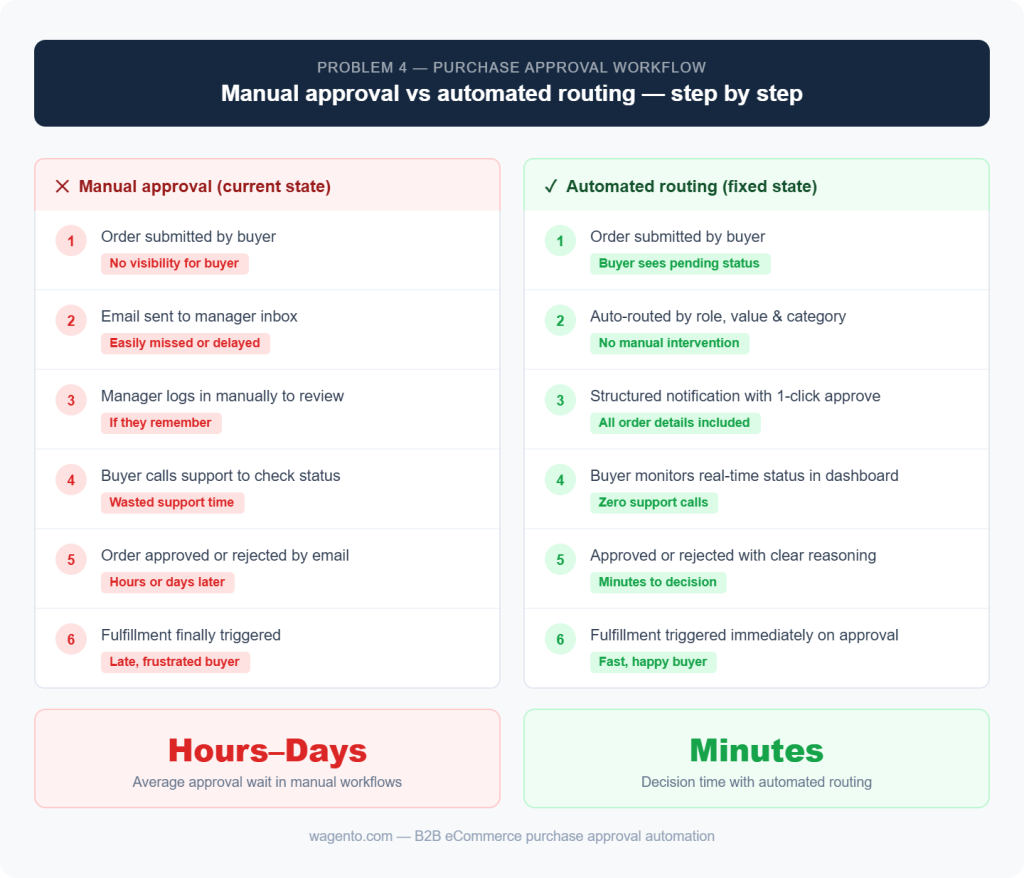
Adobe Commerce’s native B2B approval workflow capabilities support all of these patterns when properly configured. Wagento has implemented approval workflows for enterprise B2B clients with purchase hierarchies spanning dozens of buyer roles and multiple approval tiers. The result is a process that enforces corporate purchasing policy without creating operational paralysis.
Learn more about how we approach B2B eCommerce implementation for enterprise clients with complex purchasing workflows.
The Common Thread: Operational Complexity That the Platform Should Be Handling
Each of the four problems described above shares a common root cause: operational complexity that has been left to people to manage instead of being encoded into the platform.
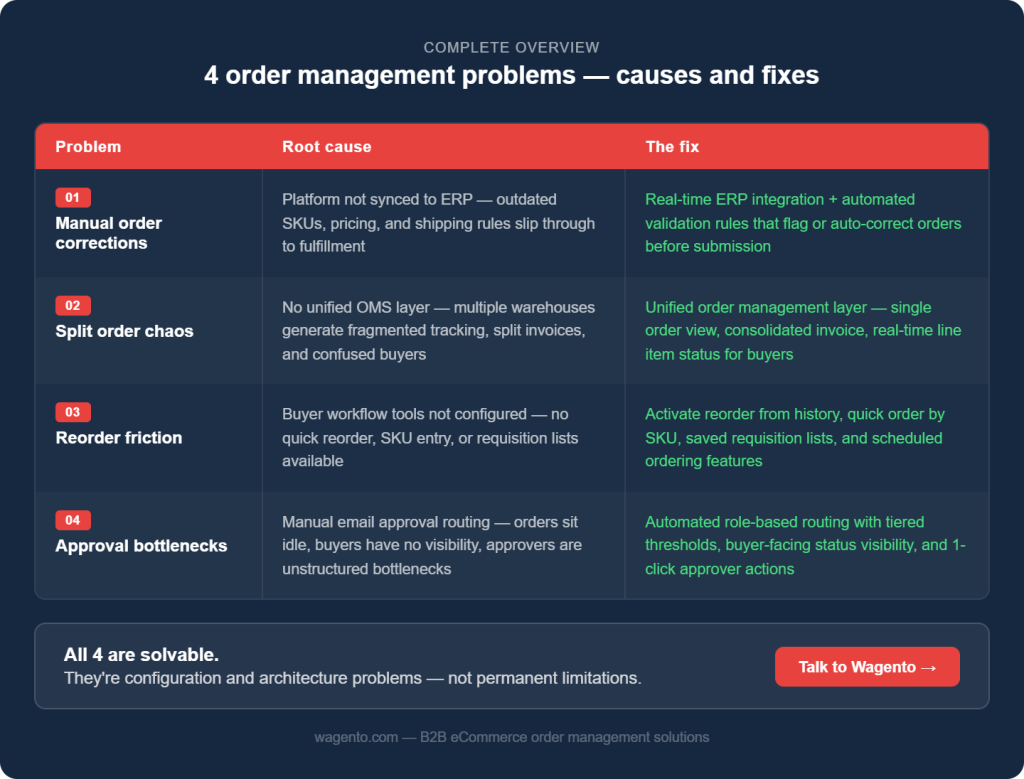
Manual order corrections happen when the platform is not the single source of truth for pricing, SKUs, and shipping rules. Split order chaos happens when there is no unified order management layer. Reorder friction happens when buyer workflow features are not activated or optimized. Approval bottlenecks happen when routing logic is not automated.
None of these are unsolvable problems. They are configuration and architecture problems — and they have clear, implementable solutions within modern B2B eCommerce platforms.
The organizations that resolve them gain a meaningful competitive advantage: faster fulfillment, lower operational cost, and a buyer experience that creates loyalty rather than eroding it.
What to Do Next
If any of the four problems described in this post are affecting your operation today, the first step is an honest audit of where the friction lives. Is it in your catalog and pricing data? In your fulfillment routing? In your buyer-facing account tools? In your approval configuration?
Wagento has spent over a decade helping B2B eCommerce businesses identify and resolve exactly these kinds of operational friction points — across Adobe Commerce, Shopify Plus, BigCommerce, and other enterprise platforms. Our approach combines platform expertise with a deep understanding of B2B buyer behavior, so the solutions we build actually solve the business problem rather than just checking a technical box.
If you are ready to take a hard look at your order management workflow, start a conversation with our team. We will help you identify where the biggest opportunities are and what it would take to capture them.
Frequently Asked Questions
B2B order management in eCommerce refers to the end-to-end process of receiving, processing, routing, fulfilling, and tracking orders placed by business buyers. Unlike B2C order management, B2B order management must handle additional complexity such as account-specific pricing, multi-location fulfillment, purchase approval workflows, and custom invoicing requirements.
Manual corrections typically occur when the eCommerce platform is not fully integrated with the ERP or inventory system, resulting in outdated pricing, discontinued SKUs, or missing shipping rules that staff must correct before fulfillment. Resolving this requires deep platform-ERP integration and real-time data synchronization.
Adobe Commerce includes native B2B functionality that supports configurable purchase approval workflows, including order value thresholds, role-based routing, buyer-facing status visibility, and approver notifications. These features require proper configuration to match a company’s purchasing policy and organizational hierarchy.
Split order fulfillment occurs when items in a single order ship from multiple warehouse locations. It can be managed effectively through a unified order management layer that consolidates tracking, invoicing, and status updates for the buyer — making the operational complexity invisible at the buyer experience level.
Platforms like Adobe Commerce B2B include features such as reorder from order history, quick order by SKU, requisition lists, and order scheduling that allow repeat buyers to repurchase without rebuilding their cart manually. These features must be activated and optimized for the specific buyer workflows of each business.
Wagento is a full-service eCommerce agency specializing in B2B and enterprise commerce on Adobe Commerce, Shopify Plus, and BigCommerce. Our team has implemented order management solutions for clients across manufacturing, distribution, healthcare, and professional services. Get in touch to learn what we can do for your business.