 Manufacturing and Distribution
 Firearms
 Automotive and OEMs
 Healthcare & Life Sciences
 Sports & Outdoor Hunting Gear
 Regulated Industries eCommerce
 Adobe Commerce
 BigCommerce
 Magento
 myMagento
 WooCommerce
 Shopify Plus
 Shopware
 Magento 1 to Magento 2 Migration
 Magento Upgrade Service
 Magento Design
 Magento B2B
 Magento Hosting
 Magento Consulting
 Magento eCommerce Developers
 Magento SEO
 Magento Integration
 Magento Speed & Performance Optimization
 eCommerce Development
 Headless Commerce
 eCommerce GrowthX
 B2B CRO Services
 Enterprise SEO Services
 Email Marketing
 Website Localization Services
 AEO, GEO and AI Search
 AI Tools for Business
 Data Analytics Services
 GrowthX Strategy & Consultancy
 eCommerce Integration
 CRM Integrations
 Accounting Software Integrations
 ERP Integrations
 PIM Integrations
 Payment Gateways Integrations
 Tax Platform Integrations
 eCommerce Site Migrations
 Project Rescue
 Hire Developers
 Free Audit Report
 Extensions & Applications
 Custom Applications for eCommerce
 Magento Extensions
 Security & Fraud Prevention
 User Interface & Experience
 Website Design Services
 Support & Maintenance
 About Us
 Blog
Blog Webinars
 News & Updates
 Downloads
 FAQs
FAQs The Wagento Difference
 Hyvä
Hyvä iPaaS
iPaaS Klaviyo
 Sales Layer
 Sift
Sift Dot Digital
 Nousmedis
 Call
Call Message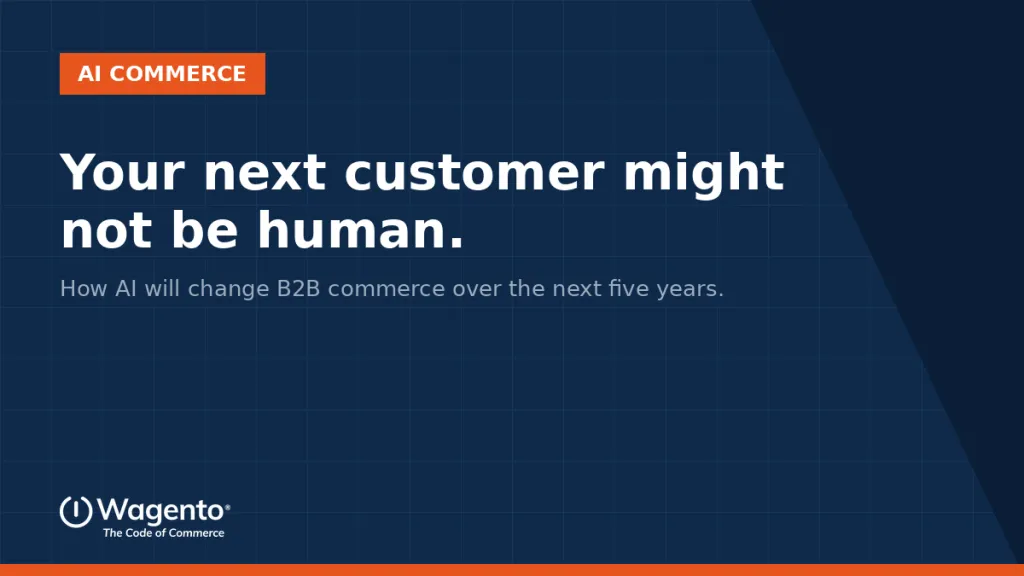
Your next customer might not be a person.
It is already normal for a procurement manager to open ChatGPT, describe what they need, and ask for a shortlist of suppliers, before they ever visit a website or call a rep. The AI reads specs, compares options, and hands over three names. If you are one of the three, you are in the deal. If you are not, you never knew the deal existed.
That is today. Over the next five years, this gets more dramatic, not less. Here is what is coming, without the hype, and what a manufacturer or distributor should actually do about it now.
Five shifts coming to B2B commerce
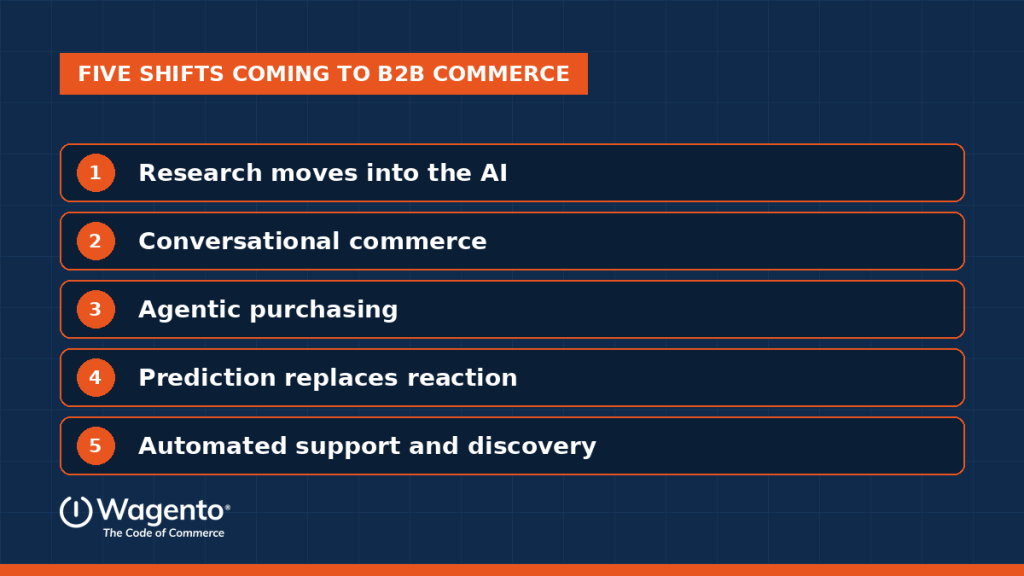
1. Research moves into the AI, and you either show up or you don’t
Buyers already start in AI tools. Soon that will be the default first step for nearly every purchase. The shortlist forms inside a conversation you cannot see, and being invisible there is the new being on page two of Google, except there is no page two to climb to.
2. Conversational commerce becomes normal
Buyers will increasingly interact with your store by asking, not clicking. ‘Show me what is compatible with this model, in stock, that ships this week.’ Stores that can answer that in plain language will win; stores that force buyers through category trees will feel broken.
3. Agentic purchasing arrives
The step beyond AI that answers questions is AI that takes action: reordering, replenishing, placing routine purchases within rules a human set. For predictable B2B reordering, this is a natural fit, and it means your systems may soon be selling to other systems, machine to machine, with no human in the loop for routine orders.
4. Prediction replaces reaction
AI applied to your own data can forecast demand, flag stockouts before they happen, and suggest pricing moves. But this only works if the data is clean and connected, which is why the boring work of the last two blogs is the foundation for the exciting work of this one.
5. Support and discovery get automated
Routine ‘is this in stock, what is compatible, where is my order’ questions get handled by AI, freeing your people for the judgment calls and relationships that machines cannot do. The sales team does not shrink; it moves up the value chain.
The honest catch: AI amplifies your foundation
Here is the part the breathless AI content leaves out. None of this works on a broken foundation. An AI agent given bad inventory data will confidently sell you things you cannot ship. A conversational store built on a thin catalog will give confidently wrong answers. Agentic purchasing on top of a disconnected stack automates the mistakes.
Bad data in, smarter problems out. The companies that win with AI over the next five years will not be the ones who bought the most AI. They will be the ones whose product data was clean, whose systems were connected, and whose content was honest enough for a machine to trust. AI does not fix a weak commerce operation. It exposes one.
Five things to do this quarter
✓ Structure your product data so machines can read it. This is the single highest-leverage AI-readiness move, and it pays off in regular search too.
✓ Publish real answers: specs, documentation, honest comparisons. Brochure content does not get cited by AI; specific, verifiable content does.
✓ Connect your systems so any future AI has accurate data to act on. AI on a disconnected stack is a liability, not an asset.
✓ Baseline your AI visibility now. Ask ChatGPT, Perplexity, and Google AI Mode about your category and your company this month. Screenshot it. You cannot improve what you have not measured.
✓ Pick one process to pilot AI on this quarter, measure it honestly, and learn. Start where the risk is low and the data is good.
Where to start
Our GrowthX visibility review shows you exactly what AI engines say about your company today, where you are invisible, and what to fix first, so you are in the answer when your buyers ask.
Book a discovery call: Contact Us | +1 (612) 594-7699
FAQs
Yes. It is already common for buyers to research suppliers, compare products, and build shortlists in AI tools before contacting anyone. Recent surveys show the large majority of business buyers now use AI somewhere in their purchase process, and that share is climbing.