
 Manufacturing and Distribution
 Firearms
 Automotive and OEMs
 Healthcare & Life Sciences
 Sports & Outdoor Hunting Gear
 Regulated Industries eCommerce
 Adobe Commerce
 BigCommerce
 Magento
 myMagento
 WooCommerce
 Shopify Plus
 Shopware
 Magento 1 to Magento 2 Migration
 Magento Upgrade Service
 Magento Design
 Magento B2B
 Magento Hosting
 Magento Consulting
 Magento eCommerce Developers
 Magento SEO
 Magento Integration
 Magento Speed & Performance Optimization
 eCommerce Development
 Headless Commerce
 eCommerce GrowthX
 B2B CRO Services
 Enterprise SEO Services
 Email Marketing
 Website Localization Services
 AEO, GEO and AI Search
 AI Tools for Business
 Data Analytics Services
 GrowthX Strategy & Consultancy
 eCommerce Integration
 CRM Integrations
 Accounting Software Integrations
 ERP Integrations
 PIM Integrations
 Payment Gateways Integrations
 Tax Platform Integrations
 eCommerce Site Migrations
 Project Rescue
 Hire Developers
 Free Audit Report
 Extensions & Applications
 Custom Applications for eCommerce
 Magento Extensions
 Security & Fraud Prevention
 User Interface & Experience
 Website Design Services
 Support & Maintenance
 About Us
 Blog
Blog Webinars
 News & Updates
 Downloads
 FAQs
FAQs The Wagento Difference
 Hyvä
Hyvä iPaaS
iPaaS Klaviyo
 Sales Layer
 Sift
Sift Dot Digital
 Nousmedis
 Call
Call Message
One product. Three departments. Three different versions of the truth.
Sales has a spec sheet from 2023. The website has whatever got typed in at launch. The ERP has the number that actually ships. All three describe the same product, and no two of them agree. Multiply that across ten thousand SKUs and you do not have a catalog. You have a rumor.
Product data is the least glamorous thing in ecommerce and quietly one of the most important. Nobody puts ‘fix the product data’ on a strategy slide. But it decides more of your outcomes than your platform choice does, and here is the part that matters in 2026: the machines deciding whether to recommend you are reading your product data, not your marketing copy.
Six places product data decides the outcome
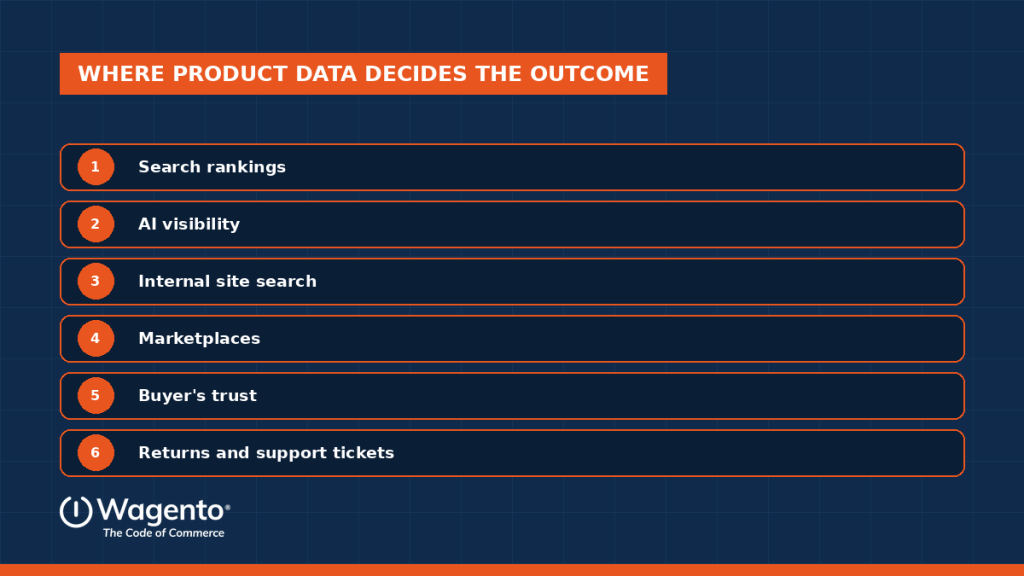
Most teams think of product data as ‘the stuff on the product page.’ It is far more load-bearing than that. It quietly determines at least six things:
- Search rankings. Complete, structured product data is what search engines use to understand and rank your pages. Thin data ranks thin.
- AI visibility. When a buyer asks an AI to compare products, the AI reads structured specifications, not your brand story. Missing attributes mean you are invisible in the answer.
- Internal search. The single highest-intent action on your site is someone using your own search box. If your data is missing the attributes they filter by, your best buyers hit a dead end on your own store.
- Marketplaces. Every marketplace has data requirements. Incomplete data means rejected listings or buried products.
- Buyer’s trust. A spec that turns out to be wrong does not just cause one return. It teaches that buyer to call and verify everything, forever, which defeats the entire point of self-service.
- Returns and tickets. A huge share of B2B returns and support tickets trace back to a product detail that was missing, wrong, or ambiguous. Your catalog quality is a customer service budget line, whether or not anyone measures it that way.
The spreadsheet ceiling
Almost every company manages product data in spreadsheets at the start, and it works, right up until it doesn’t. The ceiling arrives somewhere in the low thousands of SKUs, or the moment you add a second sales channel, or a second language, or a second brand. Suddenly the same product needs to exist in six places, and the spreadsheet that held it together becomes the thing tearing it apart.
You can always spot a company that hit the ceiling: they have a person, sometimes a whole team, whose real job is copying product information from one system into another and praying nothing got missed. That is not data management. That is data babysitting, and it does not scale.
What a PIM actually does
A PIM, or product information management system, is one source of truth for product data. You manage each product once, and the PIM publishes it everywhere: the website, every language, every marketplace, the sales team’s tools. Change a spec in one place, and it updates everywhere the product appears.
We implement Sales Layer for exactly this. The value is not the software; it is what disappears once it is in place. The reconciliation meetings disappear. The ‘which version is right’ arguments disappear. The person babysitting spreadsheets goes back to real work. And your catalog becomes something a machine can actually read, which is the difference between showing up in an AI comparison and being invisible in it.
This connects directly to how we build. Product data feeds from the PIM, systems connect through an integration layer, and the storefront reflects one clean source instead of six drifting ones. Fewer moving parts, less that can go wrong, a catalog you can trust.
Five signs your product data is holding you back
✓ Buyers regularly filter for something you sell and get no results, because the attribute is missing.
✓ The same product has different specs on your site, your sales sheets, and your ERP.
✓ You have duplicate SKUs nobody is willing to delete because nobody is sure which is real.
✓ A product update takes weeks to appear everywhere it needs to.
✓ Someone on your team spends most of their week moving product data between systems by hand.
Where to start
A product data review is part of our B2B systems audit. We look at where your data lives, how many versions of it exist, and what it is costing you in lost search visibility and support load, before recommending whether a PIM is worth it for you.
Book a discovery call: Contact Us | +1 (612) 594-7699
FAQs
A PIM (product information management system) is a single source of truth for product data that publishes to every channel. You likely need one once you pass a few thousand SKUs, add multiple sales channels or languages, or find staff spending significant time manually syncing product information between systems.