
 Manufacturing and Distribution
 Firearms
 Automotive and OEMs
 Healthcare & Life Sciences
 Sports & Outdoor Hunting Gear
 Regulated Industries eCommerce
 Adobe Commerce
 BigCommerce
 Magento
 myMagento
 WooCommerce
 Shopify Plus
 Shopware
 Magento 1 to Magento 2 Migration
 Magento Upgrade Service
 Magento Design
 Magento B2B
 Magento Hosting
 Magento Consulting
 Magento eCommerce Developers
 Magento SEO
 Magento Integration
 Magento Speed & Performance Optimization
 eCommerce Development
 Headless Commerce
 eCommerce GrowthX
 B2B CRO Services
 Enterprise SEO Services
 Email Marketing
 Website Localization Services
 AEO, GEO and AI Search
 AI Tools for Business
 Data Analytics Services
 GrowthX Strategy & Consultancy
 eCommerce Integration
 CRM Integrations
 Accounting Software Integrations
 ERP Integrations
 PIM Integrations
 Payment Gateways Integrations
 Tax Platform Integrations
 eCommerce Site Migrations
 Project Rescue
 Hire Developers
 Free Audit Report
 Extensions & Applications
 Custom Applications for eCommerce
 Magento Extensions
 Security & Fraud Prevention
 User Interface & Experience
 Website Design Services
 Support & Maintenance
 About Us
 Blog
Blog Webinars
 News & Updates
 Downloads
 FAQs
FAQs The Wagento Difference
 Hyvä
Hyvä iPaaS
iPaaS Klaviyo
 Sales Layer
 Sift
Sift Dot Digital
 Nousmedis
 Call
Call Message
Why Modern Businesses Can No Longer Afford to Be Reactive
How expert support, continuous monitoring, and predictive maintenance protect revenue, performance, and trust in today’s digital-first economy.
Get Ahead of Website Issues Before They Impact Revenue
The State of Website Support in 2026
Website support and maintenance in 2026 looks nothing like it did even three years ago.
Modern websites are no longer static platforms. They are living systems connected to payment gateways, ERPs, CRMs, marketing automation tools, shipping providers, analytics stacks, and third-party APIs. A single failure in any part of this ecosystem can slow performance, break features, or take an entire business offline.
At the same time, customer tolerance for downtime has dropped sharply. Users do not distinguish between platform errors, plugin conflicts, or hosting issues. If the site does not work, trust erodes instantly.
This is why businesses are moving away from reactive ticket-based support and toward managed, proactive website support services that focus on prevention, not just resolution.
Reactive Support Is No Longer Enough
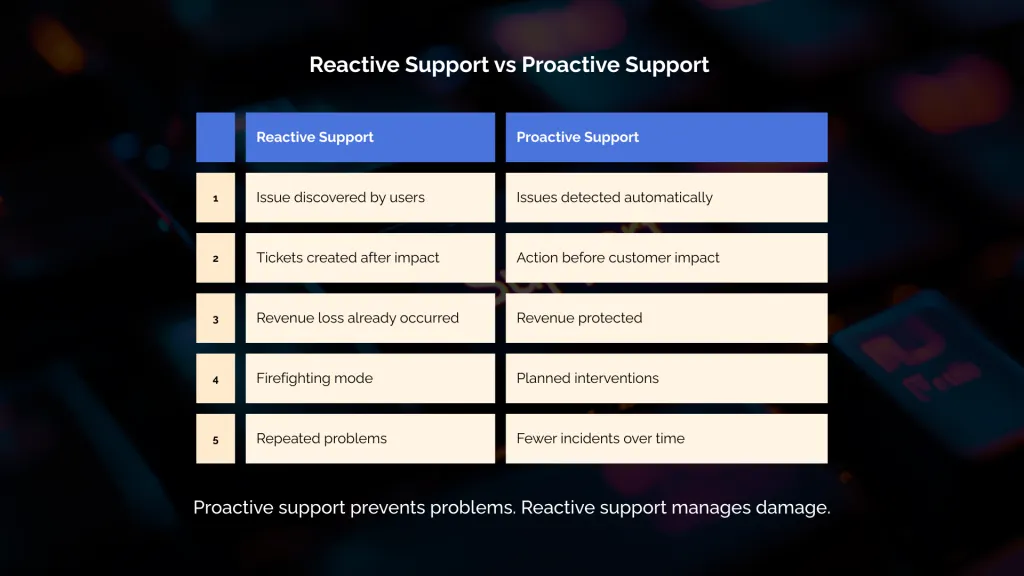
What Reactive Support Actually Looks Like
Reactive website support typically follows this pattern:
- A customer reports an issue
- A ticket is created
- A technician investigates
- A fix is applied
- The cycle repeats
While this model may close tickets, it does not reduce risk. In fact, it often increases it.
By the time an issue is visible, revenue has already been lost, performance has already dropped, or security has already been compromised.
The Hidden Costs of Waiting for Things to Break
Reactive support creates long-term damage that rarely shows up in a single report:
- Lost conversions due to slow or broken checkout flows
- SEO impact from recurring downtime or poor Core Web Vitals
- Security exposure from delayed patching
- Team burnout from constant firefighting
- Escalating maintenance costs caused by technical debt
These costs compound quickly due to scale, traffic volume, and system complexity.
What Proactive Website Support Really Means
Proactive support is not just faster response times or extended availability.
It is a fundamentally different operating model.
Continuous Monitoring Instead of Periodic Checks
Modern support teams use continuous monitoring across:
- Server health and resource usage
- Application performance
- Database behavior
- API response times
- Frontend user experience
- Background jobs and scheduled tasks
Problems are identified before users notice them.
Prevention Over Patchwork Fixes
Rather than applying isolated fixes, proactive support focuses on:
- Identifying recurring patterns
- Addressing root causes
- Reducing future incidents
- Stabilizing the platform over time
The goal is fewer incidents, not faster apologies.
AI-Driven Website Monitoring and Predictive Maintenance
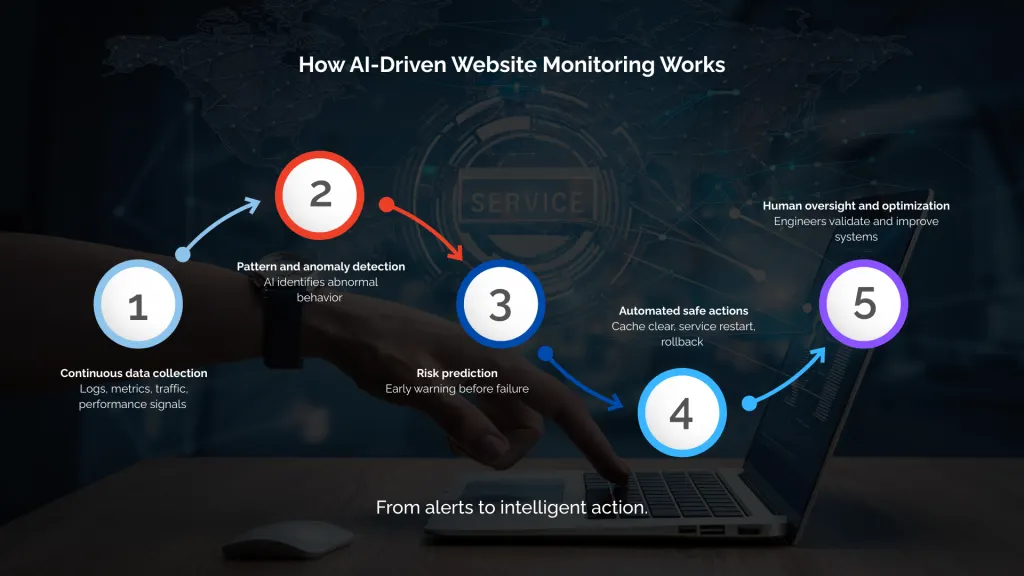
Why Manual Monitoring No Longer Scales
Human-led monitoring alone cannot keep up with modern systems. Platforms generate massive volumes of data across logs, metrics, and performance signals.
This is where AI-driven website monitoring changes the game.
How AI Improves Support in 2026
AI-powered systems analyze patterns such as:
- Gradual increases in server load
- Unusual traffic behavior
- Memory leaks
- API latency spikes
- Error rate deviations
Instead of reacting to failures, teams act on early warning signals.
Automated Issue Resolution with Human Oversight
In mature setups, AI can trigger safe automated actions such as:
- Restarting stalled services
- Clearing cache layers
- Scaling resources temporarily
- Rolling back faulty deployments
Humans remain in control, but they operate from a position of foresight rather than urgency.
AI already plays a growing role in anomaly detection, predictive alerts, and automated remediation across modern eCommerce platforms.
Performance Tuning Is Now a Continuous Discipline
Why Performance Degrades Over Time
Even well-optimized websites slow down over time due to:
- Growing databases
- New integrations
- Marketing scripts
- Seasonal traffic changes
- Feature additions
Performance tuning in 2026 is not a one-time project. It is an ongoing service. Performance must align with how Core Web Vitals are evaluated and optimized today, not with outdated speed benchmarks.
Metrics like First Contentful Paint help teams identify early performance degradation before users experience frustration.
What Continuous Performance Optimization Includes
- Query optimization and indexing
- Cache strategy refinement
- Frontend asset optimization
- API performance tuning
- Load pattern analysis
This ensures consistent speed, even as the business evolves.
Tools that measure layout stability, such as those used to test Cumulative Layout Shift, play a critical role in proactive performance monitoring.
Turn Website Maintenance into a Strategic Advantage
Security Patch Management Is a Business Risk, Not an IT Task
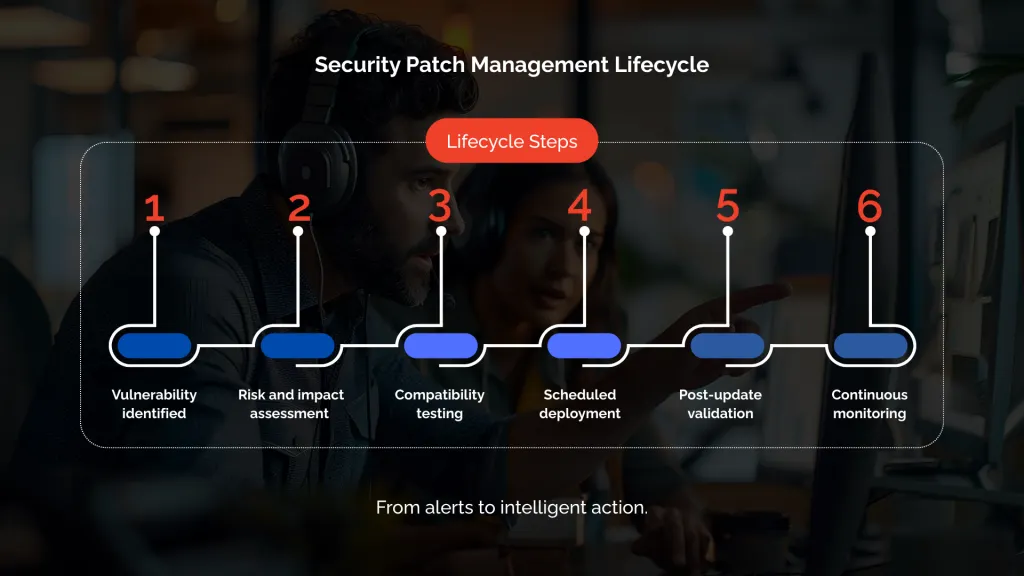
The Rising Frequency of Security Updates
Security patches are released more frequently than ever. Platforms, plugins, extensions, and libraries all introduce potential vulnerabilities.
Delaying updates increases exposure. Rushing updates increases risk of breakage.
Proactive Patch Management Solves Both Problems
A managed support team handles:
- Patch impact assessment
- Compatibility testing
- Scheduled deployments
- Rollback planning
- Post-deployment validation
Security becomes predictable, not stressful.
Many of today’s most common breaches still align with the web application security risks identified for 2025, especially when patching is delayed. Learn more about today’s most common and high-impact website security vulnerabilities.
Broken Features Are More Dangerous Than Downtime
Silent Failures Cost More Than Obvious Outages
Not all issues cause visible crashes. Many quietly damage revenue:
- Promotions not applying correctly
- Shipping rules misfiring
- Tax logic failing for certain regions
- Inventory sync delays
- Account-based pricing errors
These issues often go unnoticed for weeks without proactive monitoring.
Why Bug Fixing Must Be Continuous
Modern support includes:
- Behavioral monitoring
- Automated test coverage
- Regression detection
- Prioritized bug resolution
The result is a platform that behaves consistently under real-world conditions.
Supporting Composable Commerce in 2026
More Services Mean More Failure Points
Composable commerce stacks introduce flexibility, but they also introduce complexity.
Each service adds:
- New dependencies
- New versioning risks
- New integration points
Without unified support ownership, failures fall between vendors.
Why Composable Support Requires System-Level Thinking
Effective composable commerce support focuses on:
- End-to-end observability
- Cross-service accountability
- Centralized monitoring
- Clear escalation paths
Support teams must understand the entire system, not just individual components.
High Server Usage Is a Symptom, Not the Problem
Common Causes Behind Resource Spikes
High CPU or memory usage often stems from:
- Inefficient queries
- Poor caching
- Background job failures
- Traffic anomalies
- Integration bottlenecks
Scaling infrastructure without diagnosis only increases costs.
Proactive Troubleshooting Prevents Waste
A proactive team identifies and resolves the root cause before scaling becomes necessary.
The Risk of Outdated Plugins and Extensions
Why Plugin Neglect Creates Instability
Outdated plugins cause:
- Security vulnerabilities
- Performance degradation
- Compatibility conflicts
- Unexpected failures after core updates
Ongoing Extension Audits Are Essential
Mmature teams perform regular audits to:
- Remove unused extensions
- Replace abandoned tools
- Update safely
- Reduce platform complexity
Predictive Maintenance Is the Future of Website Support
From Incident Response to Forecasting
Predictive maintenance uses historical data to anticipate issues before they occur.
This includes:
- Traffic forecasting
- Capacity planning
- Risk scoring
- Maintenance scheduling
The Result Is Stability, Not Surprise
When issues are predicted, maintenance becomes planned work instead of emergency work.
What to Look for in a Proactive Support Partner
A true managed support partner should provide:
- 24/7 monitoring with intelligent alerts
- Dedicated support teams familiar with your stack
- Performance tuning and optimization
- Security patch management
- AI-assisted monitoring and diagnostics
- Clear reporting and accountability
Anything less is reactive support with a new label.
Work with a Team That Prevents Problems, Not Just
Frequently Asked Questions
Final Takeaway
In 2026, expert website support is not about fixing what breaks.
It is about ensuring things do not break in the first place.
Proactive support transforms maintenance from a cost into a competitive advantage.