 Manufacturing and Distribution
 Firearms
 Automotive and OEMs
 Healthcare & Life Sciences
 Sports & Outdoor Hunting Gear
 Regulated Industries eCommerce
 Adobe Commerce
 BigCommerce
 Magento
 myMagento
 WooCommerce
 Shopify Plus
 Shopware
 Magento 1 to Magento 2 Migration
 Magento Upgrade Service
 Magento Design
 Magento B2B
 Magento Hosting
 Magento Consulting
 Magento eCommerce Developers
 Magento SEO
 Magento Integration
 Magento Speed & Performance Optimization
 eCommerce Development
 Headless Commerce
 eCommerce GrowthX
 B2B CRO Services
 Enterprise SEO Services
 Email Marketing
 Website Localization Services
 AEO, GEO and AI Search
 AI Tools for Business
 Data Analytics Services
 GrowthX Strategy & Consultancy
 eCommerce Integration
 CRM Integrations
 Accounting Software Integrations
 ERP Integrations
 PIM Integrations
 Payment Gateways Integrations
 Tax Platform Integrations
 eCommerce Site Migrations
 Project Rescue
 Hire Developers
 Free Audit Report
 Extensions & Applications
 Custom Applications for eCommerce
 Magento Extensions
 Security & Fraud Prevention
 User Interface & Experience
 Website Design Services
 Support & Maintenance
 About Us
 Blog
 Webinars
 News & Updates
 Downloads
 FAQs
 The Wagento Difference
 Hyvä
 iPaaS
 Klaviyo
 Sales Layer
 Sift
 Dot Digital
 Nousmedis
 Call
 Message
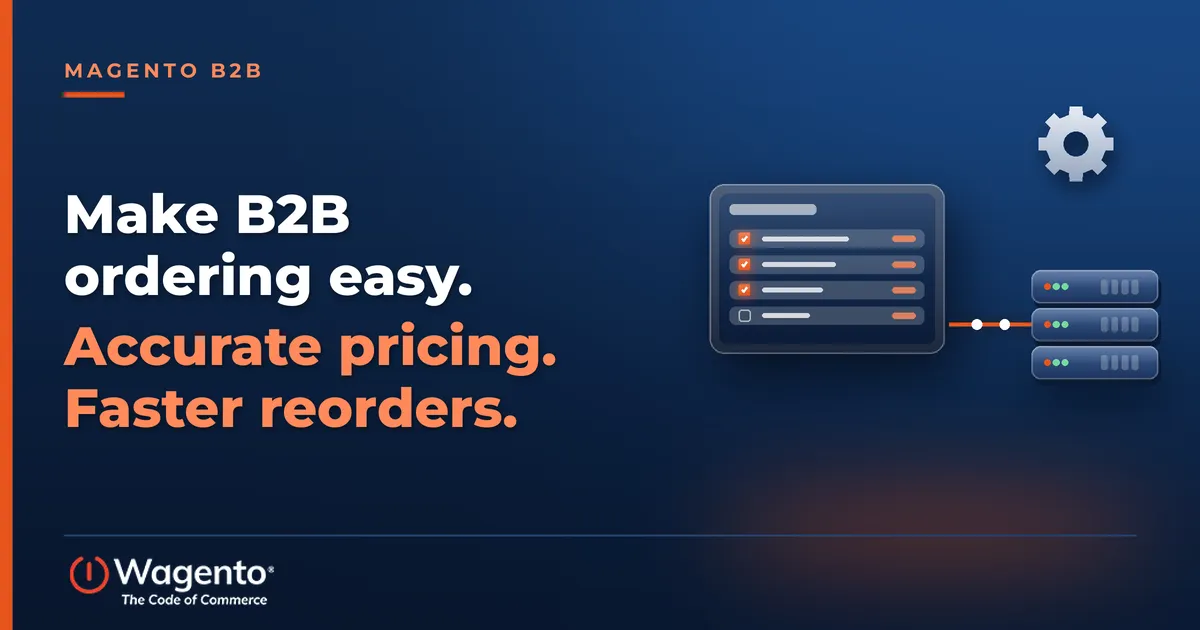
Make ordering easier for business customers while building on the systems you already run
Business buyers are consumers too. At home they order in a few taps; at work they still email spreadsheets, wait for quotes, and call to check stock. The distributors and manufacturers who close that gap win more repeat business with less effort.
Watsco, the largest HVAC/R distributor in North America, shows what that looks like at scale. Its contractors use 24/7 self-service with real-time inventory, pricing, and product information, and ecommerce reached $2.75 billion, or 37% of revenue, for the 12 months ended September 30, 2026. You do not need Watsco’s size to apply the same ideas. Magento gives B2B businesses the tools to start where they are.
What do business customers expect from a modern B2B ecommerce experience?
Most of all, they want to do things on their own schedule. A Gartner survey found that 61% of B2B buyers prefer a rep-free buying experience, while still valuing sellers for advice on fit and complex decisions. Forrester’s research adds that 94% of business buyers now use AI during their buying process.
In practice, B2B customers expect:
- Their own prices, catalogs, and payment terms as soon as they log in.
- Accurate stock and delivery dates.
- Fast reordering of the products they buy every month.
- Order history, invoices, and tracking in one place.
- Easy access to a person when they need advice.
How can online ordering make repeat purchases easier for customers and sales teams?
Repeat orders are the heart of most B2B businesses, so small improvements add up quickly. Adobe Commerce B2B includes Quick Order and Requisition Lists: buyers can order by SKU or upload a list, and keep saved lists for the products they buy again and again.
The benefit reaches your sales team too. When routine reorders move online, account managers spend their time on new opportunities, larger quotes, and the conversations where their expertise matters most.
Which self-service features can help customers access relevant products, pricing and account information?
| Feature | What the buyer gets |
| Company accounts with roles | Several people from one customer can buy, approve, and manage the account |
| Shared catalogs | The right products at the right prices for each company |
| Negotiable quotes | A clear, online way to ask for and agree on special pricing |
| Requisition lists and Quick Order | Faster repeat orders by list, SKU, or file upload |
| Order history and invoices | Answers without a phone call |
These features are part of Adobe Commerce B2B. Magento Open Source stores can add similar capabilities through extensions or custom development, which is often a sensible first step for smaller B2B programs.
How can Magento and ERP integration help teams work from more consistent order and inventory information?
Inconsistent information is one of the biggest frustrations for business buyers. Gartner found that 69% of B2B buyers report inconsistencies between what a supplier’s website says and what its sellers say.
Connecting Magento to your ERP solves this at the source. The ERP stays the system of record for customers, prices, stock, and orders, and the store shows the same information your team sees. Orders flow straight into the ERP without retyping, and status updates flow back to the customer’s account.
What opportunities can digital commerce create for manufacturers and distributors?
- Growth without adding headcount. Self-service handles routine orders at any hour.
- Larger, more complete orders. Recommendations and saved lists help buyers find everything they need in one visit.
- New customers. Customers who find you online can register, get approved, and buy.
- Better data. Every search and order shows what customers want, which improves forecasting and merchandising.
- Readiness for AI. Accurate product, price, and stock data is what lets AI assistants and agents represent you correctly.
How can you modernize the buying experience while building on the systems your business already uses?
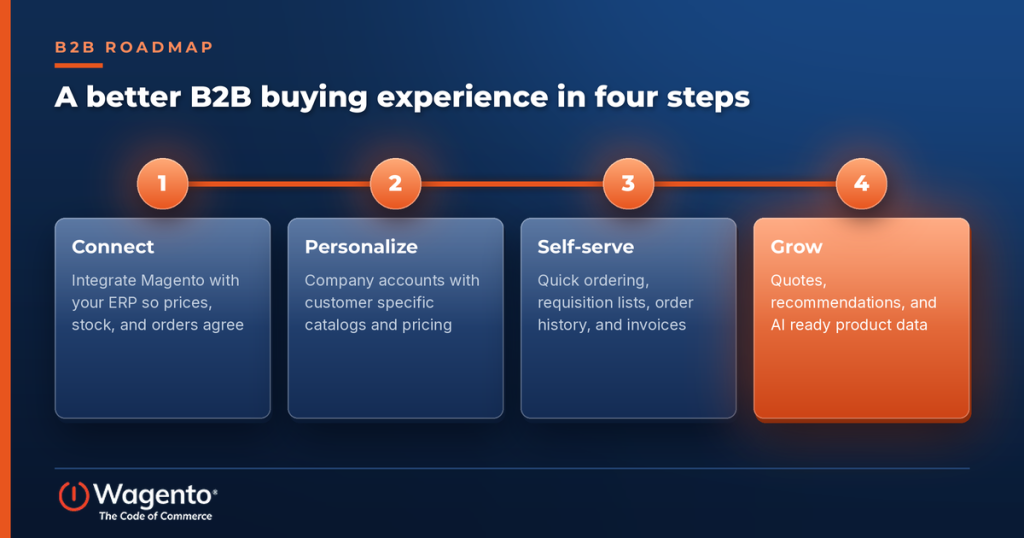
You do not need to replace what works. A phased roadmap builds on your ERP, your catalog, and your team’s knowledge:
- Connect. Integrate Magento with your ERP so prices, stock, and orders agree.
- Personalize. Turn on company accounts and customer specific catalogs and pricing.
- Self-serve. Add quick ordering, requisition lists, order history, and invoices.
- Grow. Add quotes, recommendations, and AI ready product data, then measure and improve.
Each phase delivers value on its own, so customers see improvements within months rather than waiting for a big launch. For how the systems fit together, see The B2B Commerce Tech Stack, Explained.
Explore your B2B commerce and ERP roadmap
We build it, connect it, run it, and grow it, with deep experience in B2B and ERP integration. Book a session and we will map your current systems, your customers’ needs, and a phased Magento roadmap with clear first steps.
Explore a Magento commerce and ERP integration roadmap
Booking link: Book a time with Wagento