 Manufacturing and Distribution
 Firearms
 Automotive and OEMs
 Healthcare & Life Sciences
 Sports & Outdoor Hunting Gear
 Regulated Industries eCommerce
 Adobe Commerce
 BigCommerce
 Magento
 myMagento
 WooCommerce
 Shopify Plus
 Shopware
 Magento 1 to Magento 2 Migration
 Magento Upgrade Service
 Magento Design
 Magento B2B
 Magento Hosting
 Magento Consulting
 Magento eCommerce Developers
 Magento SEO
 Magento Integration
 Magento Speed & Performance Optimization
 eCommerce Development
 Headless Commerce
 eCommerce GrowthX
 B2B CRO Services
 Enterprise SEO Services
 Email Marketing
 Website Localization Services
 AEO, GEO and AI Search
 AI Tools for Business
 Data Analytics Services
 GrowthX Strategy & Consultancy
 eCommerce Integration
 CRM Integrations
 Accounting Software Integrations
 ERP Integrations
 PIM Integrations
 Payment Gateways Integrations
 Tax Platform Integrations
 eCommerce Site Migrations
 Project Rescue
 Hire Developers
 Free Audit Report
 Extensions & Applications
 Custom Applications for eCommerce
 Magento Extensions
 Security & Fraud Prevention
 User Interface & Experience
 Website Design Services
 Support & Maintenance
 About Us
 Blog
 Webinars
 News & Updates
 Downloads
 FAQs
 The Wagento Difference
 Hyvä
 iPaaS
 Klaviyo
 Sales Layer
 Sift
 Dot Digital
 Nousmedis
 Call
 Message
A clear guide to fit, flexibility, and total investment, so you can choose with confidence
Choosing an ecommerce platform is one of the bigger decisions a growing business makes. The goal is not to buy the most powerful option. It is to choose the platform that fits where your business is going, at a total cost that makes sense.
Adobe Commerce and Magento Open Source share the same roots. Adobe describes Adobe Commerce as building on the Magento legacy with additional features for growth and scale, while Magento Open Source remains the free, open option for getting started. This guide helps you decide which one fits, and when.
What business needs make Adobe Commerce worth considering?
Adobe Commerce tends to earn its place when several of these are true:
- You sell to business customers who need their own accounts, catalogs, pricing, and quotes.
- You run several brands, regions, or storefronts and want to manage them from one place.
- Your catalog is large or complex, with many attributes, options, and price rules.
- Your store must connect reliably to ERP, PIM, CRM, and other core systems.
- You want vendor support, hosting options managed by Adobe, and longer support windows.
- You already use, or plan to use, other Adobe Experience Cloud products.
If only one of these applies, Magento Open Source may serve you well today, with room to grow into Adobe Commerce later.
How does Adobe Commerce compare with Magento Open Source for a growing company?
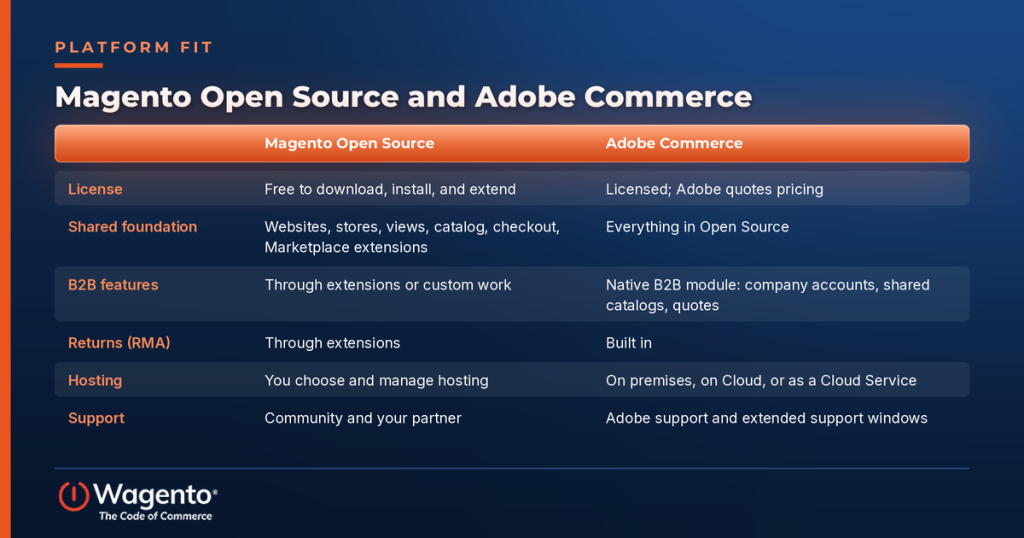
| Magento Open Source | Adobe Commerce | |
| License | Free to download, install, and extend | Licensed; Adobe quotes pricing, which partner reports describe as tied to sales volume and average order value |
| Shared foundation | Websites, stores, and store views, catalog, checkout, and Marketplace extensions | Everything in Open Source |
| B2B features | Through extensions or custom work | Native B2B module: company accounts, shared catalogs, quotes, requisition lists |
| Returns (RMA) | Through extensions | Built in, Adobe Commerce only |
| Hosting | You choose and manage hosting | On premises, Adobe Commerce on Cloud, or Adobe Commerce as a Cloud Service |
| Support | Community and your partner; Adobe ships security patches for supported versions | Adobe support, plus extended support windows offered to Adobe Commerce customers |
The useful way to read this table: Open Source gives you the full commerce foundation, and Adobe Commerce adds the business features, hosting choices, and support that matter more as complexity grows.
Which features matter most when you manage complex products, pricing or multiple storefronts?
- Customer specific catalogs and pricing. Shared catalogs let you set custom prices per product for different companies, one of the biggest reasons B2B sellers choose Adobe Commerce.
- Quotes and approvals. Negotiable quotes and company roles mirror how business buyers already work.
- Multiple storefronts. All websites, stores, and views are managed from the same admin, with settings that cascade from global to store view.
- Inventory across locations. Inventory Management supports multiple warehouses and pickup locations.
- Search that understands intent. Live Search adds semantic search for Adobe Commerce stores.
How should you estimate the full cost of an ecommerce platform over time?
Adobe does not publish a price list for Adobe Commerce; licenses are quoted, and partner and agency reports describe pricing that scales with gross merchandise value and average order value. Magento Open Source has no license fee. Neither number is the full cost.
A fair comparison looks at three to five years and includes:
| Cost area | What to include |
| Platform | License or subscription, if any |
| Hosting | Infrastructure, CDN, monitoring, and security services |
| Build | Design, development, data migration, and testing |
| Extensions and integrations | Purchase, setup, and yearly renewals; ERP, PIM, CRM, and payment connections |
| Upkeep | Security patches, version upgrades, and bug fixes |
| Growth | New features, performance work, SEO, and marketing support |
| People | Internal time to run and improve the store |
Hosting choices change this math. Adobe positions Adobe Commerce as a Cloud Service as always up to date, with lower total cost of ownership, because upgrades no longer need separate projects. Ask any vendor to show the full five year picture, not just year one.
Can your current platform support your next stage of growth, or is a change worth exploring?
Often the answer is to grow within the Magento family. Many businesses start on Magento Open Source and move to Adobe Commerce as their needs mature, keeping the same foundation, data model, and much of their existing work. Others upgrade their current version and add the features they need.
Signals that it is time to review your platform:
- New business models, such as B2B accounts, are being handled outside the store.
- Your team works around the platform instead of with it.
- Integrations need manual fixes every week.
- You are on an unsupported version and upgrades keep slipping.
If you are weighing other platforms too, our Adobe Commerce vs BigCommerce vs Shopify Plus scorecard compares them on what matters for complex B2B.
What questions should you ask before choosing an ecommerce platform or implementation partner?
- Which of our growth plans for the next three years does this platform support without custom work?
- What is the five year total cost, including hosting, upgrades, and integrations?
- How will the store connect to our ERP and other core systems?
- Who applies security patches and upgrades, and how quickly?
- What does the partner do after launch, and who will we work with?
- Can we talk to two clients with a similar setup?
Get a platform-fit consultation
We build it, connect it, run it, and grow it, on Magento Open Source and Adobe Commerce. Book a platform-fit consultation and we will map your needs to the right edition and hosting option, with a realistic view of cost. Already on Magento and planning an upgrade? See our Magento upgrade service.
Book a platform-fit consultation
Booking link: Book a time with Wagento