 Manufacturing and Distribution
 Firearms
 Automotive and OEMs
 Healthcare & Life Sciences
 Sports & Outdoor Hunting Gear
 Regulated Industries eCommerce
 Adobe Commerce
 BigCommerce
 Magento
 myMagento
 WooCommerce
 Shopify Plus
 Shopware
 Magento 1 to Magento 2 Migration
 Magento Upgrade Service
 Magento Design
 Magento B2B
 Magento Hosting
 Magento Consulting
 Magento eCommerce Developers
 Magento SEO
 Magento Integration
 Magento Speed & Performance Optimization
 eCommerce Development
 Headless Commerce
 eCommerce GrowthX
 B2B CRO Services
 Enterprise SEO Services
 Email Marketing
 Website Localization Services
 AEO, GEO and AI Search
 AI Tools for Business
 Data Analytics Services
 GrowthX Strategy & Consultancy
 eCommerce Integration
 CRM Integrations
 Accounting Software Integrations
 ERP Integrations
 PIM Integrations
 Payment Gateways Integrations
 Tax Platform Integrations
 eCommerce Site Migrations
 Project Rescue
 Hire Developers
 Free Audit Report
 Extensions & Applications
 Custom Applications for eCommerce
 Magento Extensions
 Security & Fraud Prevention
 User Interface & Experience
 Website Design Services
 Support & Maintenance
 About Us
 Blog
Blog Webinars
 News & Updates
 Downloads
 FAQs
FAQs The Wagento Difference
 Hyvä
Hyvä iPaaS
iPaaS Klaviyo
 Sales Layer
 Sift
Sift Dot Digital
 Nousmedis
 Call
Call Message
The New Era of AI Comes with Risk: A Risk Management Checklist to Keep Your Store Safe, Compliant, and Trusted
In February 2024, security researchers at JFrog reported about 100 malicious AI models on Hugging Face that could run code on the machine of anyone who loaded them. A few months later, Hugging Face disclosed unauthorized access to secrets on its Spaces platform.
If a major AI platform can be targeted, a store that runs AI chatbots, AI plugins, and third party integrations deserves the same level of care.
That care now has a date attached. Adobe enforces its security requirements for Adobe Commerce on Cloud on October 30, 2026. This guide covers what the date requires, what to fix first, and how to use the weeks you have left. It also covers the AI era risks that apply to every Adobe Commerce and Magento store, wherever it is hosted.
Who the October 30 date covers
Adobe’s enforcement policy applies to Adobe Commerce on Cloud environments running versions 2.4.4 through 2.4.9. Adobe states that the guidance does not apply to Adobe Commerce as a Cloud Service or to on premises deployments.
If your store runs on AWS with us, on your own servers, or with another host, Adobe’s date will not switch off your storefront. The security risks in the rest of this guide still apply to you, and the same habits protect you.
What Adobe requires
Adobe requires supported versions of the third party software your store depends on. Two dates matter.
| Dependency | Current version | Must move to | Deadline |
| MariaDB or Galera | 10.5 and below | 10.6 or higher | October 30, 2026 |
| Elasticsearch | Any version | OpenSearch 2.19 on 2.4.4 and 2.4.5; version 3 on 2.4.6 and above | October 30, 2026 |
| RabbitMQ | 3.9 and below | 3.13 or higher | October 30, 2026 |
| PHP | 8.1 and below | 8.2 or higher | May 31, 2027 |
| MariaDB or Galera | Above 10.5, below 10.11 | 10.11 or higher | May 31, 2027 |
| OpenSearch | 1.x | 2.19 on 2.4.4 and 2.4.5; version 3 on 2.4.6 and above | May 31, 2027 |
| Redis | 5 and below | Valkey 8 or higher | May 31, 2027 |
| RabbitMQ | Above 3.9, below 3.13 | 4.3 or higher | May 31, 2027 |
Version upgrades follow their own dates. Stores on 2.4.4 or 2.4.5 upgrade by June 1, 2027. Stores on 2.4.6 or 2.4.7 upgrade by June 1, 2028. Stores on 2.4.8 or 2.4.9 need no version action, and the dependency dates above still apply to them.
Two of these changes deserve extra attention. Moving from Elasticsearch to OpenSearch and from Redis to Valkey means changing to different software, so custom code, extensions, and configuration that mention the old service may need updates. Moving from PHP 8.1 to 8.2 can bring out deprecations in custom code and third party extensions. One more point on PHP: Adobe lists PHP 8.2 itself as reaching end of life on December 31, 2026, with PCI compliance at risk after that date, so plan for PHP 8.3 or 8.4 where your Commerce version supports it.
How the upgrade work is done
On Adobe Commerce on Cloud, you cannot upgrade these services yourself. Adobe performs the dependency upgrade after you open a support ticket, and asks for that ticket at least 30 days before the enforcement date. Adobe applies the requirements to every environment, so list staging and integration environments along with production.
Your half of the work is testing. Adobe asks merchants to upgrade and validate a non production environment first and, at minimum, check checkout, search, cart, and custom integrations. For the October 30 date, the 30 day mark was September 30. If your ticket is not open yet, open it today and ask Adobe about scheduling.
What happens if you do nothing
Adobe suspends inbound traffic to any environment that misses the requirements, and the storefront goes offline. If an environment stays out of compliance, Adobe may end the cloud service, and the data and assets in that environment are permanently deleted.
For a B2B store, that means stopped orders, buyers who cannot reach their account or their price list, and a hard conversation with finance and compliance teams. Merchants who need a short extension can contact their Adobe account team or Adobe Support, and earlier is better.
Why patch speed matters more in the AI era
Delayed patching has a track record on this platform. After CosmicSting (CVE-2024-34102) was published in June 2024, Sansec counted 4,275 stores hacked by seven separate groups, about 5% of all Adobe Commerce and Magento stores, and reported that roughly 75% of stores had not patched when automated scanning began.
SessionReaper (CVE-2025-54236) followed in 2025. Adobe released the fix on September 9, 2025. Six weeks later, Sansec reported that only 38% of stores had patched, and mass attacks began within days of a public technical writeup.
The pattern continues. On September 7, 2026, Adobe released APSB26-146 for CVE-2026-75650, a critical template engine flaw with a CVSS score of 10.0 that lets an unauthenticated attacker run code on an affected store. Adobe reports it is being exploited in the wild. Adobe’s hotfix guide asks merchants to apply the hotfix and rotate credentials. A day later Adobe released its regular September update, APSB26-138, and asks merchants to apply the APSB26-146 hotfix in addition to it.
Automated tools already turn a published flaw into mass attacks within days. In our view, AI tools lower the effort of building and running those tools further, which shrinks the safe window between a patch release and an attack. Our advice to clients is simple: apply the fix the week it ships, and rotate credentials whenever the bulletin says so.
Four AI risks to check in your store
The OWASP Top 10 for LLM Applications lists prompt injection as its first risk and excessive agency, meaning an AI tool with more permissions than it needs, among the others. In a store, that translates into four checks.
- Prompt injection in store chatbots. A chatbot that can read customer or order data can be tricked into sharing it. Limit what the chatbot can see and test it with hostile prompts.
- Exposed API keys. AI tools often need keys. Keys pasted into code, chat tools, or plugin settings can leak. Store them in a secrets manager and rotate them on a schedule.
- AI generated phishing aimed at admin users. Convincing messages are now cheap to produce. Enforce two factor authentication for every admin and train your team to verify requests.
- AI agents with order or payment access. An agent that can change orders or move money needs tight limits, approval steps, and a full log of what it did.
Risk rating: Critical, High, Medium
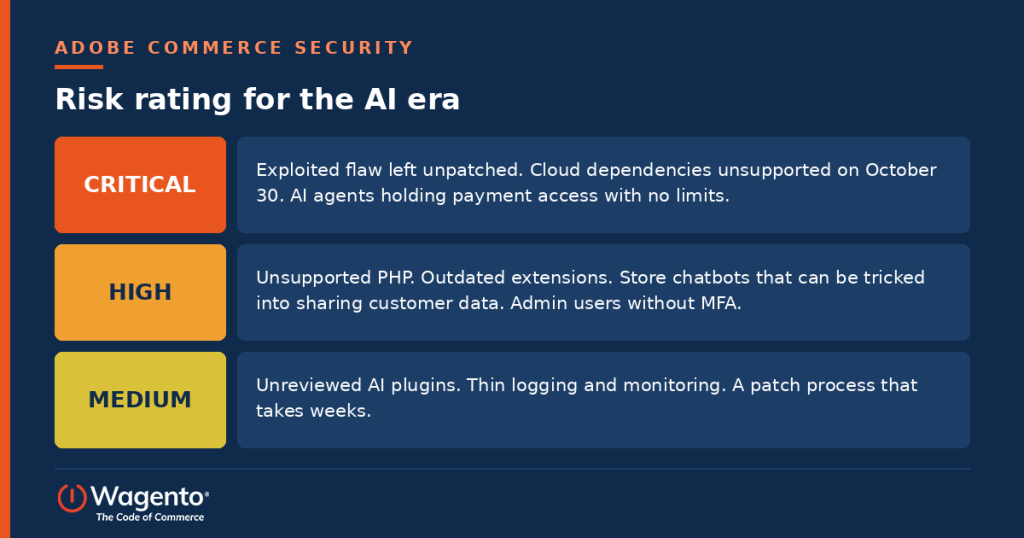
| Rating | What it looks like | What to do |
| Critical | A known exploited flaw left unpatched, such as the APSB26-146 hotfix not applied. Cloud dependencies on unsupported versions as October 30 arrives. An AI agent with payment access and no limits. | Fix this week. Apply the hotfix and APSB26-138, rotate credentials, and open the Adobe ticket. |
| High | PHP 8.1 or below. Extensions that vendors have not updated. A store chatbot that can reach customer data. Admin users without two factor authentication. | Plan and complete within the next 30 days. |
| Medium | AI plugins that nobody has reviewed. Thin logging and monitoring. A patch process that takes weeks. | Schedule for the quarter and assign an owner. |
Your timeline to October 30
| When | What to do |
| Now | Check your version and each dependency in the Cloud Console under the Containers tab. Open the Adobe ticket. Confirm the APSB26-146 hotfix and APSB26-138 are applied on every environment. |
| October 5 to 9 | Run Adobe’s Upgrade Compatibility Report. Ask extension vendors for releases that support your target versions. List custom code that touches search, queues, and cache. |
| October 12 to 16 | Adobe upgrades a non production environment. Test checkout, search, cart, and every custom integration. |
| October 19 to 23 | Fix what testing found and retest. Agree the production window with Adobe. |
| October 26 to 30 | Adobe upgrades production. Verify orders, search, and integrations, and watch the store closely for the first days. |
AI readiness and risk checklist
- Every Adobe security bulletin from the last 12 months is applied on every environment.
- Cloud dependencies match Adobe’s table for your version.
- Every extension has a vendor confirmed release for your target versions.
- Admin accounts use two factor authentication.
- API keys sit in a secrets manager and rotate on a schedule.
- Store chatbots see only the data they need.
- AI agents have spending and action limits, approval steps, and logs.
- Someone owns patching, and that person can act within days.
- You can restore the store from a tested backup.
- Your team knows who to call when something looks wrong.
How Wagento helps
We build it, connect it, run it, and grow it. For this deadline that means reading your environment, finding what needs to change, testing the upgrade path, and carrying the work to production. For stores that want patching and monitoring off their plate for good, myMagento gives you managed hosting on AWS with 24/7 support and a named owner for every patch. If you need a one time upgrade, our Magento upgrade service scopes it as a project.
Planning the version upgrade too? Read Magento 2.4.6 Is No Longer in Regular Support: What Should You Do Now, and for the bigger picture on what sits under your store, The Invisible Dependencies That Can Take Your Store Offline.
Book a pre deadline security and upgrade assessment
Booking link: Book a time with Wagento