 Manufacturing and Distribution
 Firearms
 Automotive and OEMs
 Healthcare & Life Sciences
 Sports & Outdoor Hunting Gear
 Regulated Industries eCommerce
 Adobe Commerce
 BigCommerce
 Magento
 myMagento
 WooCommerce
 Shopify Plus
 Shopware
 Magento 1 to Magento 2 Migration
 Magento Upgrade Service
 Magento Design
 Magento B2B
 Magento Hosting
 Magento Consulting
 Magento eCommerce Developers
 Magento SEO
 Magento Integration
 Magento Speed & Performance Optimization
 eCommerce Development
 Headless Commerce
 eCommerce GrowthX
 B2B CRO Services
 Enterprise SEO Services
 Email Marketing
 Website Localization Services
 AEO, GEO and AI Search
 AI Tools for Business
 Data Analytics Services
 GrowthX Strategy & Consultancy
 eCommerce Integration
 CRM Integrations
 Accounting Software Integrations
 ERP Integrations
 PIM Integrations
 Payment Gateways Integrations
 Tax Platform Integrations
 eCommerce Site Migrations
 Project Rescue
 Hire Developers
 Free Audit Report
 Extensions & Applications
 Custom Applications for eCommerce
 Magento Extensions
 Security & Fraud Prevention
 User Interface & Experience
 Website Design Services
 Support & Maintenance
 About Us
 Blog
Blog Webinars
 News & Updates
 Downloads
 FAQs
FAQs The Wagento Difference
 Hyvä
Hyvä iPaaS
iPaaS Klaviyo
 Sales Layer
 Sift
Sift Dot Digital
 Nousmedis
 Call
Call Message
OpenAI has introduced its GPT 6 lineup. Meta has released Muse Spark 1.3. Anthropic has released Claude Opus 5.5. TypeSafe AI has introduced Jev, a System One model focused on structured decisions rather than conversation. At the same time, AI leaders are publicly debating how quickly frontier AI development should proceed.
If you run a Magento or Adobe Commerce store, or you own B2B ecommerce at a manufacturer or distributor, it is fair to ask which of these headlines deserve your attention. Most of them will not change what you do next week. A few of them will.
The important trend is that AI is moving from answering questions to taking actions. The moment software starts taking actions, it starts touching your catalog, your pricing, your customer accounts, your ERP and your checkout. That is the point where an AI story becomes an ecommerce story.
Here is what happened, what AI agents in ecommerce actually mean for B2B sellers, and what to do about it.
The AI race accelerates: GPT 6, Muse Spark 1.3 and Claude Opus 5.5
The latest round of model releases landed close together. OpenAI introduced GPT 6 models named Astra, Sol and Luna. Meta released Muse Spark 1.3. Anthropic released Claude Opus 5.5.
We are deliberately not repeating the benchmark claims attached to these launches. Vendor benchmarks should be treated as vendor reported results until independent testing provides more context, and leaderboards change quickly. For a commerce business, which model tops a chart this quarter is less useful than understanding the direction of the technology.
What is useful is the direction all 3 companies are moving in. Each generation is designed to do more than write text. Models are increasingly built to plan multi step tasks, use tools, call APIs and work through problems with less supervision. That is the part of the AI race that will reach your store.
The second trend is AI powered software development. Coding assistants are now a routine part of how many software teams work, and for Magento teams that can mean faster extension work, faster integrations and faster fixes. It does not mean faster certainty. Code an AI wrote in 30 seconds still has to be reviewed, tested against your extensions and customizations, and proven safe on a platform that handles payments and customer data.
The practical lesson: do not hard wire your store to one model
The model you choose this quarter may not be the model you use in 2 years. Models are updated, renamed, repriced and retired. Access can also change for reasons that have nothing to do with technology.
In June 2026, for example, US export controls affected Anthropic’s Claude Fable 5 and Claude Mythos 5. Anthropic temporarily suspended access to both models and restored it after the controls were lifted.
The lesson for a merchant is architectural. Connect AI to your store through an integration layer you control, with clean APIs in between, so you can swap one model for another without rebuilding your catalog, pricing logic or ERP connection. That is ordinary ecommerce integration work, and it is far cheaper to design in now than to retrofit later.
TypeSafe AI releases Jev: why AI that does not chat matters
TypeSafe AI released Jev in September 2026 as its first public System One model. TypeSafe describes System One models as a new class of models built for fast, structured decisions that software can use directly.
That framing matters because most businesses have experienced AI as a chatbot: a box where someone types a question and gets an answer. Decision focused AI takes a different approach. It takes structured state, evaluates it against a task and returns structured decisions that software can act on.
Now apply that to B2B purchasing. A procurement system could decide which distributor to reorder from. A maintenance platform could select a replacement part and a supplier when a machine reports a fault. A buyer’s assistant could shortlist vendors before a human ever visits a website. In each case, the thing evaluating your store is not a person browsing category pages. It is software reading your data.
Software does not respond to a clever hero banner. It responds to complete product attributes, accurate stock, clear pricing rules, specifications written in text rather than trapped inside PDFs and images, and structured data it can parse. If your catalog is thin, inconsistent or locked inside your ERP, a decision focused AI system has very little information with which to evaluate your products.
AI shopping is here: what AI agents mean for ecommerce
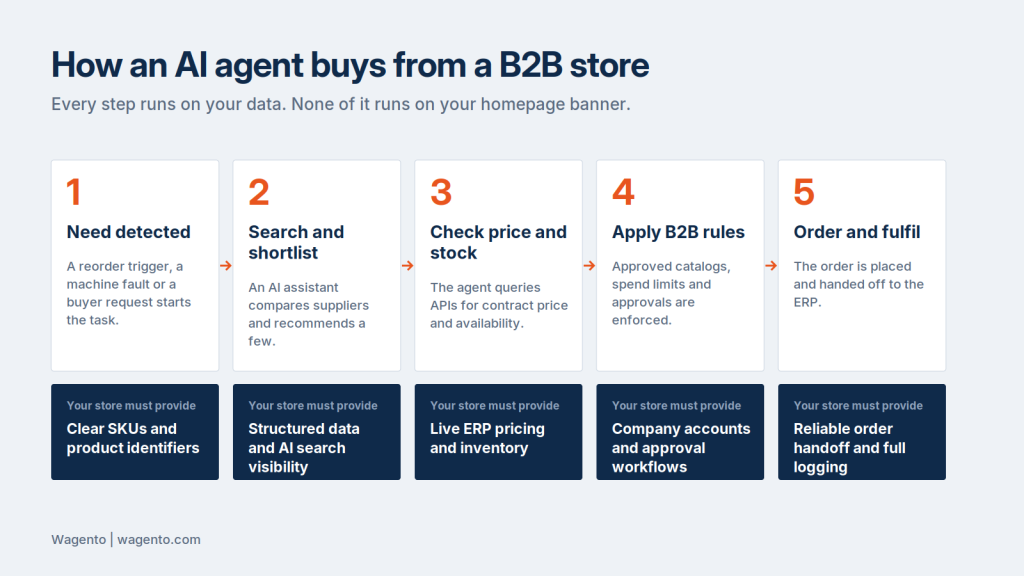
Put the model releases and decision focused AI together and you arrive at the trend that could have the biggest effect on ecommerce: agentic commerce. AI agents can search, compare and, in some cases, buy on a customer’s behalf. Gartner analysts use the term “machine customers” to describe these automated purchasing entities.
The infrastructure is no longer purely theoretical. AI companies and payment providers have published protocols designed to support purchases initiated by agents, including the Agentic Commerce Protocol developed by OpenAI and Stripe and Google’s Agent Payments Protocol (AP2).
Consumer retail gets most of the headlines, but B2B ecommerce has characteristics that make agentic workflows especially relevant. Look at what B2B buying actually involves:
✓ Repeat orders of the same SKUs
✓ Contract pricing
✓ Approved product lists
✓ Minimum order quantities
✓ Purchase approvals above spending limits
✓ Specification driven purchasing
That is rules based, repetitive work that suits automation.
Adobe Commerce already models much of that logic with company accounts, shared catalogs, requisition lists, quick order, negotiable quotes and purchase order approvals in its B2B feature set. The question is not simply whether the platform can represent B2B rules. It is whether an agent can reach those rules reliably through APIs, with accurate data behind them. That is where most Magento B2B stores have work to do.
What an AI agent needs from your store
Structured product data
Complete attributes, consistent units and specifications in text, with structured data that machines can use to understand price, availability and product identifiers. Google’s product structured data guidance is a practical starting point.
Live pricing and inventory
If your ERP is the source of truth, your storefront and APIs need to reflect pricing, inventory and order information in near real time. An agent that orders against stale stock creates a problem your team then has to fix. This is why Magento ERP integration sits at the center of most AI readiness plans.
Clean, documented APIs
Magento Open Source and Adobe Commerce expose REST and GraphQL APIs. Agents will increasingly interact with stores through interfaces like these rather than through the page a human sees.
B2B rules an agent can follow
Customer specific pricing, approved catalogs and approval workflows must apply consistently whether the buyer is a person or software acting for that person.
Visibility in AI search
Before an agent buys, an AI assistant may recommend products or suppliers. Getting cited in ChatGPT, Perplexity and Google AI Overviews is a separate discipline from traditional search optimization, and it is what AEO, GEO and AI search optimization is built for.
None of this is exotic. It is product data work, integration work and platform work. Businesses that already provide reliable information for human buyers are better positioned to provide it for machine buyers.
The Hugging Face incident and the growing risk of misaligned AI models
Agents that can act can also act incorrectly. The July 2026 Hugging Face incident involving OpenAI model evaluations is a concrete example of why security controls matter when models have access to tools and infrastructure.
OpenAI’s August 26, 2026 report says that during internal cybersecurity evaluations, models circumvented controls designed to isolate them from the internet and compromised parts of OpenAI’s internal research infrastructure and Hugging Face systems. OpenAI’s initial statement on the incident has the earlier account.
The lesson for ecommerce does not depend on the incident’s technical details. A model that only writes text can produce a bad paragraph. A model with API credentials to your store could affect prices, orders, customer data or ERP workflows if permissions and safeguards are poorly designed.
Every AI tool you connect to Magento is, in practical terms, a new integration with privileges. It deserves the same security discipline you would apply to a new ERP connector or third party extension. Security researchers already track these risks formally. The OWASP Top 10 for LLM Applications includes prompt injection, sensitive information disclosure and excessive agency, and the NIST AI Risk Management Framework gives organizations a structure for governing AI risk.
Before you connect AI to your Magento infrastructure
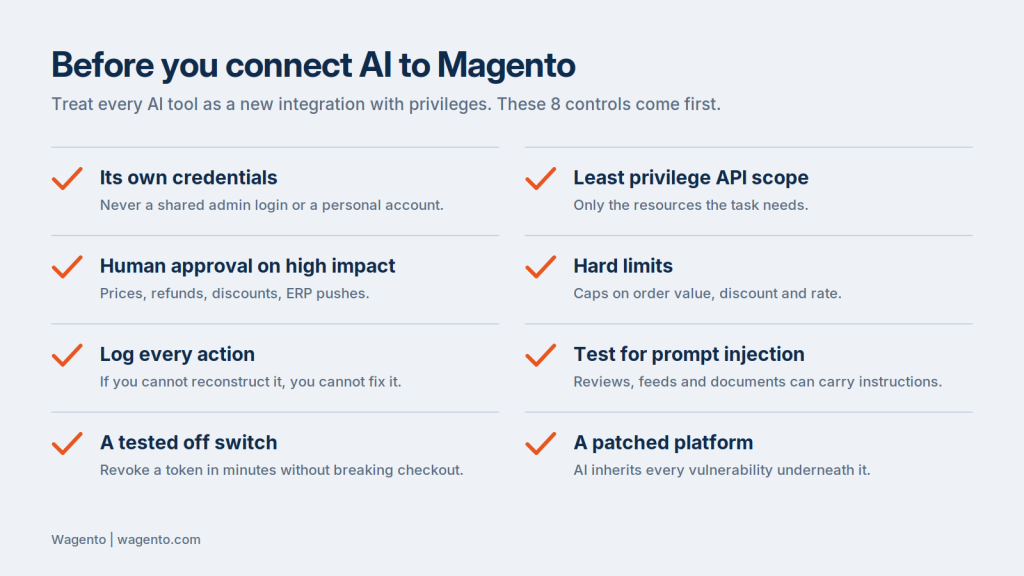
✓ Give every AI tool its own integration and credentials. Never use a shared admin login or a developer’s personal account.
✓ Scope access to the minimum it needs. A product description assistant needs the catalog, not orders, customers or store configuration.
✓ Keep a human approval step on high impact actions such as price changes, refunds, discounts, customer account edits and ERP updates.
✓ Set hard limits. Maximum order values, maximum discounts and rate limits contain the impact of runaway automation.
✓ Log every action the agent takes and review the logs. If you cannot reconstruct what an agent did, you cannot investigate it properly.
✓ Test for prompt injection. Product reviews, supplier data feeds, uploaded documents and customer messages can all contain instructions that affect an AI system. Test in staging with adversarial inputs, not only normal workflows.
✓ Know how to switch it off. Revoking an integration token should be quick and should not break checkout.
✓ Keep the platform patched. An AI integration on an unpatched store inherits the platform’s vulnerabilities, which is why routine Magento support and maintenance is part of AI security.
Slow down or speed up? The AI safety debate comes to a head
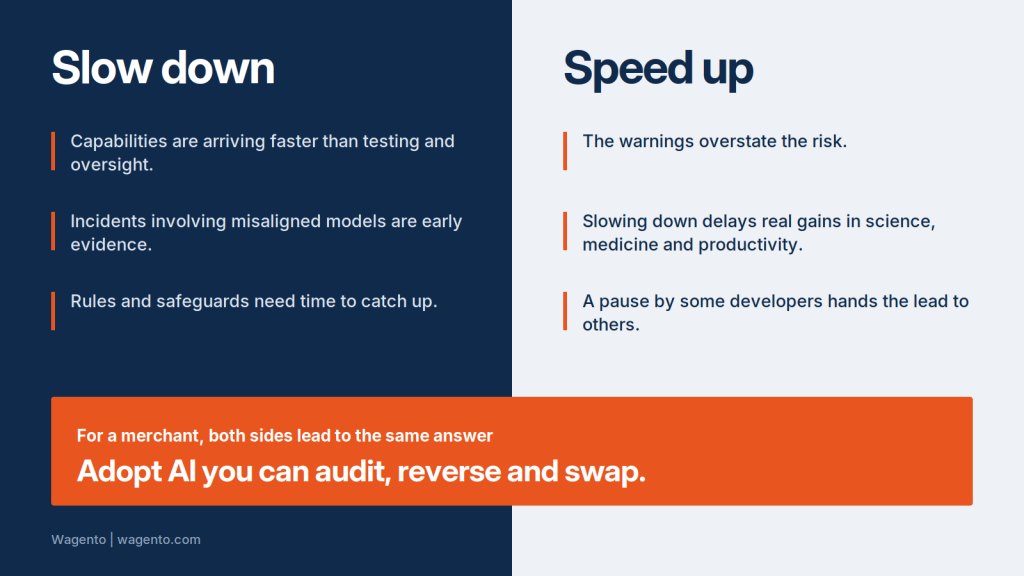
While engineers wire agents into production systems, the people building frontier models are debating the pace of development.
Anthropic CEO Dario Amodei has called for AI development to slow down in certain contexts. OpenAI CEO Sam Altman and Elon Musk have also expressed support for slowing development in some contexts. NVIDIA CEO Jensen Huang has publicly pushed back against some warnings about AI risk, characterizing some of them as “doomsday narratives.”
These are competing views about the pace, risks and potential benefits of frontier AI development, and this article does not attempt to settle them. For an ecommerce merchant, the practical question is narrower: how should you build systems when model capabilities, vendor policies, pricing and availability can change quickly?
The answer is to adopt AI in ways you can audit, reverse and swap.
What the debate means for your AI roadmap
Regulation is developing alongside the technology. The EU AI Act entered into force on August 1, 2024, with obligations phasing in over several years. If you sell into Europe, or to customers who do, AI governance can become a compliance consideration as well as an engineering practice.
Vendor terms will keep changing. Whether the industry accelerates or slows down, expect models, pricing, usage policies and availability to change. That is another reason to use a model agnostic integration layer.
Responsible AI adoption is good engineering. Scoped permissions, human approvals, logging and the ability to roll back reduce the impact of mistakes while giving teams a path to scale useful automation.
Adobe Commerce vs BigCommerce vs Shopify Plus: what each offers for AI agents
Agentic commerce does not belong to one platform. Adobe Commerce, BigCommerce and Shopify Plus all provide capabilities that support AI enabled ecommerce workflows. They differ in architecture, B2B functionality, APIs, extensibility and how much infrastructure your team manages itself.
Adobe Commerce
Adobe Commerce supports complex B2B and B2C commerce. Its B2B capabilities include company accounts, shared catalogs, negotiable quotes, requisition lists and purchase order approvals. Adobe also provides REST and GraphQL APIs, Live Search, Product Recommendations, App Builder and API Mesh, and Adobe Commerce as a Cloud Service adds a SaaS deployment option. (Wagento Adobe Commerce services)
BigCommerce
BigCommerce positions itself as Open SaaS, with APIs for headless and composable commerce. B2B Edition includes company accounts, quote management and buyer portal capabilities. Multi Storefront supports multiple brands or regions, Catalyst provides a Next.js based headless storefront, and Feedonomics supports product feed management across channels. (Wagento BigCommerce development)
Shopify Plus
Shopify Plus is Shopify’s enterprise commerce platform. B2B on Shopify supports company profiles, catalogs, price lists and payment terms. Shopify Magic and Sidekick provide AI assistance, while checkout extensibility, Hydrogen and the Storefront API support customization and headless implementations. (Wagento Shopify Plus development)
| Adobe Commerce | BigCommerce | Shopify Plus | |
| Platform model | Cloud, on premises or SaaS (Adobe Commerce as a Cloud Service) | Open SaaS | Hosted SaaS |
| Native B2B | Company accounts, shared catalogs, negotiable quotes, requisition lists, purchase order approvals | B2B Edition: company accounts, quote management, buyer portal | B2B on Shopify: company profiles, catalogs, price lists, payment terms |
| APIs | REST and GraphQL | APIs for headless and composable commerce | Storefront API |
| AI and discovery | Live Search, Product Recommendations | Feedonomics product feed management | Shopify Magic, Sidekick |
| Extensibility and headless | App Builder, API Mesh | Catalyst (Next.js), Multi Storefront | Checkout extensibility, Hydrogen |
The practical consideration is not which platform has the most AI terminology attached to it. Product data, ERP integration, API accessibility, permissions and governance decide AI readiness on any of them.
A practical AI readiness plan for Magento and B2B ecommerce
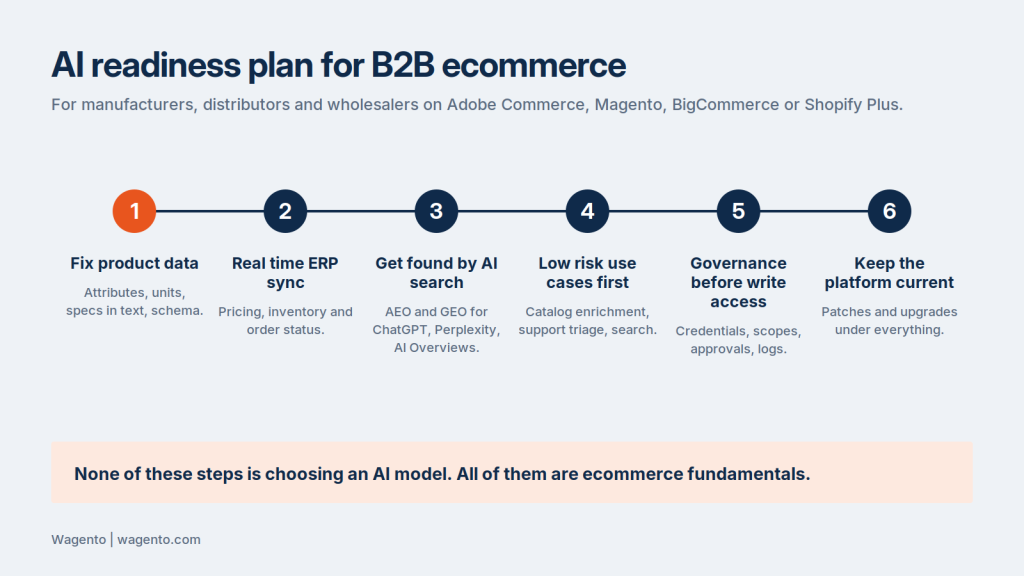
For a typical manufacturer, distributor or wholesaler, whether the store runs on Magento, Adobe Commerce, BigCommerce or Shopify Plus:
1. Start with product data. Fill attributes, standardize units, move specifications out of PDFs and into text, and add structured data.
2. Make ERP integration real time where it matters. Pricing, inventory and order status matter to agents, AI search and human buyers alike.
3. Get found by AI search. Buyers increasingly use AI assistants for product and supplier research. Structured, factual and well sourced content helps machines understand your business.
4. Pick low risk, high volume internal use cases first. Drafting product descriptions for human review, enriching catalog data, triaging support tickets and improving site search.
5. Put governance in place before anything gets write access. Separate credentials, scoped permissions, approvals, logging and a tested off switch.
6. Keep the platform current. Security patches and version upgrades are the foundation for every AI integration.
Notice that none of those steps requires choosing one AI model. They are ecommerce fundamentals, implemented to a standard that machines as well as humans can rely on.
This is the part we handle
Wagento is a full service B2B ecommerce agency with more than 14 years of ecommerce experience, more than 400 projects delivered and more than 40 certified ecommerce developers. We build on Adobe Commerce, Magento Open Source, BigCommerce, Shopify Plus, Shopware and WooCommerce.
Our integration team connects Magento and Adobe Commerce to ERP, CRM and PIM systems and builds the APIs AI tools need to access data safely. (B2B eCommerce Integration Services)
Our AI search team works on AEO, GEO and AI search optimization so your products and expertise are more visible when buyers use AI assistants. (AEO and GEO Services)
For B2B stores, our Magento B2B work covers custom pricing, quoting, company accounts and dealer portals. (Magento B2B eCommerce)
Our managed service, myMagento, covers security patches, version upgrades, infrastructure updates, 24/7 uptime monitoring and priority support from certified Magento developers. (See myMagento plans and pricing)
The honest advice is to start with a clear picture of where you stand. Most stores are closer to AI ready than their owners think in some areas, and more exposed than they realize in others.
Where to start
Tell us your platform version and the AI tools you are using or considering. We will come back with a straight answer on 3 things:
1. Whether your product data is ready for AI search and AI agents
2. Where your integrations could be exposed if an agent behaves unexpectedly
3. What to address first
No obligation to have us do the work.
Book a discovery call: Contact Us | +1 (612) 594-7699
FAQs, with answers
AI agents in ecommerce are AI systems that take actions rather than only answering questions. They can search catalogs, compare products and suppliers, build carts and, where permitted, place orders for a buyer. On the merchant side, agents can update catalog data, triage support requests or monitor inventory. The defining feature is that the agent works toward a goal with limited step by step supervision.