 Manufacturing and Distribution
 Firearms
 Automotive and OEMs
 Healthcare & Life Sciences
 Sports & Outdoor Hunting Gear
 Regulated Industries eCommerce
 Adobe Commerce
 BigCommerce
 Magento
 myMagento
 WooCommerce
 Shopify Plus
 Shopware
 Magento 1 to Magento 2 Migration
 Magento Upgrade Service
 Magento Design
 Magento B2B
 Magento Hosting
 Magento Consulting
 Magento eCommerce Developers
 Magento SEO
 Magento Integration
 Magento Speed & Performance Optimization
 eCommerce Development
 Headless Commerce
 eCommerce GrowthX
 B2B CRO Services
 Enterprise SEO Services
 Email Marketing
 Website Localization Services
 AEO, GEO and AI Search
 AI Tools for Business
 Data Analytics Services
 GrowthX Strategy & Consultancy
 eCommerce Integration
 CRM Integrations
 Accounting Software Integrations
 ERP Integrations
 PIM Integrations
 Payment Gateways Integrations
 Tax Platform Integrations
 eCommerce Site Migrations
 Project Rescue
 Hire Developers
 Free Audit Report
 Extensions & Applications
 Custom Applications for eCommerce
 Magento Extensions
 Security & Fraud Prevention
 User Interface & Experience
 Website Design Services
 Support & Maintenance
 About Us
 Blog
Blog Webinars
 News & Updates
 Downloads
 FAQs
FAQs The Wagento Difference
 Hyvä
Hyvä iPaaS
iPaaS Klaviyo
 Sales Layer
 Sift
Sift Dot Digital
 Nousmedis
 Call
Call Message
Your customer of eleven years ordered from Amazon Business on Tuesday.
Not because they are disloyal. Not because it was cheaper. Because it was four in the afternoon, they needed a part number confirmed and a delivery date they could rely on, and your portal was going to take longer than the search box already open on their screen.
They did not switch suppliers. They did not make a decision about your relationship. They just took the faster route once, and the second time it was easier than the first.
The scale, stated once
Amazon Business is reported at more than 35 billion dollars in annualized sales, serving over six million business customers across eleven countries. It is expanding across maintenance and repair supplies, office products, IT and electronics, and increasingly into industrial categories.
In distributor survey work, roughly a third named Amazon Business the single greatest threat to their business. About half said they had no strategy for competing with it.
That second number is the real story. The threat is understood. The response is not.
What buyers actually find there
It is worth being honest about this rather than dismissive, because your buyers already know the answer and pretending otherwise costs you credibility.
They find one login covering thousands of suppliers. Search that works on a part number. Availability they can believe. Reorder in two clicks from history. Invoicing and approval workflows that fit how procurement already operates. Delivery estimates that turn out to be accurate.
It is not magic, and it is not cheaper on everything. What it is, reliably, is predictable. And predictability is what a buyer under time pressure chooses at four in the afternoon.
What Amazon structurally cannot do
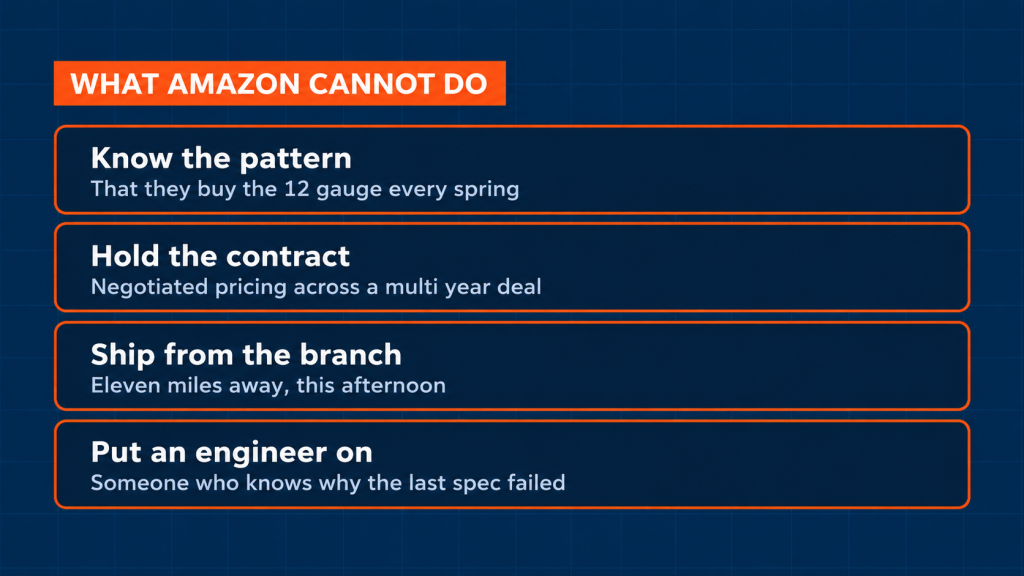
This is the whole argument, and it is stronger than most distributors give themselves credit for.
Amazon does not know that this customer buys the twelve gauge version every spring, and orders the matched connectors two weeks later. It has no memory of the relationship, only of the transactions.
It cannot hold a negotiated contract price across a multi year agreement, with volume tiers and category specific terms that your commercial team spent months structuring.
It cannot ship from a branch eleven miles away this afternoon so a crew is not standing idle tomorrow morning.
And it cannot put an application engineer on the phone who knows why the last specification failed in that environment and what to use instead.
Those are real, durable advantages. The problem is that almost all of them are invisible online, because the portal never shows them. The distributor’s genuine strengths live in people and in history, and the buying experience exposes none of it.
The phrase that keeps them invisible
Ask why the portal works the way it does and you will eventually hear some version of: we have always done it this way.
The phone order habit, because that is how the best customers have always ordered. The spreadsheet upload, because a big account asked for it once. The rep who prefers email, because he has hit his number every year for a decade. The catalog structured the way the ERP happens to store it, because that was the fastest way to launch.
Every one of those was a sensible decision, made by capable people, for reasons that were true at the time. That is exactly what makes them hard to challenge, and exactly why they need challenging now. The reasons expired quietly and nobody was told.
What competing actually requires
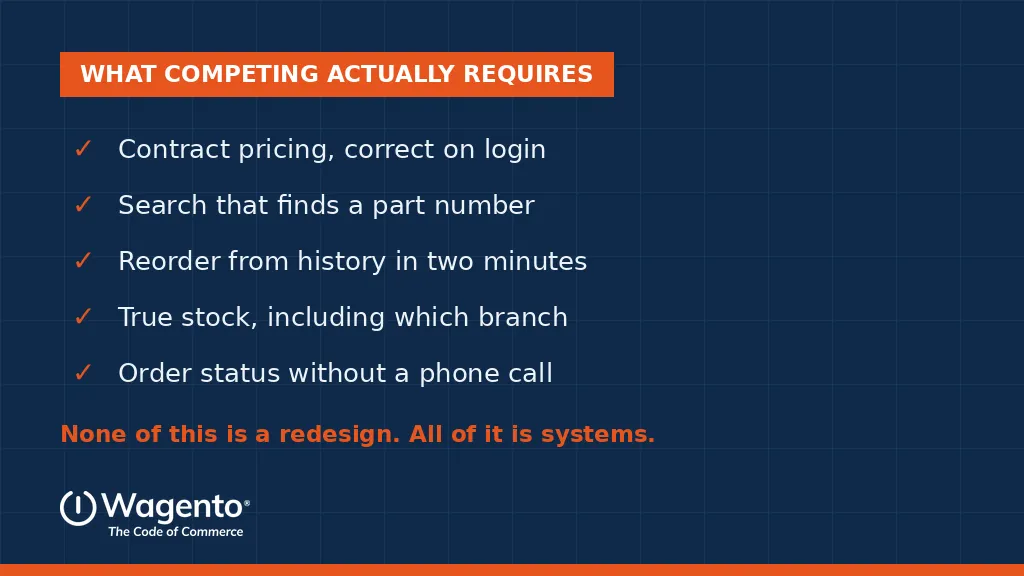
Not a redesign. Almost none of this is about how the site looks.
✓ Per customer pricing that appears correctly the moment a buyer logs in, matching their contract without anyone checking.
✓ Search that finds a product by the number stamped on the part, not just by marketing description.
✓ Reorder from order history in under two minutes, with saved lists for the things they buy every month.
✓ Stock that is true, including which branch has it, so a buyer can plan a job around it.
✓ Order status visible without a phone call, from confirmation through to delivery.
Read that list again and notice what it actually is. It is not a marketing project. It is the ERP integration, the product data, and the search configuration. The buying experience your customers want is downstream of the systems underneath it, which is why portals that get redesigned without touching the integration layer come back looking better and performing the same.
The ceiling is higher than most distributors think
Watsco, one of North America’s largest HVAC and refrigeration distributors, was reported in mid 2026 as generating roughly 37 percent of total revenue through digital channels, with ecommerce sales continuing to grow.
That is not a technology company. That is a distributor selling equipment to contractors, in a category where everyone assumed buyers would always call. If 37 percent is achievable there, the ceiling in your category is almost certainly higher than the number you have quietly accepted.
Where to start, if this describes you
Do not start with the website. Start with one honest question: what percentage of your orders last month arrived through your digital channel without a rep or a customer service agent touching them?
If you cannot answer that from a dashboard, that is the first finding. If you can, and the number is low, the reasons will almost always trace back to one of three things: pricing that is wrong or absent until someone intervenes, stock that buyers have learned not to trust, or a reorder path that takes longer than a phone call.
All three are integration problems wearing an experience costume. That is the work we do.
Where to start
Our B2B systems audit maps how your ERP, your product data and your storefront currently behave together, where the gaps are costing you orders, and what to fix first. You keep the findings whether or not you work with us.
Book a discovery call: Contact Us | +1 (612) 594-7699
FAQs, with answers
For most distributors, yes, though the nature of the threat is often misunderstood. Amazon Business is reported at over 35 billion dollars in annualized sales with more than six million business customers, and survey work has found roughly a third of distributors naming it their single greatest competitive threat. The risk is less about losing customers outright and more about displacement: becoming a second tier supplier for the items buyers cannot source easily elsewhere, while routine volume drifts away.