 Manufacturing and Distribution
 Firearms
 Automotive and OEMs
 Healthcare & Life Sciences
 Sports & Outdoor Hunting Gear
 Regulated Industries eCommerce
 Adobe Commerce
 BigCommerce
 Magento
 myMagento
 WooCommerce
 Shopify Plus
 Shopware
 Magento 1 to Magento 2 Migration
 Magento Upgrade Service
 Magento Design
 Magento B2B
 Magento Hosting
 Magento Consulting
 Magento eCommerce Developers
 Magento SEO
 Magento Integration
 Magento Speed & Performance Optimization
 eCommerce Development
 Headless Commerce
 eCommerce GrowthX
 B2B CRO Services
 Enterprise SEO Services
 Email Marketing
 Website Localization Services
 AEO, GEO and AI Search
 AI Tools for Business
 Data Analytics Services
 GrowthX Strategy & Consultancy
 eCommerce Integration
 CRM Integrations
 Accounting Software Integrations
 ERP Integrations
 PIM Integrations
 Payment Gateways Integrations
 Tax Platform Integrations
 eCommerce Site Migrations
 Project Rescue
 Hire Developers
 Free Audit Report
 Extensions & Applications
 Custom Applications for eCommerce
 Magento Extensions
 Security & Fraud Prevention
 User Interface & Experience
 Website Design Services
 Support & Maintenance
 About Us
 Blog
Blog Webinars
 News & Updates
 Downloads
 FAQs
FAQs The Wagento Difference
 Hyvä
Hyvä iPaaS
iPaaS Klaviyo
 Sales Layer
 Sift
Sift Dot Digital
 Nousmedis
 Call
Call Message
Count the agencies touching your online store right now.
For most manufacturers and distributors I talk to, the number is three or four. A development shop that owns the build. An SEO firm. A PPC agency running the ads. And somewhere, a hosting company nobody has spoken to since the last outage. Each one is competent. Each one sends a monthly report. And every report is green.
So why is revenue flat?
Because nobody in that arrangement is responsible for revenue. They are responsible for their slice of it. And the space between the slices, where most of the money actually leaks, belongs to no one.
Everybody hits their number. The business misses its number.
Here is the quiet math of the multi-agency store. Your development team is measured on shipping releases, so they ship releases. Your SEO firm is measured on rankings, so rankings improve. Your ad agency is measured on ROAS inside their platform, so that number looks great. Your host is measured on uptime, and the site is up.
Four green dashboards. One flat revenue line. Every partner optimized the metric in their contract, and not one of them was looking at the thing you actually care about, which is more orders, from more buyers, at better margin, with less manual work behind the scenes.
This is not because agencies are lazy or dishonest. Most are neither. It is a structural problem: when you divide a commerce operation into four contracts, you also divide the accountability into four pieces, and accountability does not survive being cut into pieces.
The five costs nobody puts in the proposal
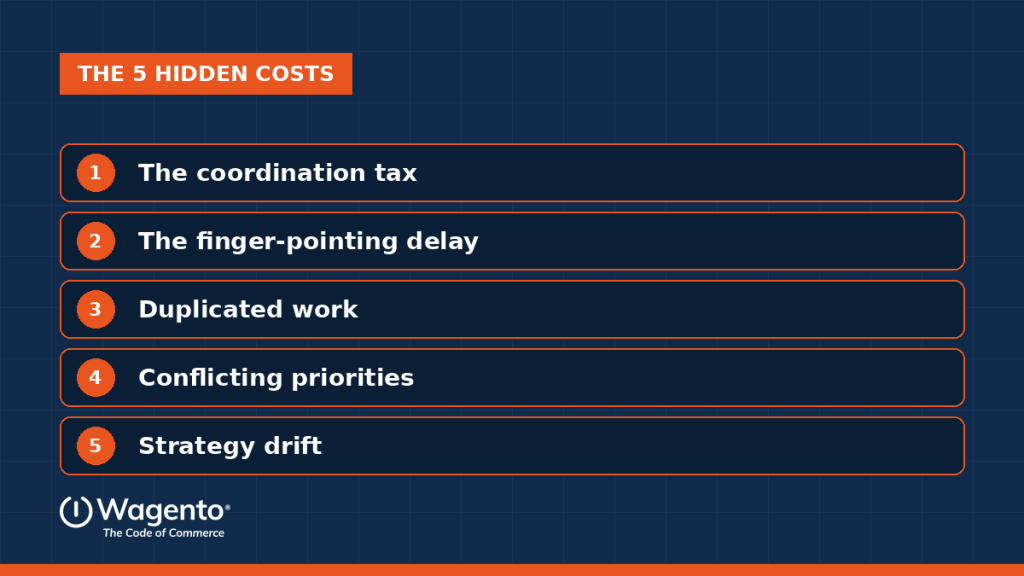
- The coordination tax. Somebody has to keep four vendors aligned, and that somebody is usually you, or a senior person on your team who was hired to do something else. Every status call, every forwarded email, every ‘can you two get on a call’ is unbilled project management coming out of your week.
- The finger-pointing delay. Checkout breaks. Is it the build, the theme, an extension, or the host? With one partner, someone owns the answer. With four, you get three days of ‘not us’ before anyone fixes it, and every one of those days is lost orders.
- Duplicated work. The SEO firm asks for changes the dev team already made. The ad agency builds landing pages the dev team could have built into the platform. You pay twice for the same outcome, and the two versions rarely match.
- Conflicting priorities. Marketing wants a campaign live Friday. Development wants to freeze for a stable release. Both are right. Neither can decide, because neither works for the other, so it lands on your desk as a fight to referee.
- Strategy drift. Four vendors means four roadmaps, and four roadmaps means no roadmap. Nobody is steering the whole ship, so the store slowly becomes a pile of individually reasonable decisions that do not add up to anything.
What single ownership looks like in practice
Lapp Tannehill is the clearest example we have of the alternative. We do not own a slice of their commerce operation. We own the website, the ERP integration, the branding, and the changes that flow from all three.
That matters more than it sounds. When the storefront, the Epicor Prelude integration, and the brand presentation are handled by one team, there is no translation layer between them. A pricing rule change in the ERP does not need a meeting between three vendors to reach the website correctly. A brand update does not break a template someone else built. Nobody has to be told what the other team decided, because there is no other team.
It also makes sense on both sides of the table, which is the part people underestimate. For LAPP Tannehill, there is one number to call and one team that cannot pass the blame. For us, we can actually be held to the outcome, because we control the pieces that produce it. An agency that owns one slice can always explain why the problem lives in someone else’s slice. We gave that excuse up on purpose.
That is what we mean by one accountable partner. Not a bigger contract. A single owner for the result.
What one accountable partner actually changes
The alternative is not ‘hire a bigger agency.’ It is ‘stop dividing the accountability.’ When one partner owns the build, the integration, the infrastructure, and the growth, three things change immediately.
Problems have one owner. When something breaks, there is no debate about whose fault it is, because it is the same team’s job either way. The clock starts on the fix, not on the blame.
Decisions have one roadmap. The campaign and the release get sequenced by people who sit in the same standup, not negotiated across a contract boundary. Speed goes up because friction goes down.
And you get your week back. The coordination tax drops to near zero, because the coordination happens inside one team instead of across four vendors and your inbox.
This is the whole reason we built Wagento the way we did: one team that builds the store, connects it to your ERP, runs it on managed infrastructure, and grows the revenue. Not because bundling is trendy, but because splitting those jobs across vendors is where B2B stores quietly bleed.
How to tell if fragmentation is costing you
✓ The last time something broke, more than one vendor was involved in figuring out whose fault it was.
✓ You or someone senior spends real hours each week coordinating agencies.
✓ Nobody can hand you a single roadmap for the store across build, marketing, and operations.
✓ Two of your vendors have built or optimized the same thing.
✓ When you ask ‘how is the store doing,’ you get four different answers depending on who you ask.
Three or more of these, and fragmentation is not a risk you might face someday. It is a cost you are paying now.
Where to start
Our B2B systems audit looks at the whole picture, build, integration, infrastructure, and growth, and shows you where the seams between your vendors are costing you orders. You get the findings whether or not you ever work with us.
Book a discovery call: Contact Us | +1 (612) 594-7699
FAQs
Not always, but for most midmarket B2B stores, yes. The exception is when you have strong internal ownership tying vendors together. Without that, the coordination cost and the accountability gap usually outweigh any benefit of best-of-breed specialists.