 Manufacturing and Distribution
 Firearms
 Automotive and OEMs
 Healthcare & Life Sciences
 Sports & Outdoor Hunting Gear
 Regulated Industries eCommerce
 Adobe Commerce
 BigCommerce
 Magento
 myMagento
 WooCommerce
 Shopify Plus
 Shopware
 Magento 1 to Magento 2 Migration
 Magento Upgrade Service
 Magento Design
 Magento B2B
 Magento Hosting
 Magento Consulting
 Magento eCommerce Developers
 Magento SEO
 Magento Integration
 Magento Speed & Performance Optimization
 eCommerce Development
 Headless Commerce
 eCommerce GrowthX
 B2B CRO Services
 Enterprise SEO Services
 Email Marketing
 Website Localization Services
 AEO, GEO and AI Search
 AI Tools for Business
 Data Analytics Services
 GrowthX Strategy & Consultancy
 eCommerce Integration
 CRM Integrations
 Accounting Software Integrations
 ERP Integrations
 PIM Integrations
 Payment Gateways Integrations
 Tax Platform Integrations
 eCommerce Site Migrations
 Project Rescue
 Hire Developers
 Free Audit Report
 Extensions & Applications
 Custom Applications for eCommerce
 Magento Extensions
 Security & Fraud Prevention
 User Interface & Experience
 Website Design Services
 Support & Maintenance
 About Us
 Blog
Blog Webinars
 News & Updates
 Downloads
 FAQs
FAQs The Wagento Difference
 Hyvä
Hyvä iPaaS
iPaaS Klaviyo
 Sales Layer
 Sift
Sift Dot Digital
 Nousmedis
 Call
Call Message
It is 9:00 AM and a buyer just ordered 15 units through your portal. At 8:00 AM, an hour earlier, a sales rep sold the last of that stock over the phone.
The portal said 15 available. The ERP said 0. The order went through anyway. Now your warehouse team is calling the customer to apologize, and the customer is quietly wondering why they bothered using the portal at all.
If you have launched a B2B ecommerce platform and orders are still falling through the cracks months later, the problem is almost never the ecommerce platform. It is the ERP integration. This is the conversation many agencies avoid during sales and most platform demos gloss over, so let us have it plainly: here is what actually goes wrong, and what good looks like.
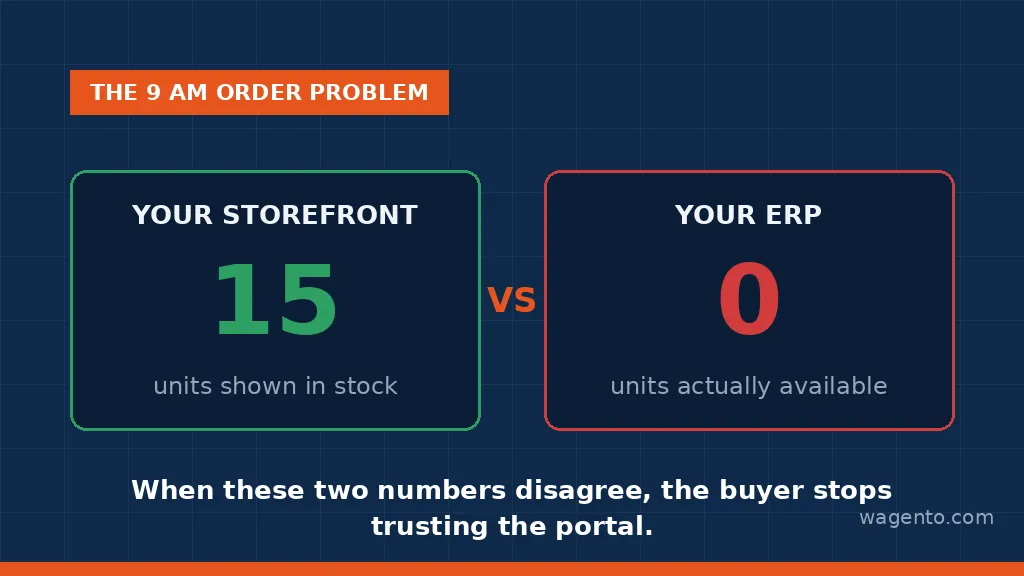
Failure 1: Inventory latency, where trust goes to die
Most failed integrations share a root cause: nightly batch sync. Data moves once a day, which means your storefront is wrong for hours at a time, every day. For a B2C store selling candles, that is survivable. For a distributor whose buyers order against real production schedules, it is fatal, because every mismatch teaches the buyer that the rep is more reliable than the portal.
For B2B sellers with real daily order volume, near real time inventory sync is table stakes, not a premium feature. If a rep sells stock at 8:00 AM, the portal needs to know within minutes, not tomorrow.
Failure 2: Contract pricing edge cases
“Just pull the customer’s price from the ERP.” Every integration plan says this, and every B2B ERP laughs at it. Open the pricing module of a real distributor’s ERP and you will find base price lists, customer specific overrides, volume discount tiers, contract pricing with expiration dates, promotional pricing, and cost plus rules that vary by product category.
An integration that handles the common 80 percent of those scenarios and misses the other 20 does not feel 80 percent done to your customers. It creates a customer service nightmare: inside sales spends its days manually correcting orders and apologizing for wrong prices, and buyers learn to distrust every number on the screen.
The fix starts before code: document every pricing scenario that currently exists in your ERP, then test the integration against all of them, not just the common ones. This is the first exercise in every Wagento B2B systems audit, and it regularly surfaces pricing rules the merchant’s own team had forgotten existed.
Failure 3: The rekeying tax
When the integration does not carry orders cleanly into the ERP, humans do. Customer service re-enters emailed orders. Finance reconciles duplicates. Inside sales fixes prices after the fact. Add up those hours across a month and most operators discover they are paying a part time salary in manual correction work that never appears as a line item anywhere.
Worse, every manual touch is an error opportunity: a transposed quantity, a missed unit of measure, a shipment to the wrong branch. The rekeying tax compounds.
What good looks like
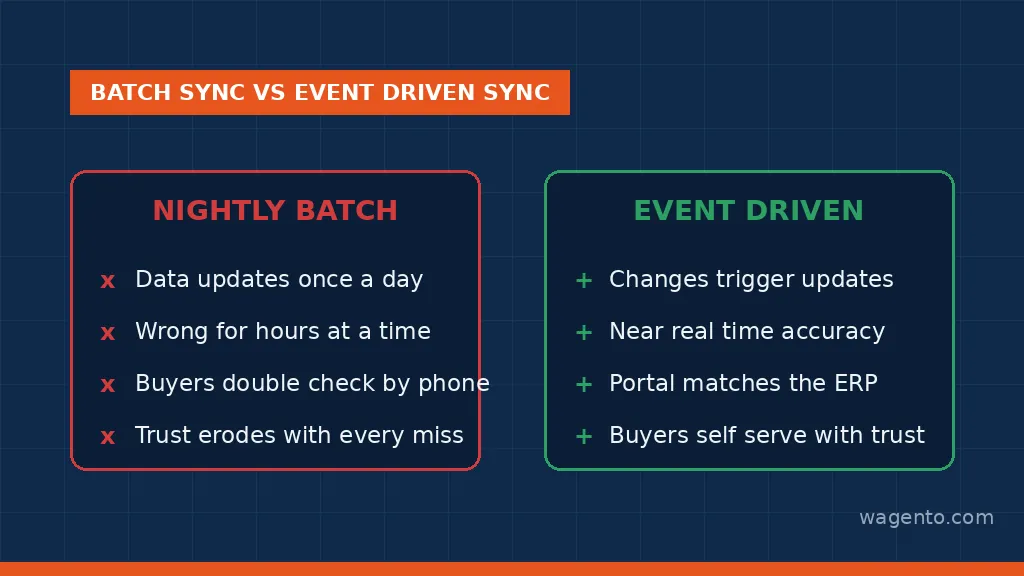
- Event driven, not batch driven. Inventory, order status, and pricing changes in the ERP trigger updates that propagate to the storefront in near real time. Batch jobs are reserved for bulk operations that are not time sensitive, like nightly catalog enrichment.
- An integration layer your own team can operate. Whether it is an integration platform or custom API bridges, your team must be able to monitor, debug, and extend it without calling the people who built it. If the integration is a black box, you do not own your commerce operation.
- Testing with real production data. B2B integrations must be tested against a full replica of your actual pricing and inventory scenarios before go live. It takes longer. It surfaces problems while they are cheap.
- Monitoring and alerting from day one. Sync failures should page a human before a buyer finds them.
What this looks like in practice: Wagento client stories
Lapp Tannehill is a wire and cable distributor whose buyers depend on contract pricing and precise availability. We connected their Adobe Commerce storefront directly to the Epicor Prelude ERP, so every logged in buyer sees their own negotiated price and real stock position on every SKU. Orders flow into Epicor without rekeying. The storefront reflects the system, which is the entire standard.
Jays Company came to us the other way around: a platform already live, with performance bottlenecks, failing workflows, and ERP sync problems that had been quietly breaking orders for months. We stabilized the platform, rebuilt the failing sync, and stayed on for ongoing support. Not every valuable project is a new build; sometimes it is a rescue.
Final thoughts: accuracy is the product
Your buyers will forgive a plain design. They will not forgive a portal that lies about price or stock. If your storefront and your ERP disagree, every marketing dollar you spend is driving buyers to a store that teaches them to call instead.
The next step
Our B2B systems audit maps every pricing and inventory scenario in your ERP and traces how each one behaves on your storefront today. You get the gap list before anyone proposes a build.
Book a discovery call with Wagento: Contact Us | +1 (612) 594-7699
FAQs
Almost always because inventory syncs in batches, once nightly or every few hours, while stock actually changes continuously through rep orders, other channels, and warehouse adjustments. The fix is event driven sync, where changes in the ERP push to the storefront in near real time.