
 Manufacturing and Distribution
 Firearms
 Automotive and OEMs
 Healthcare & Life Sciences
 Sports & Outdoor Hunting Gear
 Regulated Industries eCommerce
 Adobe Commerce
 BigCommerce
 Magento
 myMagento
 WooCommerce
 Shopify Plus
 Shopware
 Magento 1 to Magento 2 Migration
 Magento Upgrade Service
 Magento Design
 Magento B2B
 Magento Hosting
 Magento Consulting
 Magento eCommerce Developers
 Magento SEO
 Magento Integration
 Magento Speed & Performance Optimization
 eCommerce Development
 Headless Commerce
 eCommerce GrowthX
 B2B CRO Services
 Enterprise SEO Services
 Email Marketing
 Website Localization Services
 AEO, GEO and AI Search
 AI Tools for Business
 Data Analytics Services
 GrowthX Strategy & Consultancy
 eCommerce Integration
 CRM Integrations
 Accounting Software Integrations
 ERP Integrations
 PIM Integrations
 Payment Gateways Integrations
 Tax Platform Integrations
 eCommerce Site Migrations
 Project Rescue
 Hire Developers
 Free Audit Report
 Extensions & Applications
 Custom Applications for eCommerce
 Magento Extensions
 Security & Fraud Prevention
 User Interface & Experience
 Website Design Services
 Support & Maintenance
 About Us
 Blog
Blog Webinars
 News & Updates
 Downloads
 FAQs
FAQs The Wagento Difference
 Hyvä
Hyvä iPaaS
iPaaS Klaviyo
 Sales Layer
 Sift
Sift Dot Digital
 Nousmedis
 Call
Call Message
Somewhere right now, a procurement manager is typing your product category into ChatGPT and asking for a shortlist of suppliers. You will never see the conversation. You will only see whether the RFQ arrives.
Forrester’s 2026 survey of nearly 18,000 business buyers found that 94 percent used AI during their most recent purchase process, and buyers now rate AI a more meaningful research source than vendor websites, sales reps, or product experts. G2’s research adds that about half of B2B software buyers now begin their research in an AI chatbot rather than a search engine, and a third ended up purchasing from a vendor they had never heard of before the AI suggested it.
The B2B funnel did not shrink. It moved somewhere you cannot see.
The uncomfortable math of the invisible funnel
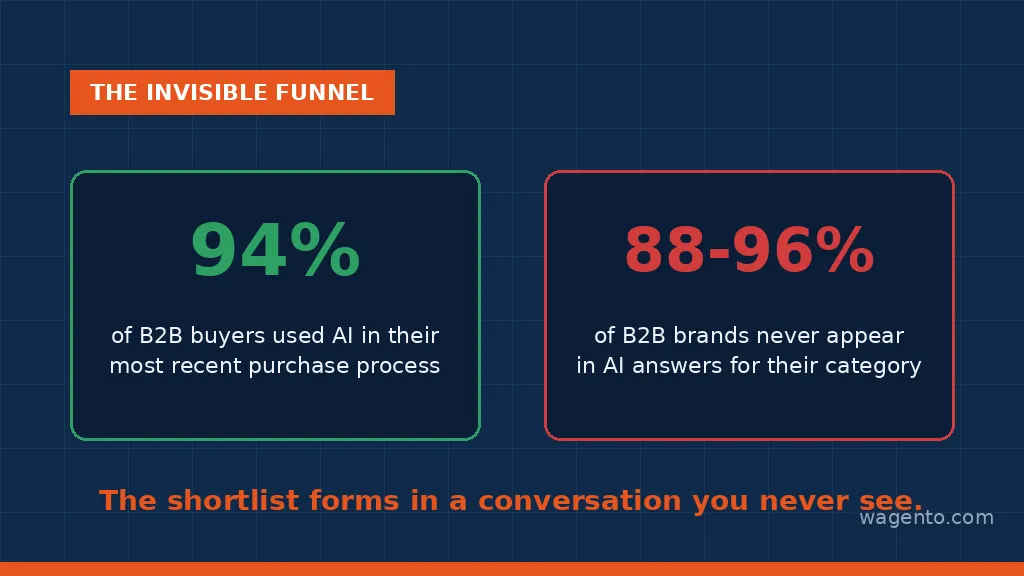
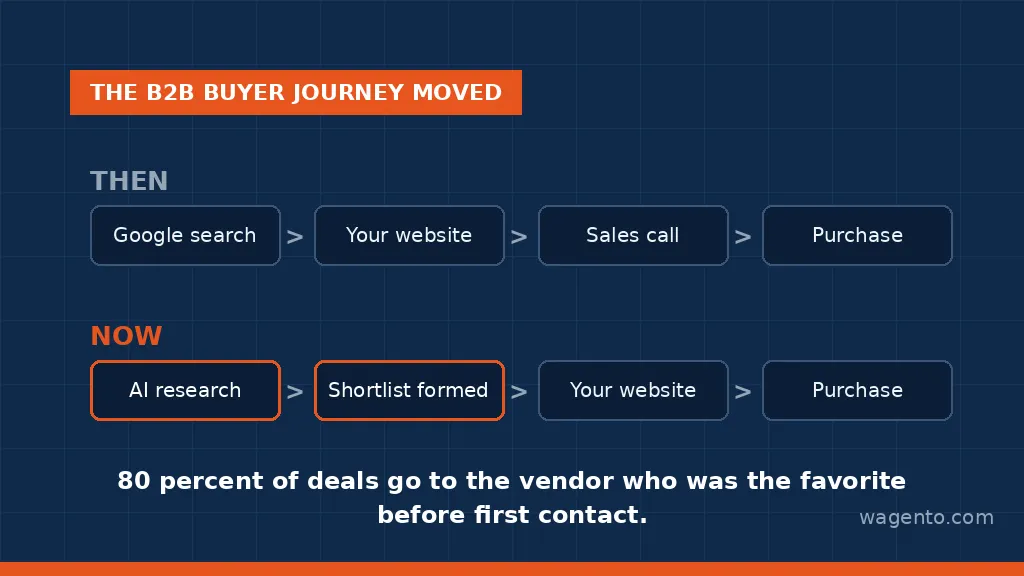
Two more numbers complete the picture. First, separate 2026 studies measuring how often B2B brands appear when buyers query their category in AI tools put invisibility at 88 to 96 percent: roughly nine out of ten suppliers simply never show up in the answer. Second, research on buying outcomes consistently finds that around 80 percent of deals go to the vendor who was the buyer’s favorite before first contact.
Put those together: the shortlist is being assembled inside AI conversations, most suppliers are absent from those conversations, and the supplier who is present usually wins. For manufacturers and distributors whose demand once came from trade shows, directories, and Google rankings, this is the largest quiet shift in a decade.
Why your SEO does not automatically transfer
A reasonable assumption: we rank well on Google, so we must do fine in AI answers. The data says otherwise. A 2026 Moz analysis of 40,000 queries found that 88 percent of Google AI Mode citations do not appear in the organic top 10, and academic work confirms a large share of AI cited domains never appear in traditional search results at all.
AI engines assemble answers from sources they treat as authoritative, and analyses of over a million prompts show more than 85 percent of non paid AI citations come from earned media and credible third party publications, not vendor homepages. There is no ad slot in the answer. There is no retargeting pixel in the conversation. Visibility has to be earned in a new way.
The upside: AI traffic is the best traffic you can get
Here is the reason to treat this as an opportunity rather than a threat. Multiple 2026 analyses found AI referred visitors convert at several times the rate of traditional organic traffic, with one widely cited study measuring 14.2 percent for AI referred visits against 2.8 percent for Google organic. Those visitors arrive having already compared you, priced you, and shortlisted you. When they land, they are validating a decision, not starting one.
Fewer visits, far more intent. The suppliers who show up in AI answers are collecting the most qualified pipeline in their category.
How to become citable: AEO and GEO in plain terms
Answer engine optimization (AEO) and generative engine optimization (GEO) are the practices of earning presence in AI generated answers. Stripped of jargon, four things move the needle:
✓ Publish specific, citable content. AI engines cite content that answers real buyer questions with real numbers: honest price ranges, implementation timelines, capability comparisons. Generic thought leadership does not get cited; specificity does. Research presented at SIGKDD found that adding statistics to content improves AI citation rates by 30 to 40 percent.
✓ Make your product data machine readable. Clean schema markup, structured specifications, consistent SKU data. If a PIM feeds your catalog, this is where that investment pays twice.
✓ Earn presence on the sources AI already trusts. Industry publications, review platforms, credible directories. Since most citations come from earned media, PR and AI visibility are now the same project.
✓ Measure it. Run your category queries in ChatGPT, Perplexity, and Google AI Mode monthly. Track whether you appear, what the AI says about you, and how that changes. Fewer than a quarter of marketers currently track AI visibility at all, which means measurement alone is a competitive edge right now.
This is why we built GrowthX
Building the store was never the finish line. GrowthX is Wagento’s growth practice, and it treats organic search, AI presence (AEO and GEO), conversion rate optimization, email, and paid campaigns as one system measured against revenue, because that is how buyers actually experience it: they meet you in an AI answer, validate you on your site, and convert through an experience that either holds or leaks.
The proof is in the outcomes: refined campaign strategy lifted Eichler’s revenue by 245 percent, and a compliance safe PPC launch for Jays Company returned over 850 percent ROAS in a category most agencies will not touch. The same discipline now extends to AI visibility: baseline what the engines say about you, fix the content and data gaps, earn the citations, and measure monthly. Explore GrowthX and our AEO, GEO, and AI Search services.
Final thoughts: the answer is being written either way
Whether or not you act, AI engines are already answering questions about your category, your competitors, and possibly your company. The only choice is whether you shape what the answer says. The suppliers who move in 2026, while fewer than a quarter of their competitors even measure this, will own shortlists that are very hard to dislodge later.
The next step
Request a GrowthX visibility review. We will run your category queries across ChatGPT, Perplexity, and Google AI Mode, show you exactly what the engines currently say about your company, and map the path into the answer.
Book a discovery call with Wagento: Contact Us | +1 (612) 594-7699
FAQs
Yes. Forrester’s 2026 survey of nearly 18,000 buyers found 94 percent used AI during their most recent purchase process, and G2 found about half of software buyers now start research in an AI chatbot rather than a search engine. Supply chain research shows the same pattern for industrial and distribution categories.