


















eCommerce success is no longer determined only by features, design, or marketing spend. It is determined by how well your infrastructure performs under pressure.
Traffic spikes. Global buyers. Complex integrations. Security threats. AI-driven personalization. Headless storefronts. Enterprise expectations.
Behind all of this sits one critical foundation: your hosting environment.
For Adobe Commerce, Magento, and modern headless architectures, hosting is no longer a commodity. It is a strategic decision that directly impacts revenue, customer experience, security posture, and long-term scalability.
This guide breaks down what high-performance managed eCommerce hosting really means, why businesses are moving away from self-managed infrastructure, and how the right hosting partner helps you build, run, and grow with confidence.
Ready to eliminate hosting bottlenecks before they cost you revenue?
Why Hosting Has Become a Board-Level eCommerce Decision
In earlier years, hosting was treated as a technical checkbox. Choose a server, deploy the site, move on.
That approach no longer works. In 2026, eCommerce platforms power global operations with real-time inventory, ERP synchronization, AI recommendations, and omnichannel experiences. Any weakness in hosting now shows up as lost revenue, security exposure, or customer churn.
What Changed
Several major shifts have elevated hosting from IT detail to executive priority:
- Adobe Commerce and Magento deployments are more complex and integration-heavy
- Headless commerce introduces multiple infrastructure layers that must stay synchronized
- Performance expectations are unforgiving with Google Core Web Vitals and UX benchmarks
- Security threats now target infrastructure, not just applications
- Downtime is no longer tolerated in enterprise commerce environments
Hosting must now support speed, reliability, security, and scalability at the same time.
That is why businesses are increasingly choosing fully managed eCommerce hosting instead of running infrastructure themselves.
What Managed eCommerce Hosting Actually Means

Managed hosting is often misunderstood as basic server maintenance. In reality, modern managed eCommerce hosting is a complete operational partnership.
It covers everything required to keep your commerce platform fast, secure, compliant, and resilient at scale.
Core Elements of Managed eCommerce Hosting
A true managed hosting solution includes:
- Optimized infrastructure designed specifically for eCommerce workloads
- Platform expertise for Adobe Commerce and Magento environments
- Proactive performance monitoring and optimization
- Built-in scalability with auto-scaling and load balancing
- Enterprise-grade security and compliance management
- Continuous uptime monitoring and incident response
- Ongoing infrastructure tuning as your business evolves
This is not generic cloud hosting. It is hosting purpose-built for commerce.
Optimized Hosting Environments for Adobe Commerce and Magento
Adobe Commerce and Magento remain among the most powerful eCommerce platforms available. They are also demanding when it comes to infrastructure.
Why Generic Hosting Fails Magento and Adobe Commerce
Many performance and stability issues stem from hosting environments that were never designed for commerce platforms:
- Shared resources create unpredictable performance
- Improper caching configurations slow down storefronts
- Weak database tuning impacts checkout and search
- Insufficient scaling causes failures during peak traffic
- Lack of platform expertise leads to slow issue resolution
What Optimized Hosting Looks Like
An optimized Adobe Commerce or Magento hosting environment includes:
- Dedicated resources for PHP, database, and cache layers
- Advanced caching strategies using Varnish and Redis
- CDN integration for global performance consistency
- Database optimization tailored to catalog and order volume
- Environment separation for production, staging, and development
When hosting is designed specifically for the platform, performance becomes predictable instead of fragile.
Magento hosting strategies are increasingly focused on AI-assisted performance tuning, cloud-native scalability, and support for headless storefronts. This industry perspective highlights how optimized infrastructure is becoming a key differentiator for high-growth Magento and Adobe Commerce businesses.
As AI-driven features become core to Adobe Commerce in 2026, hosting environments must be capable of supporting advanced machine learning workloads. AI-powered services such as personalization, search optimization, and predictive analytics depend heavily on stable, high-performance infrastructure to deliver real business impact.
Performance SLAs That Actually Protect Revenue
Performance matters just as much as availability.
Why Performance SLAs Matter
Performance SLAs define clear expectations for:
- Page load times
- Infrastructure response times
- Incident resolution windows
- Traffic surge handling
- Availability guarantees
Without performance SLAs, hosting providers are accountable only for servers being online, not for your site actually performing well.
Hosting as a Performance Multiplier
High-performance hosting directly impacts:
- Conversion rates
- Bounce rates
- SEO rankings
- Customer trust
- Lifetime value
Managed hosting ensures performance is monitored, measured, and optimized continuously, not just during launches or incidents.
Performance SLAs should be tied to real user experience metrics, not just uptime. First Contentful Paint plays a critical role in how quickly customers perceive your storefront as usable, which directly impacts bounce rates, conversions, and SEO performance in competitive eCommerce environments.
Scalability Without Stress
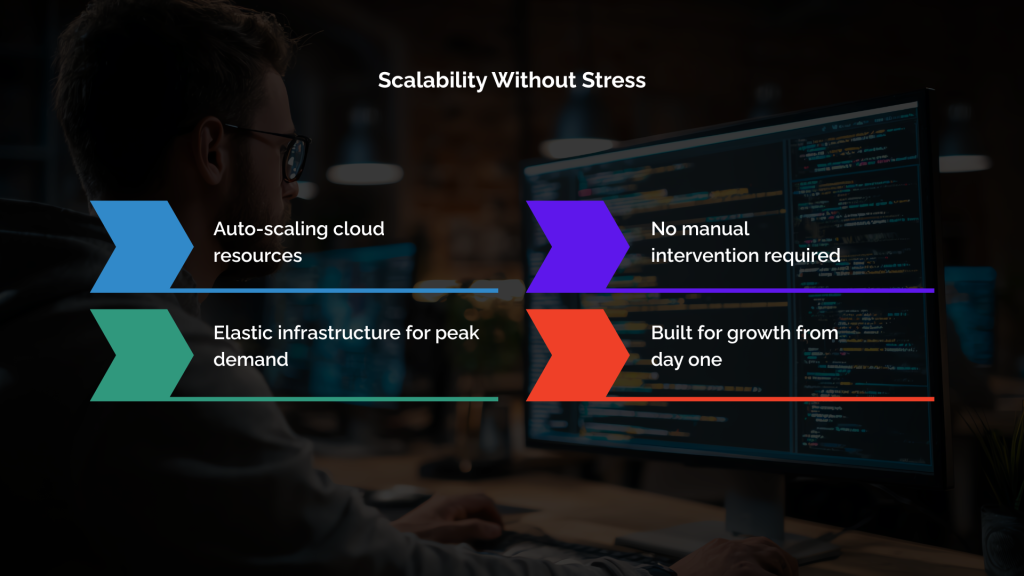
Growth is only valuable if your infrastructure can keep up.
The Scalability Challenge in Modern eCommerce
Scalability today is not only about traffic. It includes:
- Seasonal demand spikes
- Marketing campaign surges
- B2B customer ordering patterns
- International expansion
- Catalog growth and data volume
Self-managed hosting often struggles with these variables because scaling requires manual intervention, planning, and risk.
Auto-Scaling and Elastic Infrastructure
Modern managed hosting leverages:
- Auto-scaling compute resources
- Elastic load balancing
- Containerized deployments
- Cloud-native architectures
This allows your infrastructure to grow and shrink automatically without downtime or emergency fixes.
As B2B eCommerce operations grow more complex in 2026, infrastructure scalability becomes a strategic requirement rather than a technical preference. This aligns closely with how modern B2B businesses are rethinking architecture, integrations, and long-term growth planning to support higher order volumes, custom pricing, and enterprise workflows.
Struggling with slow pages, traffic spikes, or infrastructure anxiety?
Security and PCI Compliance Are No Longer Optional

Security breaches in eCommerce are no longer rare events. They are expected risks.
What Secure Managed Hosting Covers
A secure managed hosting environment includes:
- PCI-compliant infrastructure configurations
- Web application firewalls
- DDoS protection
- Intrusion detection and prevention
- Continuous patching and vulnerability management
- Secure backups and disaster recovery plans
Shared Responsibility Made Simple
With self-managed hosting, security responsibilities are often unclear. With managed hosting, accountability is defined and proactive.
This reduces risk exposure and ensures compliance does not become a recurring fire drill.
Choosing a hosting provider requires careful evaluation of security standards, uptime reliability, compliance readiness, and managed support capabilities. A strong hosting foundation helps reduce operational risk while ensuring consistent performance and data protection for eCommerce platforms.
Hosting for Headless and Composable Commerce
Headless commerce has matured significantly. It also introduces new infrastructure demands.
Why Headless Requires Specialized Hosting
Headless commerce involves:
- Separate frontend and backend systems
- API-driven data flows
- Microservices and third-party integrations
- Higher reliance on performance consistency
Generic hosting struggles to support this complexity efficiently.
Hosting Built for Headless Architecture
Managed headless hosting focuses on:
- API performance and reliability
- Containerized deployments
- Observability-driven monitoring
- Seamless scaling across services
- Security across distributed components
This ensures flexibility does not come at the cost of stability.
One Partner to Build, Run, and Grow
One of the most underestimated advantages of managed hosting is operational continuity.
The Cost of Fragmented Responsibility
When build teams, hosting providers, and support vendors are disconnected:
- Issues take longer to resolve
- Accountability is unclear
- Performance optimization stalls
- Strategic growth slows
The Value of an eCommerce Hosting Partner
A true eCommerce hosting partner understands:
- Your platform architecture
- Your business goals
- Your growth roadmap
- Your operational constraints
This allows hosting to evolve alongside your business instead of becoming a bottleneck.
Common Signs Your Current Hosting Is Holding You Back
Many businesses tolerate poor hosting longer than they should.
Warning Signals to Watch For
- Slow page loads despite optimization efforts
- Performance drops during promotions
- Frequent emergency fixes or downtime incidents
- Security concerns that feel reactive
- Difficulty scaling without risk
- Lack of visibility into infrastructure performance
If these sound familiar, your hosting environment is likely limiting growth.
How to Choose the Right Managed eCommerce Hosting Partner
Not all managed hosting providers are equal.
What to Look For in 2025
- Proven Adobe Commerce and Magento expertise
- Experience with headless and enterprise architectures
- Clear performance and uptime SLAs
- Strong security and compliance track record
- 24/7 monitoring and proactive support
- Ability to support long-term growth
Hosting should feel like an extension of your internal team, not an external vendor.
Build on infrastructure designed for scale, security, and performance
Frequently Asked Questions
What is managed eCommerce hosting?
Managed eCommerce hosting is a fully supported hosting solution where infrastructure, performance, security, and scalability are handled by eCommerce experts.
Is managed hosting better than self-managed cloud hosting?
For most growing and enterprise eCommerce businesses, yes. Managed hosting reduces operational risk, improves performance, and frees teams to focus on growth.
Can managed hosting support headless commerce?
Yes. Modern managed hosting is designed to support headless and composable architectures with API-first infrastructure.
Does managed hosting include security and PCI compliance?
Yes. Secure managed hosting includes PCI-compliant infrastructure, DDoS protection, firewalls, monitoring, and proactive patching.
When should a business switch to managed hosting?
When performance, security, scalability, or operational complexity start limiting growth, managed hosting becomes a strategic upgrade.