



















Sarah, a busy marketing executive, had been meaning to upgrade her home office for weeks but never found the time to browse multiple websites. One evening, after a hectic day, she opened her favorite ecommerce site to look for an ergonomic office chair within her budget of $300. Almost immediately, an AI shopping agent greeted her with a friendly message, asking what she was looking for. Sarah typed her request, and within seconds, the agent presented a curated selection of chairs tailored to her preferences and even took into account her past browsing habits.
Curious to know which chair would fit best in her space, Sarah asked the AI for reviews and price comparisons. To her delight, the AI offered a virtual try-on feature that allowed her to see how each chair would look in her home office through augmented reality. The AI agent didn’t stop there; noticing her interest in assembling a complete office setup, it suggested a matching desk and accessories, bundling them together with a special limited-time discount.
When Sarah moved to check out, the AI noticed a brief pause and sensed her hesitation. To make the decision easier, it immediately offered an additional 5% discount and free shipping if she completed her order right away. Of course, AI fetched this information and cart abandonment strategy from the original eCommerce website. Feeling reassured and valued, Sarah accepted the offer and smoothly finalized her purchase with just a few clicks.
After the delivery arrived, the AI agent followed up with personalized care tips for her new chair and a gentle reminder to register the warranty. Weeks later, it even suggested ergonomic keyboards and accessories tailored to her setup, anticipating her evolving needs. Through every step, Sarah experienced what felt like a personal shopping assistant who understood her priorities and made buying effortless—transforming a once-daunting task into a seamless, enjoyable journey.
The landscape of online shopping is undergoing a revolutionary transformation. As consumers demand more personalized, efficient, and intelligent shopping experiences, AI in ecommerce has evolved from simple recommendation engines to sophisticated AI shopping agents that can autonomously navigate the entire buyer journey. These intelligent systems are not just changing how we shop—they’re fundamentally reshaping what it means to be a consumer in the digital age.
What Are AI Shopping Agents?
AI shopping agents are autonomous software programs powered by artificial intelligence that act on behalf of consumers to research, compare, and purchase products online. Unlike traditional chatbots or simple recommendation systems, these autonomous ecommerce agents can understand context, learn from user preferences, and make complex decisions throughout the shopping process.
Think of an AI virtual shopping assistant as your personal shopping concierge that never sleeps. These systems can:
- Research products across multiple platforms
- Compare prices and features automatically
- Track price fluctuations and notify users of deals
- Make purchases based on predefined criteria
- Handle returns and customer service interactions
- Learn from past purchases to improve future recommendations
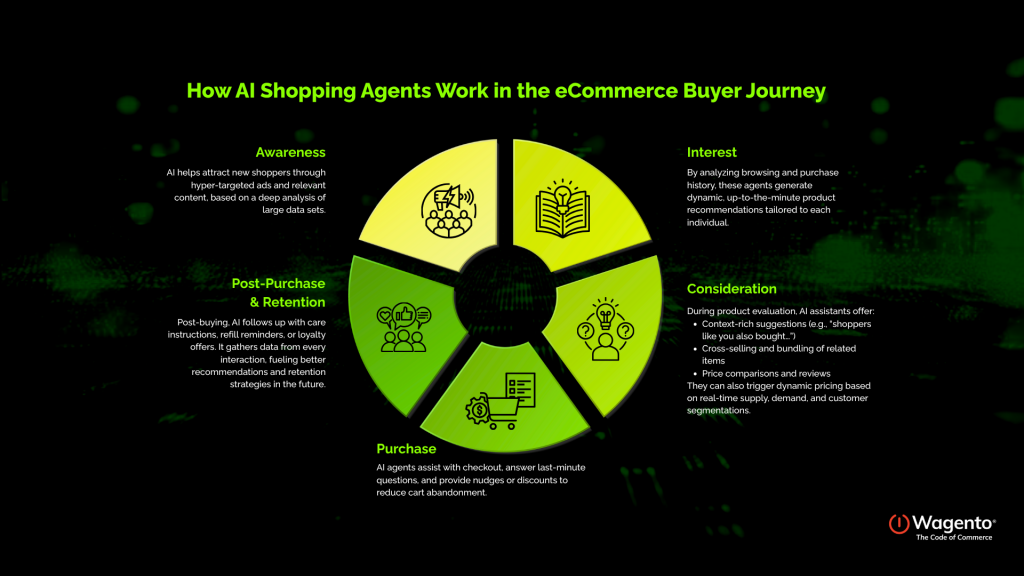
How AI Shopping Agents Work in the eCommerce Buyer Journey
1. Awareness
AI helps attract new shoppers through hyper-targeted ads and relevant content, based on a deep analysis of large data sets.
2. Interest
By analyzing browsing and purchase history, these agents generate dynamic, up-to-the-minute product recommendations tailored to each individual.
3. Consideration
During product evaluation, AI assistants offer:
- Context-rich suggestions (e.g., “shoppers like you also bought…”)
- Cross-selling and bundling of related items
- Price comparisons and reviews
They can also trigger dynamic pricing based on real-time supply, demand, and customer segmentations.
4. Purchase
AI agents assist with checkout, answer last-minute questions, and provide nudges or discounts to reduce cart abandonment.
5. Post-Purchase & Retention
Post-buying, AI follows up with care instructions, refill reminders, or loyalty offers. It gathers data from every interaction, fueling better recommendations and retention strategies in the future.
AI Shopping Agents vs. Traditional Chatbots
| Aspect | Traditional Chatbots | AI Shopping Agents |
| Approach | Reactive, rule-based | Proactive, learns and adapts |
| Personalization | Limited | Highly contextual, real-time |
| Tasks | Answer FAQ, track orders | Guide full journey, recommend, upsell |
| Data Integration | Siloed, limited context | Unified with customer/product data |
| Conversational Ability | Scripted | Natural, multi-turn, complex queries |
Real-World Examples from eCommerce Giants
Amazon
- Personalized Recommendation Engine: Amazon’s AI-powered agent – Rufus, drives 35% of its sales, suggesting items based on your browsing, purchase history, and what similar customers bought. While the tech is mostly behind the scenes, it acts like an autonomous AI shopping “agent,” surfacing the right items at the right time. Amazon also uses Alexa, its voice assistant, to enable shopping by voice, answering queries, suggesting products, and even placing orders for customers.
Walmart
- Conversational AI and Online Grocery: Walmart uses AI-driven chatbots and virtual assistants to guide shoppers to the right products, suggest replenishments, and manage online grocery lists based on purchase history. Their virtual agent can recommend items, answer questions via chat, and help customers complete transactions more seamlessly.
H&M and Zara
- AI Chatbots and Video Assistants: H&M’s chatbot provides real-time product search, style tips, and personalized outfits, guiding shoppers through catalogs. Zara’s AI video chatbots provide visual, real-time help with styling, helping users pick outfits with live feedback and recommendations.
Sephora
- Virtual Artist: Sephora’s AI-powered Virtual Artist lets shoppers try on makeup virtually and get personalized recommendations based on their face, significantly boosting online engagement and sales conversions.
IKEA
- IKEA Place App: Uses AI and AR to let customers visualize how furniture will look in their home, improving confidence and reducing returns by over 30%.
- Google AI Shopping Agent: Google integrates an AI agent across Google Search, Gmail, and Google Pay, allowing personalized recommendations, product discovery, and one-click “Buy” functionality fueled by user data.
Leading AI Shopping Agents
- Perplexity AI Shopping Agent: Perplexity offers an agent that can browse retail sites, compare prices, find products, and even click “checkout” on behalf of shoppers. It supports features like “Snap to Shop” (photo-based product search) and direct purchasing with payment integration.
- ChatGPT’s Role in AI Shopping Agents: One of the most influential AI models driving the evolution of virtual assistants and shopping agents is ChatGPT. Its natural language processing capabilities make it highly adaptable for creating conversational agents that can guide users through product discovery, provide personalized recommendations, and even assist with post-purchase support. ChatGPT’s ability to understand context, predict user preferences, and engage in meaningful dialogue makes it an invaluable tool for creating customer-centric shopping experiences.
- alby (by Bluecore): Works in the background on retailer sites, answering product questions, recommending alternatives, handling FAQs, and nudging customers to buy—all personalized based on shopper behavior.
- Agentforce (Salesforce): Retailers use Salesforce’s Agentforce to build custom AI agents that answer questions, guide purchases, process orders and returns, and run personalized promotions—across multiple communication channels.
- Manifest AI: Used by many Shopify merchants, this GPT-powered AI agent chats with customers, runs interactive quizzes, recommends products, and provides personalized shopping pages.
- Shopmate: Delivers tailor-made product suggestions, helps with lists and pricing, and can provide customer support; integrates with various eCommerce platforms.
- Emily AI: Acts as an AI-powered personal shopper for product discovery and recommendations, especially for fashion and luxury brands on Shopify.
- Lyro AI (Tidio): Focuses on customer support and loyalty programs, offering next-order coupons and prompt routing for service issues.
Summary Table: Retailers & AI Agent Use
| Retailer | AI Agent/Tech Name(s) | Customer Experience Highlights |
| Amazon | Personalized AI, Alexa | Dynamic recommendations, voice shopping, reorder prompts |
| Walmart | Conversational AI, Chatbots | Guided grocery shopping, smart recommendations |
| H&M, Zara | AI Chatbot, Video Assistant | Style advice, product discovery, live support |
| Sephora | Virtual Artist | Virtual try-ons, makeup recommendations |
| IKEA | IKEA Place (AI+AR) | Place furniture virtually at home, lower return rates |
| Google Shopping AI Agent | Personalized recommendations, seamless checkout | |
| Perplexity | Perplexity Shopping Agent | Multi-site product search, checkout, one-click buying |
| Bluecore | alby | Background Q&A, recommendations, cross-selling |
| Salesforce | Agentforce | Omnichannel support and shopping, custom AI agent workflows |
| Shopify | Manifest AI, Emily AI, Shopmate | Real-time chat, personalized pages, product quizzes, end-to-end shopper support |
These examples show AI agents aren’t just demos or add-ons—they’re already central to the way leading online retailers enhance personalization, streamline the journey, and help shoppers buy easier, faster, and more confidently.
We recently found podcast on AI Agents and you definitely wanna hear it.
Real-World B2B AI Shopping Agent Use Cases
1. Intershop Copilot for Buyers
- What it does: Intershop Copilot is an AI-powered procurement assistant designed for complex B2B needs. It enhances product search, provides automated product recommendations, streamlines ordering, and supports buyers via conversational interfaces.
- User Benefit: Buyers can quickly find the right products, receive personalized suggestions, and complete procurement tasks efficiently—even across large, catalog-heavy marketplaces.
- Impact: Automates operational tasks (search, order entry, service) and enables human teams to focus on strategic activities.
2. OroCommerce AI SmartAgent
- What it does: OroCommerce’s AI SmartAgent acts as a digital assistant within its B2B ecommerce platform. It can answer account and product queries, create quotes, and place orders via natural language commands—directly within the buyer’s workflow.
- User Benefit: Reduces procurement friction by offering instant responses and automating routine inquiry and order processes.
- Additional Feature: SmartOrder, which turns emailed PDFs and other order docs into actionable online orders, automating entry and validating the data before processing.
3. Autonomous B2B Sourcing Bots (e.g., Pactum for Walmart, Maersk)
- What they do: Autonomous bots, such as Pactum’s AI, negotiate multi-round contracts with suppliers, optimize procurement terms, handle supplier onboarding, and manage fulfillment logistics with minimal human intervention.
- User Benefit: Cuts sourcing and negotiation time, increases supplier compliance, and ensures price competitiveness.
- Where Used: Major enterprises like Walmart and Maersk utilize these AI agents to drive negotiations and manage procurement at scale.
4. AI Chatbots for B2B Platforms
- Examples: Tidio, Dashly, Cognism, B2B Rocket, and Smartsupp are deployed on B2B ecommerce portals.
- Functions:
- Answer product and pre-sale questions in real time, 24/7.
- Direct buyers to quotations, assist with self-service order placement, and handle post-purchase support.
- Identify and qualify leads, schedule sales calls, and recommend products—helping sales teams focus on high-value opportunities.
5. AI-Driven Marketplaces and Automation Engines
- What’s emerging: Some B2B marketplaces now feature autonomous product search bots, AI-powered catalog management agents, and personalization engines (like those from SAP CX and Salesforce Agentforce) to optimize catalog navigation, pricing, and promotions automatically for each business account.
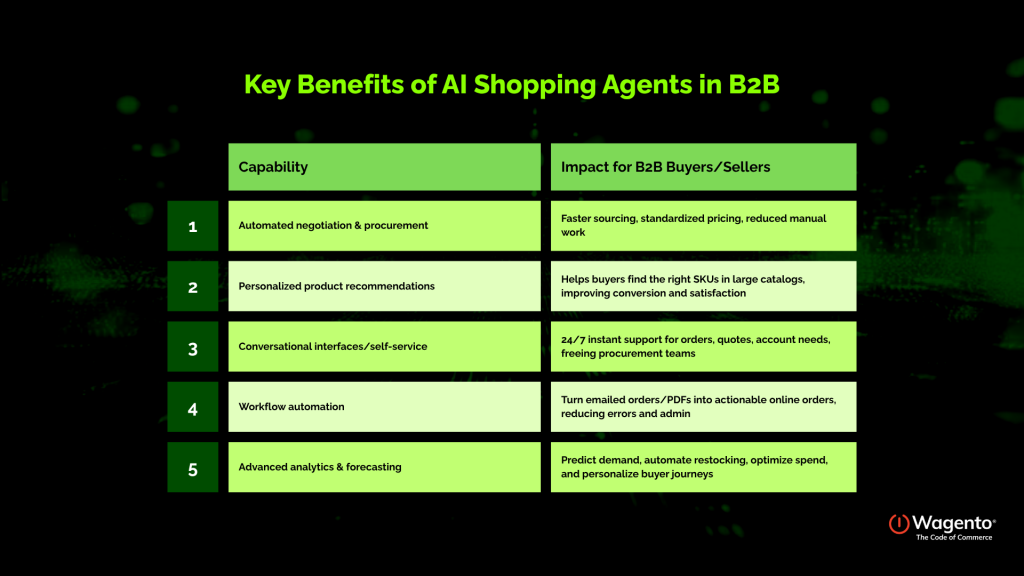
Key Benefits of AI Shopping Agents in B2B
| Capability | Impact for B2B Buyers/Sellers |
| Automated negotiation & procurement | Faster sourcing, standardized pricing, reduced manual work |
| Personalized product recommendations | Helps buyers find the right SKUs in large catalogs, improving conversion and satisfaction |
| Conversational interfaces/self-service | 24/7 instant support for orders, quotes, account needs, freeing procurement teams |
| Workflow automation | Turn emailed orders/PDFs into actionable online orders, reducing errors and admin |
| Advanced analytics & forecasting | Predict demand, automate restocking, optimize spend, and personalize buyer journeys |
Notable B2B AI Shopping Agents by Name
- Intershop Copilot
- OroCommerce SmartAgent
- Pactum AI
- Smartsupp AI Assistant
- Salesforce Agentforce (customizable for B2B workflows)
- Tidio/Dashly/Cognism (popular for B2B chat automation)
The Evolution from Reactive to Proactive Shopping
Traditional eCommerce platforms have been largely reactive, waiting for customers to search, browse, and make decisions. Agentic AI shopping represents a paradigm shift toward proactive commerce, where intelligent agents anticipate needs and take action before the customer even realizes they need something.
This transformation is driven by several key technological advances:
Advanced Natural Language Processing
Modern AI buying assistants can understand complex, conversational requests like “Find me a laptop that’s good for video editing but won’t break the bank” and translate these into specific product searches and comparisons.
Predictive Analytics by AI Shopping Agents
By analyzing purchase history, browsing patterns, and external factors (like seasonal trends or lifestyle changes), these systems can predict when you’ll need to reorder products or suggest new items that align with your evolving preferences.
Multi-Platform Integration
Autonomous shopping bots can simultaneously search across dozens of retailers, comparing not just prices but also shipping options, return policies, and customer reviews to find the optimal purchase decision.
How AI Agents Enhance the Shopping Experience
The integration of AI bots for online shopping is creating unprecedented levels of convenience and personalization in the eCommerce experience. Here’s how these systems are transforming each stage of the buyer journey:
Discovery and Research Phase
Traditional product discovery relies heavily on search algorithms and recommendation engines that show you products similar to what you’ve already viewed. AI shopping agents take a more holistic approach:
- Contextual Understanding: They consider your current life situation, upcoming events, and changing needs
- Cross-Category Intelligence: An agent might suggest a phone case when you buy a new smartphone, or recommend appropriate accessories for a hobby you’re getting into
- Real-Time Market Analysis: Continuous monitoring of product launches, reviews, and market trends to surface emerging options
Comparison and Evaluation
The comparison shopping phase, traditionally one of the most time-consuming aspects of online shopping, becomes seamless with AI agents:
- Comprehensive Feature Analysis: Agents can compare products across dozens of specifications and features simultaneously
- Personalized Scoring: Each product receives a personalized score based on your specific priorities and preferences
- Dynamic Price Monitoring: Real-time tracking of price changes, availability, and promotional offers across multiple retailers
Purchase Decision and Transaction
AI customer journey ecommerce optimization reaches its peak during the actual purchase phase:
- Automated Negotiations: Some advanced agents can even negotiate prices or apply coupon codes automatically
- Optimal Timing: Purchase timing optimization based on price prediction algorithms and inventory levels
- Risk Assessment: Evaluation of seller reputation, return policies, and shipping reliability
Post-Purchase Experience by AI Shopping Agents
The relationship between AI agents and customers doesn’t end at checkout:
- Delivery Tracking: Proactive updates and problem resolution for shipping issues
- Usage Optimization: Tips and suggestions for getting the most out of purchased products
- Warranty and Maintenance: Automated tracking of warranty periods and maintenance schedules
The Technology Behind Autonomous Shopping Bots
eCommerce automation AI relies on a sophisticated stack of technologies working in concert:
Machine Learning and Deep Learning
Advanced algorithms that can learn from vast amounts of shopping data, user behavior patterns, and market trends to make increasingly accurate predictions and recommendations.
Computer Vision
For product image analysis, allowing agents to understand visual attributes and compare products based on appearance, quality indicators, and other visual cues.
Natural Language Generation by AI Shopping Agents
Enabling agents to communicate findings and recommendations in natural, conversational language that feels human-like rather than robotic.
Blockchain and Smart Contracts
For secure, automated transactions and to ensure transparency in pricing and product authenticity verification.
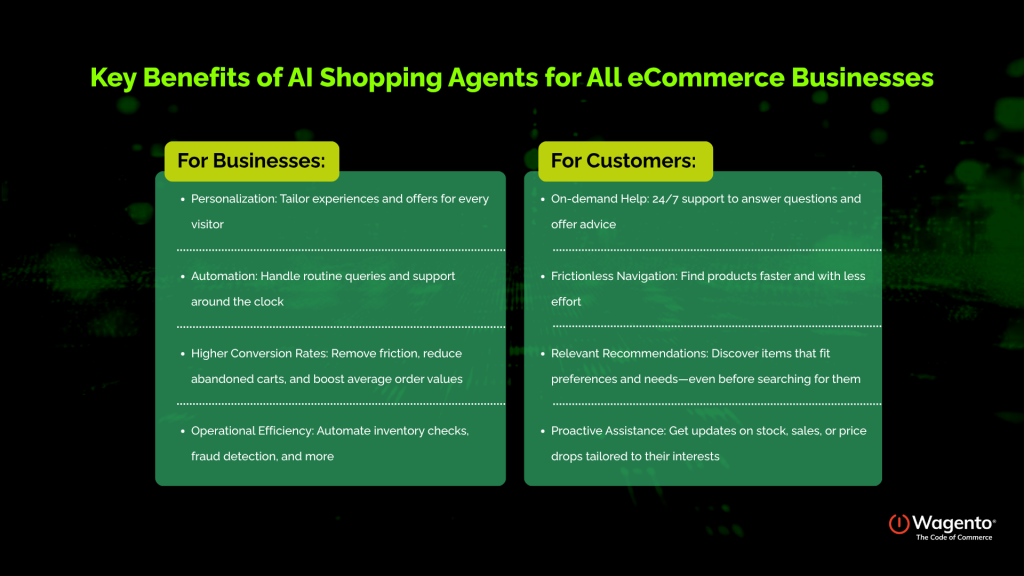
Key Benefits of AI Shopping Agents for All eCommerce Businesses
For Businesses:
- Personalization: Tailor experiences and offers for every visitor
- Automation: Handle routine queries and support around the clock
- Higher Conversion Rates: Remove friction, reduce abandoned carts, and boost average order values
- Operational Efficiency: Automate inventory checks, fraud detection, and more
For Customers:
- On-demand Help: 24/7 support to answer questions and offer advice
- Frictionless Navigation: Find products faster and with less effort
- Relevant Recommendations: Discover items that fit preferences and needs—even before searching for them
- Proactive Assistance: Get updates on stock, sales, or price drops tailored to their interests
AI-Driven eCommerce Personalization: Beyond Basic Recommendations
AI-driven eCommerce personalization powered by autonomous agents goes far beyond showing you “customers who bought this also bought.” These systems create deeply personalized shopping environments that adapt in real-time:
Behavioral Pattern Recognition
AI agents analyze not just what you buy, but how you shop—your research patterns, decision-making timeline, price sensitivity, and brand preferences.
Contextual Personalization
Understanding that your shopping needs vary based on context—shopping for yourself versus gifts, urgent needs versus planned purchases, budget constraints at different times.
Emotional Intelligence by AI Shopping Agents
Advanced systems can detect frustration, excitement, or uncertainty in your interactions and adjust their approach accordingly.
Challenges and Considerations
While the potential of autonomous shopping agents is enormous, several challenges need to be addressed:
Privacy and Data Security
The effectiveness of AI shopping agents depends on access to detailed personal data, raising important questions about privacy protection and data ownership.
Trust and Transparency
Consumers need to understand how these agents make decisions and ensure they’re acting in the customer’s best interest rather than maximizing retailer profits.
Market Competition and Fairness
There’s a risk that AI agents could create unfair advantages for certain retailers or lead to market manipulation through coordinated buying behaviors.
Technical Limitations in AI Shopping Agents
Current AI technology, while impressive, still has limitations in understanding complex, nuanced preferences and handling edge cases.
The Future of Autonomous eCommerce
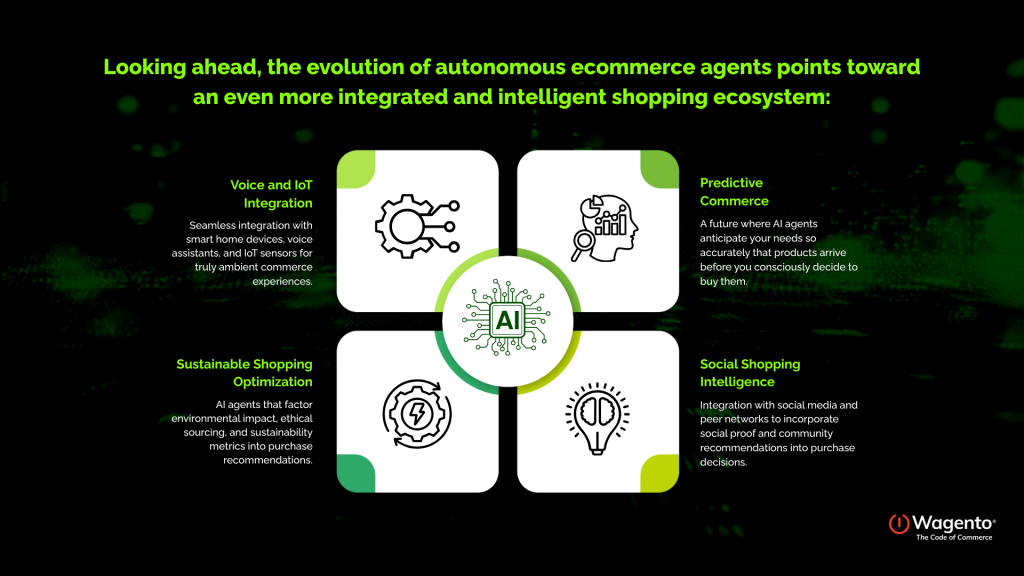
Looking ahead, the evolution of autonomous ecommerce agents points toward an even more integrated and intelligent shopping ecosystem:
Predictive Commerce
A future where AI agents anticipate your needs so accurately that products arrive before you consciously decide to buy them.
Social Shopping Intelligence
Integration with social media and peer networks to incorporate social proof and community recommendations into purchase decisions.
Sustainable Shopping Optimization
AI agents that factor environmental impact, ethical sourcing, and sustainability metrics into purchase recommendations.
Voice and IoT Integration by AI Shopping Agents
Seamless integration with smart home devices, voice assistants, and IoT sensors for truly ambient commerce experiences.
How to Use AI in eCommerce: Getting Started
For businesses looking to implement AI shopping agents, the journey typically follows these steps:
- Data Infrastructure Development: Establishing robust data collection and management systems
- Customer Journey Mapping: Understanding your specific customer behaviors and pain points
- AI Tool Selection: Choosing the right combination of AI technologies for your use case
- Pilot Program Implementation: Starting with a limited scope to test and refine the system
- Scaling and Optimization: Gradually expanding capabilities based on performance and user feedback
What Should Be the Next Move for eCommerce Businesses?
The rise of AI shopping agents and autonomous shopping bots presents both unprecedented opportunities and potential disruptions for eCommerce businesses. Companies that act strategically now will position themselves as leaders in the autonomous commerce era, while those that delay risk being left behind. Here’s a comprehensive roadmap for eCommerce businesses to navigate this transformation:
Immediate Actions (0-6 Months)
1. Audit Your Data Infrastructure: The foundation of effective ecommerce automation AI is robust data collection and management. Businesses should immediately assess their current data capabilities:
- Product information quality and completeness
- Customer behavior tracking systems
- Integration capabilities between different platforms
- Data privacy compliance and security measures
2. Enhance Product Data Quality AI shopping agents rely heavily on structured, detailed product information. Businesses must prioritize:
- Comprehensive product descriptions with technical specifications
- High-quality images from multiple angles
- Accurate inventory and pricing data
- Clear categorization and tagging systems
- Regular data updates and maintenance
3. Implement Basic API Infrastructure: Prepare for integration with AI virtual shopping assistants by developing or upgrading API capabilities:
- RESTful APIs for product catalogs
- Real-time inventory and pricing feeds
- Order processing and tracking systems
- Customer service integration points
Medium-Term Strategic Initiatives (6-18 Months)
4. Develop Agent-Friendly Business Policies: Traditional eCommerce policies may not align with how autonomous eCommerce agents operate. Consider:
- Flexible return and exchange policies that agents can process automatically
- Transparent pricing with clear terms for bulk or repeat purchases
- Streamlined account creation and authentication processes
- Clear communication of shipping options and timelines
5. Create Agent Partnership Programs: Rather than viewing AI agents as competition, forward-thinking businesses should embrace them as new distribution channels:
- Develop partnerships with major AI shopping platforms
- Offer special pricing or terms for agent-driven purchases
- Provide dedicated support channels for agent interactions
- Create agent-specific product bundles and recommendations
6. Invest in Competitive Intelligence Understanding how AI buying assistants evaluate and compare products becomes crucial:
- Monitor how your products perform in agent-driven comparisons
- Analyze competitor strategies in the agent marketplace
- Track price sensitivity and feature importance through agent interactions
- Develop strategies to highlight your unique value propositions
Long-Term Transformation (18+ Months)
7. Build Your Own AI Shopping Capabilities: While partnering with existing agents is important, developing proprietary AI-driven eCommerce personalization capabilities provides competitive advantages:
- Custom recommendation engines that understand your customer base
- Predictive inventory management based on agent buying patterns
- Dynamic pricing strategies that respond to agent negotiations
- Personalized customer service through AI assistants
8. Reimagine Customer Relationships: The relationship between businesses and customers evolves when agentic AI shopping becomes prevalent:
- Focus on building trust with both humans and AI systems
- Develop new customer retention strategies that work through agents
- Create value-added services that complement agent capabilities
- Establish direct communication channels that bypass agents when appropriate
9. Optimize for Agent Discovery: Traditional SEO and marketing may become less relevant as agents handle product discovery:
- Understand how different AI agents source and evaluate products
- Optimize product listings for agent consumption rather than human browsing
- Develop structured data formats that agents can easily process
- Create content that helps agents understand your brand story and values
Measuring Success in the Agent Era
Traditional eCommerce metrics may not fully capture success when AI bots for online shopping drive significant portions of sales:
New KPIs to Track:
- Agent engagement rates and conversion metrics
- Average order values through agent channels
- Customer lifetime value in agent-mediated relationships
- Brand preference scores among different AI platforms
- Speed of adaptation to new agent technologies
Evolving Metrics:
- Customer acquisition cost (CAC) through agent channels
- Return on investment (ROI) for agent partnership programs
- Market share in agent-driven product categories
- Customer satisfaction in hybrid human-agent interactions
Risk Mitigation Strategies
Avoid Over-Dependence on Single Platforms:
While partnering with major AI shopping agents is important, businesses should:
- Diversify across multiple agent platforms
- Maintain direct customer relationships
- Invest in owned-channel optimization
- Develop contingency plans for platform changes
Protect Brand Integrity to AI Shopping Agents
Ensure that autonomous shopping bots represent your brand accurately:
- Provide detailed brand guidelines to agent platforms
- Monitor how agents describe and recommend your products
- Maintain control over pricing and promotional strategies
- Establish clear boundaries for agent negotiations
Building Internal Capabilities
The shift toward AI-driven commerce requires new skill sets and your team should be ready. You need:
- Data scientists to analyze agent behavior patterns
- AI specialists to develop internal capabilities
- Partnership managers to handle agent relationships
- Customer experience designers for hybrid human-AI interactions
Technology Infrastructure for AI Shopping Agents
Invest in the technical foundation for AI integration:
- Cloud-based systems that can scale with agent demand
- Real-time data processing capabilities
- Advanced analytics and reporting systems
- Robust security measures for automated transactions
The businesses that thrive in the age of AI customer journey ecommerce optimization will be those that embrace AI agents as partners rather than threats, investing early in the infrastructure, relationships, and capabilities needed to succeed in an autonomous commerce world.
Industry-Specific Considerations
For Manufacturers:
- Develop comprehensive product specification databases that agents can access for technical comparisons
- Create digital product catalogs with detailed manufacturing capabilities and lead times
- Implement direct-to-consumer AI agent integration to bypass traditional distribution channels
- Establish automated quoting systems for custom or bulk orders through agent interactions
For Distributors:
- Build robust inventory management systems that provide real-time availability across multiple locations
- Develop territory and pricing logic that agents can navigate for location-specific recommendations
- Create automated credit approval and payment processing for agent-facilitated B2B transactions
- Establish integration with manufacturer systems for drop-shipping capabilities
For Wholesalers:
- Implement tiered pricing structures that agents can automatically access based on order volumes
- Develop minimum order quantity (MOQ) logic that agents can factor into purchase recommendations
- Create automated account verification systems for agent-driven B2B purchases
- Establish real-time freight calculation and logistics coordination capabilities
For Retailers:
- Invest in advanced image recognition and virtual try-on technologies for fashion items
- Maintain comprehensive technical specification databases for electronics and appliances
- Develop compatibility checking systems for complex product ecosystems
- Create automated reordering systems for consumable goods and subscription-based purchases
For Healthcare:
- Implement strict compliance systems for prescription verification and controlled substance regulations
- Develop integration with electronic health records (EHR) systems for medication management
- Create automated insurance verification and prior authorization processing
- Establish secure communication channels for HIPAA-compliant agent interactions
- Build drug interaction and contraindication checking systems for AI safety protocols
For Firearms and Ammunition:
- Develop robust age and legal eligibility verification systems that agents can access
- Implement automated background check integration with federal and state databases
- Create location-based restriction checking for state and local compliance requirements
- Establish secure chain-of-custody documentation for regulated product transfers
- Build specialized compliance reporting systems for regulatory requirements
For Automotive and OEMs:
- Develop comprehensive parts compatibility databases linking VIN numbers to specific components
- Create automated fitment verification systems for aftermarket parts and accessories
- Implement integration with service scheduling systems for maintenance-related purchases
- Establish real-time pricing for fluctuating commodity-based components
- Build technical specification comparison tools for complex automotive systems
For Travel and Hospitality:
- Develop dynamic pricing integration that agents can access for real-time booking optimization
- Create comprehensive amenity and service databases that agents can filter and compare
- Implement automated reservation modification and cancellation processing
- Establish integration with loyalty programs and membership benefits
- Build location-based recommendation systems for activities and dining
For Sports and Outdoor:
- Develop detailed product specification databases including technical performance metrics
- Create weather and seasonal integration for activity-appropriate product recommendations
- Implement size and fit guidance systems for equipment and apparel
- Establish safety certification and compliance information for technical gear
- Build activity-specific product bundling and compatibility systems
Final Thoughts: The Autonomous Shopping Revolution
AI shopping agents represent more than just a technological upgrade to eCommerce—they signify a fundamental shift toward a more intelligent, personalized, and efficient marketplace. As these systems continue to evolve, they promise to eliminate much of the friction and inefficiency that currently characterizes online shopping.
The businesses that embrace this transformation early, while thoughtfully addressing the challenges around privacy, trust, and fairness, will be best positioned to thrive in the autonomous commerce era. For consumers, the promise is clear: a shopping experience that’s not just more convenient, but genuinely more intelligent and aligned with their true needs and values.
The age of autonomous shopping is not a distant future—it’s happening now, reshaping the eCommerce landscape one intelligent interaction at a time. The question isn’t whether AI shopping agents will transform online commerce, but how quickly businesses and consumers will adapt to this new paradigm.
As we stand at the threshold of this transformation, one thing is certain: the future of shopping will be autonomous, intelligent, and more personalized than ever before. The revolution has begun, and its impact will be felt across every aspect of the digital marketplace.
Frequently Asked Questions
AI in eCommerce can be implemented in various ways to enhance both customer experience and operational efficiency. For businesses, integrating AI involves using tools such as personalized recommendation engines, AI-powered chatbots for customer service, and dynamic pricing models. AI can analyze customer behavior, recommend products based on preferences, and automate responses to frequently asked questions. Moreover, predictive analytics powered by AI can help businesses forecast trends, optimize inventory, and even automate marketing campaigns. By leveraging AI, eCommerce businesses can boost customer satisfaction, increase conversions, and streamline processes.
AI agents significantly enhance the online shopping experience by offering personalization and instant assistance. They learn from each customer’s browsing history, preferences, and past purchases, allowing them to recommend products that match individual tastes and needs. These agents provide real-time support, guiding customers through the buying process, from product discovery to checkout. They also improve decision-making by offering price comparisons, related product suggestions, and post-purchase recommendations. Furthermore, AI agents reduce friction, lowering cart abandonment rates by offering incentives, discounts, and reminders tailored to the customer’s behavior, ultimately leading to a more engaging and seamless shopping experience.
To implement AI shopping agents for your eCommerce store, start by integrating AI-powered tools that enhance key areas of the buyer journey. First, use AI agents for personalized product recommendations based on browsing and purchase history. You can also deploy AI chatbots to handle customer queries in real-time, improving engagement and providing instant support. Additionally, AI agents can assist with the checkout process by offering personalized discounts, nudging users to complete their purchases. Finally, post-purchase AI can follow up with loyalty offers, re-order reminders, and relevant product suggestions, driving repeat business. By adding these AI features, you will create a more intuitive, efficient, and customer-centric shopping experience.
AI shopping agents are autonomous software tools that assist customers in online shopping. These agents use artificial intelligence to analyze user data and make personalized recommendations, guide users through product discovery, and facilitate purchases. Unlike traditional recommendation engines, AI agents can learn from interactions with customers, adapt to their preferences, and engage in more complex tasks, such as handling customer service inquiries, comparing prices across platforms, and offering personalized discounts. These agents function as virtual shopping assistants that improve the overall shopping experience by making it faster, more intuitive, and tailored to each individual customer.
AI shopping agents work by gathering and analyzing vast amounts of customer data, including browsing history, past purchases, and interactions with the site. They use machine learning algorithms to recognize patterns in this data and predict what products a customer is likely to be interested in. These agents then offer personalized recommendations, compare prices, and present relevant product options in real-time. AI agents also use natural language processing to communicate with customers via chatbots, providing instant answers to queries and helping them navigate the site. Over time, these agents improve by learning from customer interactions, delivering increasingly accurate and relevant suggestions.
AI shopping agents offer several benefits to eCommerce businesses, particularly in terms of automation, personalization, and efficiency. First, AI agents automate routine tasks like answering customer inquiries, processing orders, and handling returns, which reduces the need for human intervention and lowers operational costs. By analyzing customer data, AI agents provide personalized shopping experiences, which can increase customer satisfaction and drive sales. Additionally, these agents help reduce cart abandonment by offering real-time product recommendations, dynamic pricing, and personalized discounts. Over time, AI agents can help businesses optimize inventory, forecast trends, and increase conversions, ultimately leading to a higher return on investment.
To stay ahead in the rapidly evolving landscape of AI shopping agents, businesses should take proactive steps to integrate AI-driven solutions into their eCommerce strategy. Here’s what you can do next:
Evaluate Your Data Infrastructure: AI shopping agents rely on high-quality data. Ensure your product information, customer behavior data, and inventory systems are well-organized and accessible for AI tools to process effectively.
Invest in AI Technology: Start by exploring AI platforms that offer product recommendations, chatbots, and automated customer service solutions. Partner with AI service providers or integrate ready-to-use solutions like Salesforce’s Agentforce or Manifest AI.
Personalize the Customer Experience: Leverage AI to deliver personalized experiences, such as tailored product recommendations and dynamic pricing. Understanding your customers’ preferences through AI tools will allow you to engage them in ways that feel relevant and timely.
Focus on Integration Across Channels: Ensure that your AI shopping agents can seamlessly operate across various platforms, including websites, mobile apps, and even voice assistants. Omnichannel support will provide a more unified experience for your customers.
Experiment and Test: Start small with a pilot program, testing AI agents in specific areas like customer support or product discovery. Analyze performance and customer feedback, then expand based on what works best.
Focus on Customer Trust and Privacy: As you introduce AI agents, make sure you prioritize data security and transparency. Customers need to feel confident that their data is being handled responsibly.
By adopting these steps, you’ll be better positioned to compete in the AI-driven shopping revolution, offering customers a seamless, personalized, and innovative shopping experience that keeps them coming back.