 Manufacturing and Distribution
 Firearms
 Automotive and OEMs
 Healthcare & Life Sciences
 Sports & Outdoor Hunting Gear
 Regulated Industries eCommerce
 Adobe Commerce
 BigCommerce
 Magento
 myMagento
 WooCommerce
 Shopify Plus
 Shopware
 Magento 1 to Magento 2 Migration
 Magento Upgrade Service
 Magento Design
 Magento B2B
 Magento Hosting
 Magento Consulting
 Magento eCommerce Developers
 Magento SEO
 Magento Integration
 Magento Speed & Performance Optimization
 eCommerce Development
 Headless Commerce
 eCommerce GrowthX
 B2B CRO Services
 Enterprise SEO Services
 Email Marketing
 Website Localization Services
 AEO, GEO and AI Search
 AI Tools for Business
 Data Analytics Services
 GrowthX Strategy & Consultancy
 eCommerce Integration
 CRM Integrations
 Accounting Software Integrations
 ERP Integrations
 PIM Integrations
 Payment Gateways Integrations
 Tax Platform Integrations
 eCommerce Site Migrations
 Project Rescue
 Hire Developers
 Free Audit Report
 Extensions & Applications
 Custom Applications for eCommerce
 Magento Extensions
 Security & Fraud Prevention
 User Interface & Experience
 Website Design Services
 Support & Maintenance
 About Us
 Blog
Blog Webinars
 News & Updates
 Downloads
 FAQs
FAQs The Wagento Difference
 Hyvä
Hyvä iPaaS
iPaaS Klaviyo
 Sales Layer
 Sift
Sift Dot Digital
 Nousmedis
 Call
Call Message
build & migrate
Storefronts on Adobe Commerce, BigCommerce, Shopify Plus, and Shopware.
Connect
ERP, PIM, and CRM integration that keeps your data in sync.
We build on the platform that fits your business, not ours.







14 +
Years of Expertise
400 +
Projects Delivered
40 +
Certified Developers
6
ERP Platforms Integrated
WHY wagento
Built for the businesses the platforms forget.
Wagento is a B2B ecommerce development company that starts with the systems already running your business.
We connect your storefront to your ERP, catalog, and pricing rules so inventory, orders, and contract pricing stay correct across every channel.
The result is commerce your operations team trusts and your buyers actually use. No rekeying, no stale stock, no surprise pricing. The store reflects the system, every time.
-
Integration first
Your ERP is the source of truth. The storefront serves it, not the other way around, so inventory, pricing, and orders stay correct everywhere your buyers transact.
-
Built to hold
We engineer for the upgrade you will run in two years, not just the launch this quarter. Clean code, documented, and ready for the next platform release.
-
Platform neutral
Adobe Commerce, BigCommerce, Shopify Plus, or Shopware. We recommend what fits your business, then take you all the way to launch and beyond.
the code of commerce
Three rules we build by.
Our tagline is not decoration. It is the standard every Wagento build is measured against.
01
Step 01
Your ERP is the source of truth.
02
Step 02
Build to hold, not just to launch.
03
Step 03
Platform neutral, always.
Services
Everything your B2B store needs, from one team.
One team for the full lifecycle: connect your systems, build the storefront, then optimize and support it.
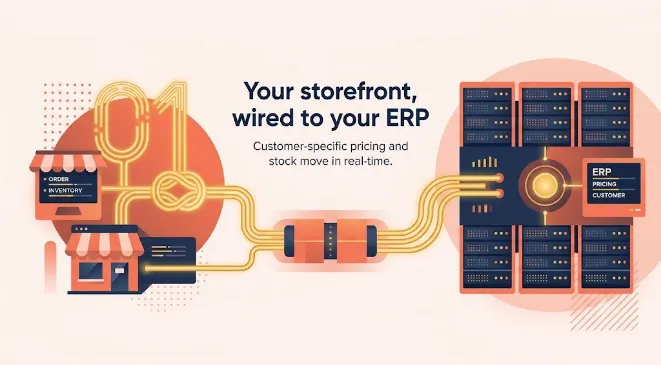
01 — integration
Your storefront, wired to your ERP
For manufacturers and distributors, the store is only as good as the data behind it. We provide ERP, PIM, and CRM integration services, connecting your storefront to your business systems so customer specific pricing, inventory, and orders move in real time.
- Real time inventory and pricing through ERP integration
- Customer specific price lists and contract pricing
- Order, invoice, and account sync in both directions
- Product data managed once in your PIM, published everywhere with PIM integration
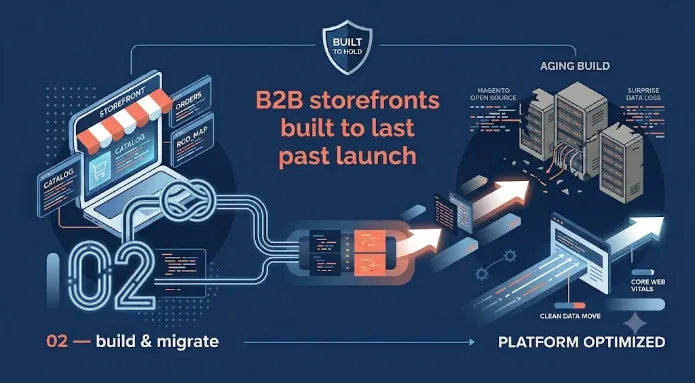
02 — Build & Migrate
B2B storefronts built to last past launch
We design and build B2B ecommerce storefronts on the platform that fits your catalog, your buyers, and your roadmap. Migrating off Magento Open Source or an aging build? We deliver Magento migration services with no surprise data loss.
- Adobe Commerce, BigCommerce, Shopify Plus, and Shopware
- Magento migration and upgrades, including Magento end of life
- Performance work that passes Core Web Vitals
- Accessible, documented, and built for your next upgrade
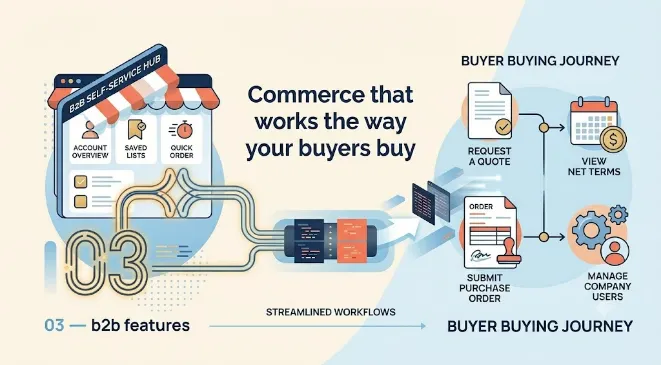
03 — B2B Features
Commerce that works the way your buyers buy
B2B ecommerce is not retail with a logo swap. We build enterprise ecommerce solutions your accounts expect, from quoting to reorders to net terms, so your largest customers can self serve without picking up the phone.
- Company accounts, roles, and approval workflows
- Quotes, net terms, and purchase order checkout
- Fast reorder, saved lists, and bulk ordering
- Customer specific catalogs and contract pricing for wholesale ecommerce
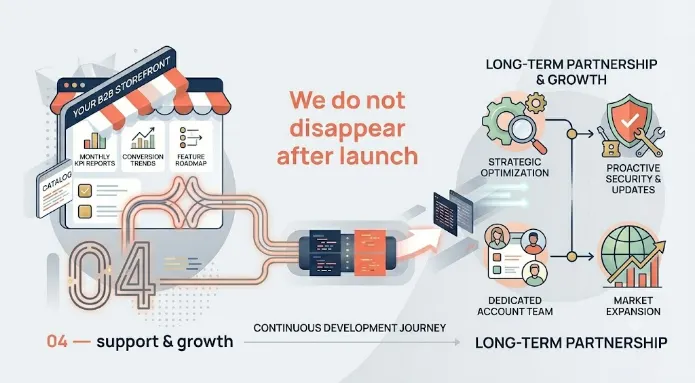
04 — support & growth
We do not disappear after launch
Your ecommerce store is a system you will run for years. We monitor it, keep it current, and keep improving conversion and revenue with ecommerce optimization prioritized by impact, not guesswork.
- Managed ecommerce support and proactive monitoring
- Platform and security updates, handled
- Conversion and revenue optimization
- Clear monthly reporting and performance optimization
Platforms
Collaborating with leading ecommerce platforms.
We leverage deep expertise across platforms to deliver B2B solutions tailored to your catalog and buyers.

Our deepest bench. As an Adobe Solution Partner with certified developers, we build complex B2B catalogs, shared catalogs, and ERP integrations for manufacturers that have outgrown simpler tools.
A fast, lower maintenance path to B2B. BigCommerce B2B Edition handles price lists, quoting, and buyer accounts out of the box, so you spend less on infrastructure and more on selling.
Running Magento Open Source or stuck on an old version? We support, secure, and upgrade Magento builds, and migrate you cleanly when the platform reaches end of life.
When speed to market matters. We build Shopify Plus stores with B2B features and clean ERP connections for brands that want a modern storefront without a heavy ops footprint.
An enterprise commerce engine for high volume operators. We implement Scayle for brands that need headless flexibility and scale across markets.
Open, API first, and strong in Europe. We build Shopware stores for B2B sellers that want flexibility and a lower license cost than the enterprise suites.
Methodology
A B2B methodology built around your numbers.
Every engagement follows the same disciplined path, so you always know what is happening and what it is worth.
01
STEP 01
Audit and analysis
We map your systems, data, and revenue leaks before writing a line of code.
02
STEP 02
Revenue opportunities
We prioritize the work by impact, so the roadmap pays for itself.
03
STEP 03
Define monthly KPIs
Clear targets and reporting, so progress is measured, not assumed.
04
STEP 04
Delivery and maintenance
We ship, monitor, and maintain, keeping the platform stable as you grow.
Our Work
Results for complex B2B operators.
A sample of what tighter systems and a better storefront have delivered for our clients.
Live · ERP integrated
Epicor Prelude
Lapp Tannehill
A wire and cable distributor with a storefront wired to the ERP so pricing and availability stay accurate for every buyer.
Revenue increase
2540%
Hyde Park Jewelers
A migration to BigCommerce created an accessible, luxury environment with brand pages built to strict guidelines from houses like Rolex.
Lighthouse score
94
XRay Marketplace
A Hyva retheme proving that budget limits can drive high quality outcomes, with strong returns on a focused tech investment.
Revenue increase
245%
Eichler's
Refined ad campaigns lifted ROAS sharply using GA4, Tag Manager, Merchant Center, and Ads for a popular gift retailer.
Our Clients






Testimonials
Trusted by B2B ecommerce brands worldwide.
Don't just take our word for it. See what clients say about partnering with Wagento to drive their digital growth.


Wagento consistently rises to the challenge. They translated our vision into a stunning website, and their ongoing development support keeps the experience seamless for our clients and retailers. Partha and his team handle requests with speed and real attention to detail.
Amanda Pehrson
Digital Marketing Manager, Hyde Park Jewelers

Working with Miguel and the Wagento team has been integral to our site transition. We appreciate the open communication and the dedication to helping us customize our site while staying on track. We could not have launched without them.
Marie Whelan
Digital Marketing Manager, SERRV International

When we needed to migrate to Magento 2, we turned to Wagento. They did an excellent job, allowing us to maintain our competitive edge with the latest technology and virtually no downtime during the transition.
Ron Salmon
Owner, Bus Depot, Inc.
Resources
Insights for B2B operators.
Practical guides on integrating your systems, building B2B storefronts, and growing revenue.
Free ebook
The Complete Guide to B2B eCommerce Integrations
Powering growth for manufacturers, distributors, and beyond. The systems, the sequence, and the pitfalls to avoid.
View all case studiesTop 5 Trends for 2026
Where B2B teams are putting budget and attention this year.
B2B Sales Strategies That Drive Conversions
Five tactics to generate qualified leads and close more deals.
B2B Growth Strategies to Scale Smarter
Market intelligence, automation, and scalable commerce.
B2B Customer Retention That Drives Loyalty
Keep buyers engaged long after the first order.
Partners
Trusted partners of a global ecommerce agency.
Working alongside industry leaders to deliver scalable, results driven ecommerce solutions.









faq
Have questions? We've got answers.
Common questions from manufacturers, distributors, and wholesalers about building and integrating B2B ecommerce.
Wagento is a B2B ecommerce agency. We build and migrate online stores for manufacturers, distributors, and wholesalers, and we integrate those stores with your ERP, PIM, and CRM so pricing, inventory, and orders stay correct on every channel.
Discuss Your Needs with a Trusted Partner
What Happens Next?
Our team of eCommerce experts will schedule an online consultation to discuss your project in detail and provide tailored solutions to help you succeed.