




















It’s Christmas morning, and the Johnson family is gathered around the tree for the gift-opening tradition. Amidst the pile of wrapped presents, Emily has a special announcement that adds to the festive cheer. She reveals that the family’s online boutique, after a recent upgrade to an advanced eCommerce platform, has achieved record sales this holiday season. Thrilled by this business success, Emily surprises her family with a holiday getaway to a charming ski resort, which includes a visit to a festive holiday market in the US to experience the season’s magic.
The family celebrates their hard work paying off, reflecting on how the digital enhancements not only simplified their operations but also brought them closer as a family, working together to make their business thrive. The success story is a testament to the power of embracing digital solutions in eCommerce, making this holiday season especially rewarding and memorable for the Johnsons.
🎅Santa’s Gone Digital and So Are the Shoppers! How Online Shopping Transforms Christmas Holiday Market in the US
As the holiday season rolls around, twinkling lights and festive decorations start to appear, heralding the busiest shopping period of the year. Imagine a small town blanketed in snow, where every shop window is dressed in its holiday best, enticing passersby with the promise of the perfect gift. Yet, in today’s digital age, many of these shoppers are turning to their devices rather than the high street to find their festive purchases.
This festive season, the American spirit of gift-giving is being unwrapped in a distinctly 21st-century style: eCommerce. The shift from in-store shopping carts to digital carts has redefined what the holiday rush looks like, bringing a significant surge in online sales across the Christmas market in the United States.
A Season of Spectacular Sales
According to projections from Statista, the Christmas market for online retail sales in the U.S. during the 2024 holiday season is set to continue its upward trajectory with a growth rate of 9.5%, signaling robust consumer confidence and a strong preference for the convenience of digital shopping.
The Shift to Digital Shopping and Gifting
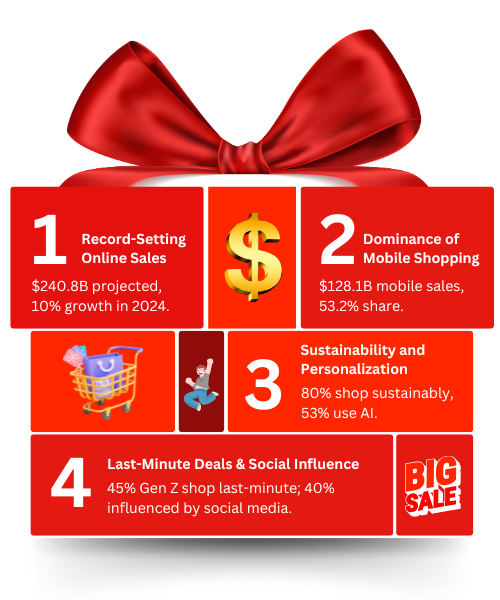
An analysis from Adobe Analytics further enriches our understanding of this trend. During the 2024 Christmas season, the Christmas market in the US is expected to see online sales hit nearly $240.8 billion, marking a 10% increase from the previous year. This leap in digital consumerism is not just about buying products; it’s about the transformation in how Americans choose to share the joy of the season. From personalized gifts shipped directly from artisan websites to gift cards that allow recipients to select their own pleasures, the landscape of giving is evolving.
The Hindu Business Line found that this year’s Black Friday in the United States set a new record with total sales hitting $10.8 billion, marking a 3.4% increase from 2023. Notably, online sales surged by 14.6%, while in-store sales saw a modest rise of 0.7%.
According to Salesforce, the global holiday season, starting with Thanksgiving Day, generated $33.6 billion in online sales, a 6% year-over-year increase. In the U.S., sales rose 8% to $8.1 billion, while Europe saw a 10% growth.
Top Trends Driving Online Purchases
- Discounts, discounts, & discounts: Adobe Analytics found that substantial discounts are reaching as high as 30% off the listed price, are anticipated to incentivize consumers to purchase higher-value items within categories such as electronics, appliances, and sporting goods, thereby contributing in excess of $2 billion in incremental consumer expenditure this season.
- Mobile Shopping (Thumb Shopping): A record $128.1 billion is projected to be spent via mobile devices during the 2024 holiday season, representing 53.2% of all online sales and contributing to the growth of Buy Now, Pay Later services.
- Social Media Influence (Web of Influence): 40% of Gen Zs use Social. Platforms like Instagram, Facebook, and Pinterest are increasingly driving shopping decisions, with targeted ads based on user behavior steering the holiday shopping experience. This holiday season, influencers are driving 10x more shopping than general social media, while AI chatbots see a 100% traffic surge to retail sites. What a Web of Influence! Still not considering investing in social media? Well, this is your sign to do it!
- Last-Minute Deals: Retailers are extending their holiday promotions well into the last week before Christmas, capitalizing on the tendency of shoppers to make last-minute purchases online. According to a study from Hostinger, 45% of Gen Z shoppers and 44% of Millennials made 1-2 urgent or last-minute purchases in the past six months, while 30% from both groups completed 3-5 such purchases.
Your eCommerce Store Is Up but Is It Optimize for Holiday Season?
Tap this holiday season to make the most of out it. From personalized strategies to seamless logistics, let our eCommerce marketing agency help you maximize your holiday revenue.
- Sustainability and Ethics (The Green Side): More consumers are considering the ethical and environmental impact of their purchases, opting for brands that promise sustainability in their products and operations. Recent data research shows that approximately 80% adopt more sustainable purchasing habits and 83% indicate they would prefer brands with stronger sustainability practices.
- Personalization: As technology advances, so does the ability to offer personalized shopping experiences. Retailers are leveraging AI and data analytics to provide tailored product recommendations and customized deals, enhancing the customer journey and boosting satisfaction and loyalty. According to Wagento, 77% of B2B buyers are more likely to connect with companies that understand their unique needs.
According to Salesforce data, 53% of shoppers in the Christmas market in the US are interested in using generative AI to find the ideal gift. With generative AI now integrated into many consumer products by major tech companies, consumers are increasingly using these tools to make smarter purchasing decisions.
The revenue in the eCommerce market in the United States is projected to experience continuous growth over the next five years, with a total increase of $657.8 billion (+53.79%) between 2024 and 2029, founds Statistia. This eCommerce 5-year projection in the US highlights the sustained expansion and opportunities within the digital retail landscape.
The Economic Impact of Holiday Markets in the US
The surge in the eCommerce markets of B2B, B2C, and D2C has significant implications for employment and revenue generation within the US (specifically the Christmas market). It supports a myriad of jobs in logistics, customer service, digital marketing, and IT, among others. Local economies also benefit as small businesses expand their digital presence, reaching customers far beyond their geographical boundaries.
The Challenge of Logistics for Holiday Markets in the US
With great sales come great challenges. The increased volume of online orders places immense pressure on shipping and logistics, often leading to delays during the peak season. Retailers and logistic companies are constantly innovating to improve delivery efficiency, from expanding warehousing facilities to deploying advanced fleet tracking systems
Partner with an expert agency from B2B eCommerce industry to tackle these logistical challenges head-on, ensuring seamless delivery efficiency and a stress-free peak season for your business.
Final Thoughts: A Future Wrapped in Digital Ribbons
As the last ornaments are placed on the Christmas tree and the final gifts are nestled under it, one thing is clear—the Christmas market in the US is increasingly embracing digital holiday shopping. eCommerce not only offers convenience but also brings a new dimension to festive traditions, making the season of giving more inclusive and accessible. As snowflakes continue to dance their wintery waltz, the glow of screens across America lights up with the promise of a joyous, prosperous, and profoundly digital Christmas.
🎄⛄ Merry Christmas from Team Wagento🎅🦌
This festive season, we’re sending warm wishes 🎁 and cheer to all our amazing visitors, clients, employees, and everyone out there. Here’s a cookie for you 👉🍪.
Looking for more gifts from us? Avail a FREE Site Audit.
Looking to grow your sales with an eCommerce marketing agency? Know more about our eCommerce growth strategy.
Frequently Asked Questions
Composable commerce is a modern approach to building eCommerce platforms using modular, best-of-breed components. Instead of relying on a single, monolithic system, you can “compose” your tech stack by selecting individual services—such as a CMS, PIM, or checkout engine—that are connected via APIs. This allows for greater flexibility, easier upgrades, and faster innovation across your eCommerce operations.
Composable technology refers to the practice of building digital systems using interchangeable and independent modules. In eCommerce, this often means selecting tools like headless CMS, ERP, CRM, and OMS, then connecting them through APIs to form a custom platform. The benefit of composable technology is that it enables you to scale and adapt quickly without being locked into a single vendor or system.
Composable architecture is the technical foundation of composable commerce. It follows an API-first, cloud-native, and microservices architecture model. This structure allows each system component (like search, pricing, or cart) to operate independently, making it easier to update, replace, or scale any part without affecting the others. Composable architecture is ideal for businesses that need agility and future-ready infrastructure.
Composable commerce is different because it shifts control back to the business. Traditional platforms are often monolithic, meaning all features are bundled together, which can slow down innovation and increase costs over time. In contrast, composable commerce allows businesses to choose only the tools they need, integrate them seamlessly, and adapt quickly as requirements evolve. This results in faster go-to-market, lower long-term costs, and a more tailored customer experience.
Headless commerce is an eCommerce architecture where the front-end (the “head”) is decoupled from the back-end systems. This means your storefront or user interface can be built using any framework or technology, while still communicating with back-end tools like your CMS, product database, or cart system via APIs. Headless commerce supports greater design flexibility, faster content delivery, and the ability to create consistent experiences across web, mobile, and other digital touchpoints.
Headless commerce works by allowing the front end and back end of your site to operate independently but stay connected through APIs. In a composable architecture, this headless structure is one of the key components—it enables businesses to swap or update the UI, checkout experience, or content engine without touching the core commerce engine. This leads to faster updates, better performance, and more freedom to create customized digital experiences for each channel or user group.